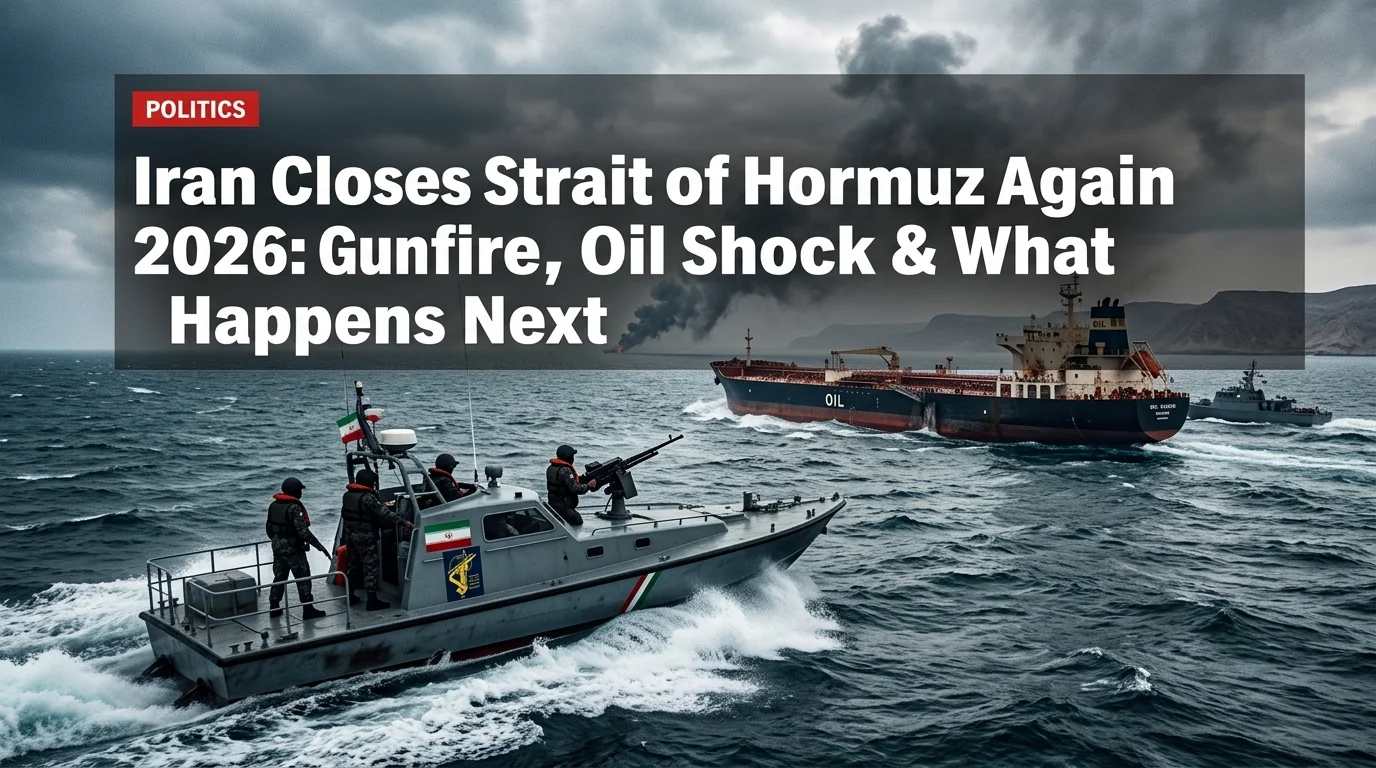
Iran closed the Strait of Hormuz again on Saturday, April 18, 2026 — just hours after briefly announcing it was open — after the United States refused to lift its naval blockade of Iranian ports. Iranian gunboats opened fire on ships attempting to transit the critical waterway, reversing a brief market rally and plunging global energy markets back into crisis. Oil prices have now surged past $120 a barrel — see Oil at $120 a Barrel: What the Global Energy Crisis Means for You.
The whiplash sequence of events unfolded rapidly: on April 17, Iran announced that commercial vessel passage through the strait was "completely open." The nuclear deal deadline looming April 22 is covered in US-Iran Ceasefire Expires April 22. Oil prices dropped 11% in hours. Then President Trump clarified that the U.S. blockade against vessels entering or leaving Iranian ports would remain "in full force" until Tehran reaches a deal. Iran responded by cancelling the reopening. See also: Russia's deadliest 2026 drone strike on Ukraine — the two conflicts are reshaping global energy markets simultaneously.
What Is the Strait of Hormuz — and Why Does It Matter So Much?
The Strait of Hormuz is a narrow shipping channel between Iran and Oman — its closure is also driving California gas prices past $8 a gallon — just 21 miles wide at its narrowest point — that connects the Persian Gulf to the Gulf of Oman and the open ocean. It is the world's single most important oil chokepoint.
Every day, approximately 20 million barrels of oil flow through the strait's two unidirectional sea lanes, representing roughly 20% of all globally traded oil. That oil comes from Saudi Arabia, the United Arab Emirates, Iraq, Kuwait, and Qatar — the heart of global petroleum supply. There is no viable alternative route for most of it.
How We Got Here: The 2026 Iran Crisis Timeline
The current crisis traces back to February 28, 2026, when the United States and Israel launched coordinated airstrikes against Iran and carried out the killing of Supreme Leader Ali Khamenei. Iran responded by closing the Strait of Hormuz — a threat it had made for decades but never carried out.
The closure triggered the largest energy shock in modern history. Analysts described it as bigger than the 1973 Arab oil embargo. Oil prices spiked immediately, shipping insurers halted coverage for Gulf-bound voyages, and energy-importing nations from Japan to Germany began emergency rationing discussions.
The U.S. then imposed a naval blockade, halting all shipping to and from Iranian ports in an attempt to strangle the Iranian economy into negotiations. Iran countered by maintaining its grip on the strait.
Saturday's Escalation: Ships Fired On
The re-closure Saturday was not just an announcement. Iran's Islamic Revolutionary Guard Corps (IRGC) took direct action.
The UK Maritime Trade Operations organization — which monitors shipping safety globally — reported that a tanker near the strait was attacked by two IRGC gunboats. No injuries were reported, but the vessel was forced to reverse course. Two Indian-flagged commercial ships were also reported to have come under fire while attempting passage.
Iran broadcast directly to ships in the waterway that the strait was again closed to maritime traffic. Ship owners and operators confirmed they were abandoning transit attempts.
Oil Prices and Economic Impact
The brief reopening on April 17 caused oil to drop sharply — one of the largest single-day oil price drops in years. That relief is now gone.
With the re-closure confirmed, markets face a sustained shortage. The International Monetary Fund has already cut its 2026 global growth forecast to 3.1%, down from 3.3%, citing the strait crisis as the primary driver. Analysts at Bloomberg warn oil could stabilize near $100 per barrel if the closure continues through May.
The economic pain is not evenly distributed. Nations most exposed include:
- Japan — imports nearly 90% of its oil through the strait
- South Korea — roughly 70% of crude oil supply
- India — a major buyer of both Gulf and Iranian crude
- China — the world's largest oil importer, with extensive Gulf supply chains
- Germany and EU — energy transition has reduced but not eliminated exposure
What Both Sides Want
The United States is demanding Iran halt its nuclear program, end support for regional proxy groups, and agree to a comprehensive deal before any sanctions or blockade are lifted. Trump has said the blockade "will remain in full force" until this happens.
Iran wants the blockade lifted first before any negotiations. Iranian officials have called the U.S. position a "gun to our head" and have made clear they view the strait as their primary leverage in any standoff.
The gap between these positions is wide. No diplomatic framework is currently active.
- Economic pain on both sides is mounting
- International pressure on U.S. allies growing
- Iran's economy near collapse under sanctions + blockade
- Qatar and Oman actively mediating
- Neither side willing to move first
- Iranian hardliners see compromise as surrender
- Trump faces domestic pressure to appear tough
- No agreed mediator or framework in place
What Happens Next
The most likely near-term scenarios, according to analysts:
Scenario 1 — Negotiated partial reopening: Iran allows non-U.S.-affiliated tankers to transit in exchange for a temporary pause on port blockade enforcement. Oil drops to $80-85 range. Most likely if Qatar/Oman mediation succeeds.
Scenario 2 — Continued standoff: Both sides hold. Oil stays near $100. Global recession risk rises significantly. This is where we are now.
Scenario 3 — Escalation: A military incident in the strait — a tanker sunk, a U.S. naval vessel struck — pulls the region into direct conflict. This is the tail risk that markets cannot fully price.
The Bottom Line
Saturday's re-closure is a reminder that this crisis is nowhere near resolved. Iran's leverage — control of 20% of global oil — is real. The U.S. blockade's pain is also real. Neither side is blinking yet.
For ordinary people, the impact shows up in gas prices, airline ticket costs, heating bills, and goods that move by ship. The Strait of Hormuz is 21 miles wide. Right now, it is the most expensive 21 miles on Earth.