
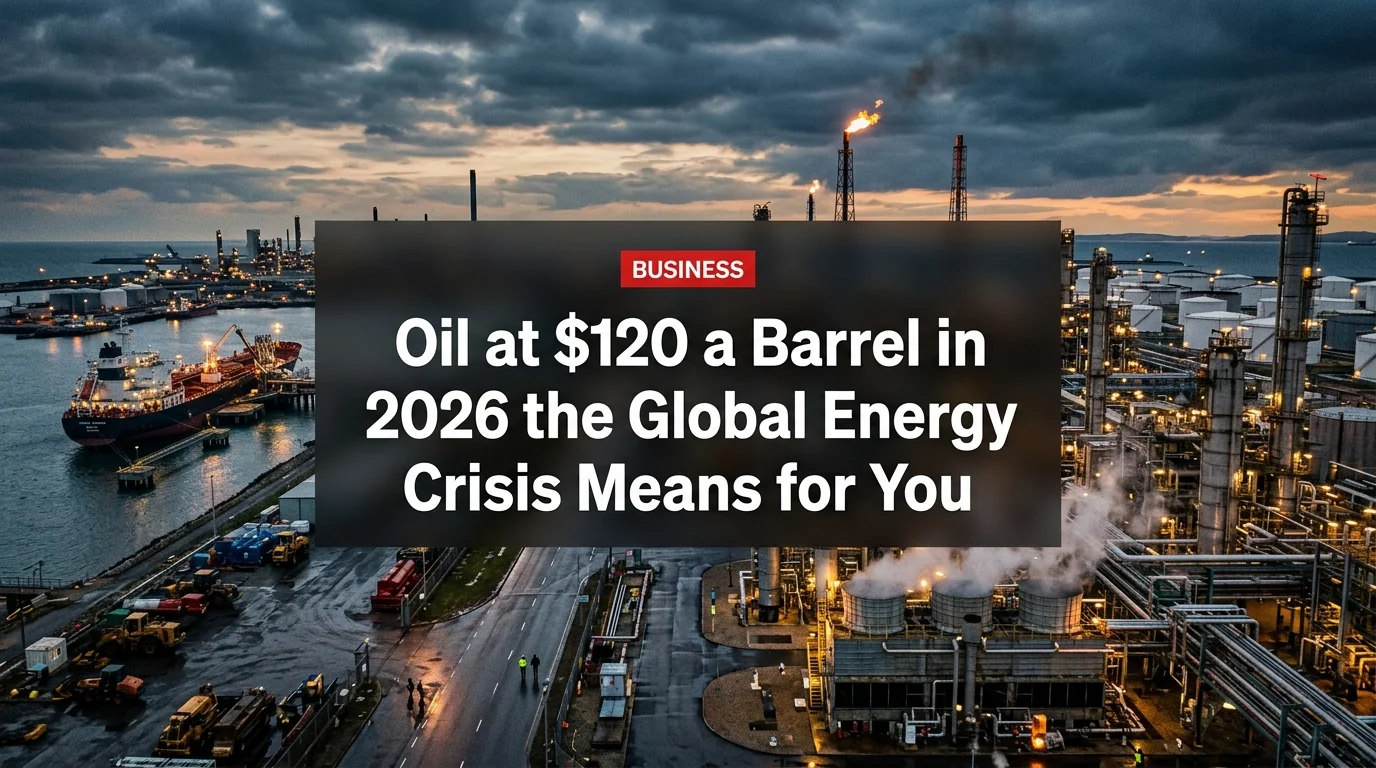
Oil prices have rocketed past $120 per barrel in 2026 — and the International Energy Agency isn't sugarcoating it. Officials at the IEA have called the ongoing disruption the greatest global energy security challenge in history, warning that West Asia's lost production capacity could take at least two years to fully recover.
Brent crude briefly touched $128 per barrel in early April, its highest level on record, before pulling back to around $95 in mid-April. That volatility isn't reassurance — it's whiplash. And analysts say consumers are only beginning to feel the real-world effects.
Why Oil Prices Exploded in 2026
The immediate cause is the Iran-Israel conflict and the ceasefire negotiations that have left the situation unresolved, combined with the near-total shutdown of tanker traffic through the Strait of Hormuz — a narrow waterway that normally carries around 20 million barrels per day, or roughly 20% of global oil consumption.
With the U.S. Navy enforcing restrictions on the strait and Iranian-backed forces threatening Gulf shipping lanes, global oil markets have been left scrambling. Saudi Arabia, the UAE, Kuwait, and Iraq together export the majority of their crude through Hormuz. There is no easy alternative.
What This Means at the Pump
Gas prices in the United States surged well above $5 per gallon in most states during March and April. In coastal cities like Los Angeles and New York, prices briefly exceeded $6.50 per gallon. Even as Brent crude has edged back from its April peak, refinery costs and fuel distribution pressures mean pump prices remain stubbornly high.
For drivers, that's a meaningful dent: the average American household spends around $2,500 per year on gasoline in normal times. At current prices, that figure has climbed to an estimated $3,800 to $4,200 depending on vehicle and driving habits.
Electric vehicle sales jumped 34% in Q1 2026 as consumers rushed to hedge against further price rises — but for households without access to EVs or charging infrastructure, there's little relief in sight.
Flights, Shipping, and Everything That Moves
Jet fuel prices have nearly doubled compared to 2024 levels. Airlines absorbed losses for weeks before beginning to roll out fuel surcharges. As of April 2026, most major carriers have added $40–$90 per ticket in surcharges on international routes, with transatlantic and transpacific fares up 18–25% year-over-year.
The shipping industry is similarly strained. Container freight rates spiked in February and March as routes were rerouted around the Cape of Good Hope — adding 10–14 days to Asia-Europe voyages — and fuel costs ballooned. That delay and expense ripples into the prices of electronics, clothing, and manufactured goods.
- EV adoption accelerating faster than any prior forecast
- Renewable energy investment hitting record levels globally
- IEA projects Hormuz partial reopening by mid-2026
- Inflation reignited: food, fuel, and freight all rising
- Low-income households disproportionately affected
- No quick fix — full output recovery estimated 2+ years away
Grocery Bills Going Higher
Food inflation was already a sore point for American households. Now, with fuel costs affecting fertilizer production, agricultural machinery, refrigerated transport, and delivery logistics, groceries are taking another hit.
The USDA has flagged potential 5–8% grocery price increases in Q2 2026, with proteins, fresh produce, and imported goods most exposed. Packaged food companies have quietly begun their own rounds of price increases, citing input costs. The compounding squeeze is especially hard on families already navigating the new SNAP benefit restrictions that took effect this spring.
The IEA's Emergency Response
For only the third time in its history, the IEA coordinated a record emergency oil release from member nations' strategic petroleum reserves. The move, announced in March 2026, aimed to put an additional 60 million barrels on the market to dampen price spikes — roughly three days of global demand.
The release helped cool the market temporarily. But IEA executive director Fatih Birol has been blunt: strategic reserves are a buffer, not a solution. "We are managing a supply disruption of historic scale," Birol said. "The world has never dealt with a closure of the Strait of Hormuz of this duration."
What Happens Next
The EIA's latest Short-Term Energy Outlook, released in April 2026, projects Brent crude averaging $115 per barrel in Q2 2026, then easing into the $90–$100 range in the second half of the year — assuming the Strait of Hormuz is partially reopened by mid-year.
That's a big assumption. The US-Iran ceasefire expires April 22 with no confirmed extension, and the simultaneous Russian escalation in Ukraine is adding to geopolitical uncertainty. Any military re-escalation or Iranian response to renewed pressure could send prices surging again.
For consumers, the near-term outlook means elevated costs on almost everything that requires energy to make, move, or refrigerate — which is, essentially, everything.
- The Strait of Hormuz carries 20% of global oil and is currently largely closed to commercial traffic
- Brent crude peaked at $128/barrel on April 2, 2026 — a historic record
- The IEA coordinated its third-ever emergency strategic reserve release in March 2026
- U.S. gas prices have topped $6.50/gallon in major cities
- Full recovery of Middle East production capacity is estimated to take at least two years
- Airlines, shippers, and food companies are already passing costs to consumers
The Bottom Line
The 2026 oil price crisis is not a short-term blip. It's the product of a geopolitical rupture affecting the single most important chokepoint in global energy trade. While prices have pulled back from their April peak, the structural disruption — to supply chains, to inflation, to household budgets — will persist well into 2027 and beyond.
Watch for whether diplomatic progress on the Strait of Hormuz accelerates. That single variable now controls the trajectory of the global economy more than any central bank or government stimulus package.