
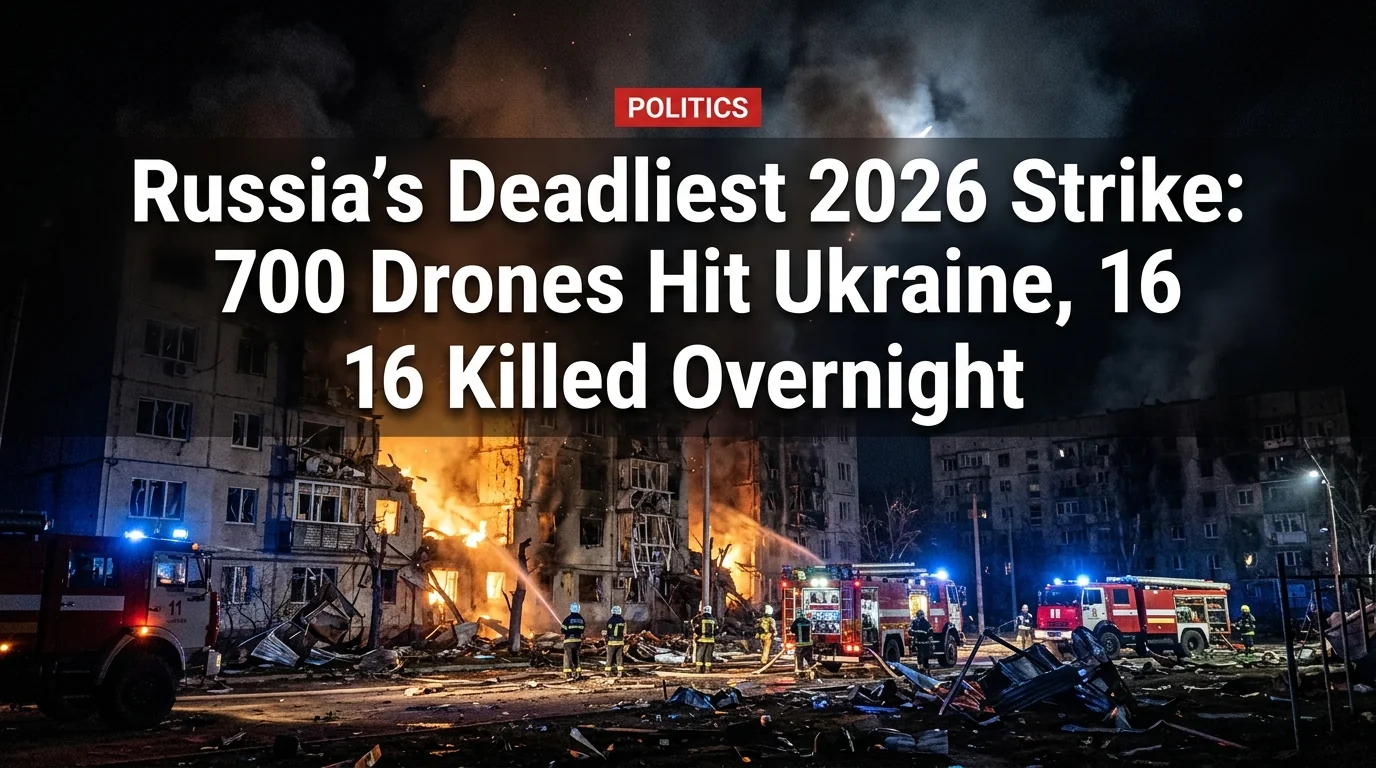
Russia launched its most devastating aerial assault of 2026 on Ukraine overnight Thursday into Friday, firing nearly 700 drones and 19 ballistic missiles at civilian areas across multiple cities. At least 16 people were killed and more than 100 injured, making it the single deadliest attack on Ukrainian soil this year.
What Happened: A Night of Fire Across Ukraine
The attack began in the late hours of April 16 and continued through early April 17, 2026. Ukraine's Air Force reported that Russian forces launched 636 drones and 19 ballistic missiles simultaneously — a combined barrage designed to overwhelm air defenses. Ukraine's defense systems intercepted 31 missiles and 636 drones, officials said, but enough got through to cause significant casualties.
Kyiv bore some of the heaviest strikes. Mayor Vitali Klitschko confirmed four people were killed in the capital, including a 12-year-old child, after a drone slammed directly into an occupied 18-story residential tower. Emergency teams spent hours extracting survivors from the rubble.
In Odesa, nine people were killed as drones and missiles struck apartment buildings along the Black Sea port city. Dnipro, in southeastern Ukraine, reported two confirmed dead after residential buildings were hit. Additional casualties were reported in other regions.
Why Now? The Iran War Factor
Military analysts and Ukrainian officials pointed to a critical vulnerability that Russia is now exploiting: the ongoing U.S.-Iran conflict has stretched Western air defense resources thin. Ukraine has been scrambling to resupply and repair its Patriot and IRIS-T batteries, many of which have been under extraordinary strain since the Iran war began drawing down equipment stocks allocated to European security.
"Russia is reading the map correctly," one European defense official told NBC News. "When American attention and munitions are divided between two theaters, they push harder here."
U.S. officials have acknowledged the strain but said commitments to Ukraine remain intact. The Biden — now Trump — transition in defense posture toward Ukraine remains a point of tension with NATO allies who fear a prolonged gap in air defense coverage.
Kyiv: A Drone in a High-Rise
Perhaps the most striking image from the overnight assault was the direct drone impact into a residential high-rise in Kyiv. The building, home to dozens of families, sustained severe structural damage to multiple floors. Rescue workers worked through the night under floodlights, pulling civilians — some still in pajamas — from debris.
Klitschko posted videos to Telegram showing the scale of destruction: a gaping hole where several apartments once stood, fire crews on ladders, and civilians gathered in shock on the street below. "This is terrorism," Klitschko wrote. "Targeting sleeping families. A child is dead."
The 12-year-old victim was identified by Ukrainian media as a resident of the struck building. The child's death drew immediate condemnation from European leaders.
Ukraine Fires Back: Drones Reach Russian Territory
Ukraine did not absorb the strikes without response. In exchange, Ukrainian forces launched their own drone campaign against Russian territory, with UPI reporting 18 total killed as both sides traded aerial attacks. Russian air defense claimed to intercept 207 Ukrainian drones, though independent verification remains difficult.
The overnight exchange marks a further escalation in the tit-for-tat drone war that has defined the conflict's most recent phase, with both sides demonstrating their capacity to strike deep inside each other's borders.
International Reaction
European leaders condemned the attack swiftly. Germany's Chancellor and France's President both issued statements calling for additional air defense shipments to Ukraine. The EU's foreign policy chief described the attack as "a war crime against civilians" and called for an emergency session of the UN Security Council.
The Trump administration had not issued a formal statement as of Friday morning Washington time, though a spokesperson said the President had been briefed and that U.S. support for Ukraine's defense "remains firm."
NATO Secretary General Mark Rutte said the alliance would "accelerate consultations" on air defense resupply, acknowledging that the Iran conflict had created real pressure on available military stocks.
What Comes Next
The attack raises immediate questions about Ukraine's ability to sustain air defense coverage over its major cities as the war enters its fourth year. Ukraine has been pushing NATO allies for more Patriot batteries and interceptor missiles, with only partial deliveries fulfilled so far in 2026. The same global disruptions driving the oil price crisis above $120 per barrel have complicated weapons procurement and logistics across Europe.
For ordinary Ukrainians, Friday brings another grim morning of air raid sirens, destroyed homes, and funerals. With peace negotiations stalled and Russia showing no signs of reducing its tempo, analysts warn the frequency of mass strikes may increase further as summer approaches.
- This was Russia's largest single drone-and-missile attack of 2026
- The strike killed at least 16 people, including a child; over 100 more were injured
- Russia launched ~700 drones and 19 ballistic missiles in a coordinated overnight assault
- Kyiv, Odesa, and Dnipro were the hardest-hit cities
- Ukraine's air defenses intercepted the vast majority of projectiles but could not stop all of them
- Military analysts link Russia's escalation to U.S. air defense resources being partially diverted to the Iran conflict
The war in Ukraine continues without any ceasefire or diplomatic off-ramp in sight on the eastern front, even as the Trump administration pursues a parallel deal with Iran. For Ukrainians, both conflicts are deeply connected — and Friday's carnage is the most visible sign yet of how the broader geopolitical moment is being used against them.