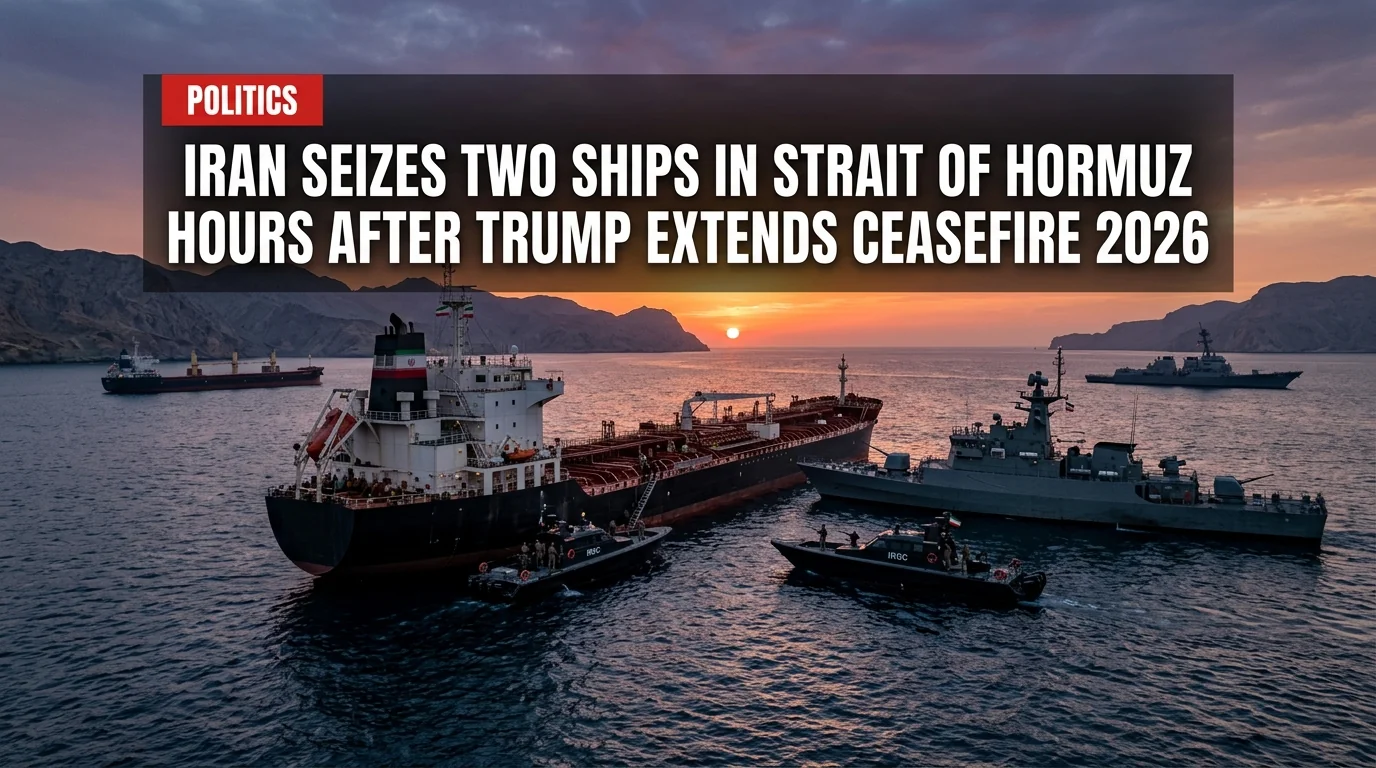
Iran's Islamic Revolutionary Guard Corps (IRGC) seized two container ships in the Strait of Hormuz on Wednesday — just hours after President Donald Trump extended the US-Iran ceasefire indefinitely. The move sent oil markets surging and raised fresh doubts about whether a lasting peace deal remains possible.
What Happened
The IRGC Navy confirmed it had boarded and detained two vessels transiting the Strait of Hormuz, citing "maritime violations." Both ships were escorted to Iranian ports. A third vessel in the area was reportedly targeted and disabled. Iranian state media framed the seizures as a lawful response to the ongoing US naval blockade of Iranian ports.
Iran's parliamentary speaker and chief negotiator Mohammad Bagher Ghalibaf said the ceasefire "has no meaning" while the US maintains a naval blockade. "A full ceasefire can only exist when it is not violated by a blockade of our ports," he said in remarks broadcast on Iranian state television.
The White House responded by calling the seizures "a flagrant violation of international maritime law" and said the US Navy was monitoring the situation closely. As of Wednesday evening, no new military action had been ordered.
Oil Prices Spike
Markets moved immediately. Brent crude jumped more than 1.8% following reports of the seizures, crossing the $100-per-barrel threshold once again.
The crisis has already been compared to the 1970s energy shock. Analysts at the Dallas Fed warned in March that a prolonged closure of Hormuz could reduce global GDP growth by up to 0.3 percentage points if the disruption lasts two quarters.
How We Got Here
The 2026 Strait of Hormuz crisis began on February 28, when the United States and Israel launched a coordinated air campaign against Iran following the assassination of Supreme Leader Ali Khamenei. Iran retaliated with missile and drone strikes against Israel, US military bases, and US-aligned Gulf states — and announced the closure of the strait to commercial traffic.
Since the closure began, the IRGC has launched 21 confirmed attacks on commercial vessels. Approximately 20,000 mariners and 2,000 ships remain stranded in the Persian Gulf, unable to transit safely.
Rerouting around Africa's Cape of Good Hope — the only viable alternative for most tankers — adds weeks to transit times and has driven shipping costs to record highs.
Global Ripple Effects
The economic fallout extends well beyond the Persian Gulf. Germany's Lufthansa Group announced this week it is canceling 20,000 short-haul flights through October, directly citing soaring jet fuel costs linked to the Hormuz crisis. The first 120 daily flights were canceled effective immediately.
Trump's approval rating on economic issues fell to 30% in April — down from 38% in March — as rising energy prices squeeze American households. A new AP-NORC poll released Wednesday linked the drop directly to the Iran war's impact on fuel and food costs.
What Comes Next
Diplomatic sources told NBC News and CNN that US negotiators have given Iran a limited window — potentially weeks — to present a consolidated peace proposal that addresses the nuclear program, the blockade, and the status of detained ships and mariners. Iran has not publicly committed to a timeline.
Analysts are divided on what Wednesday's ship seizures signal. Some read them as a negotiating tactic — Iran demonstrating leverage before peace talks. Others see a pattern of escalation that could collapse the ceasefire entirely.
What is certain: with oil above $100, global shipping routes disrupted, and diplomatic talks still unresolved, the Strait of Hormuz remains the most consequential flashpoint in the world economy heading into May 2026.
Stay with Linos.ai for live updates as the situation develops.