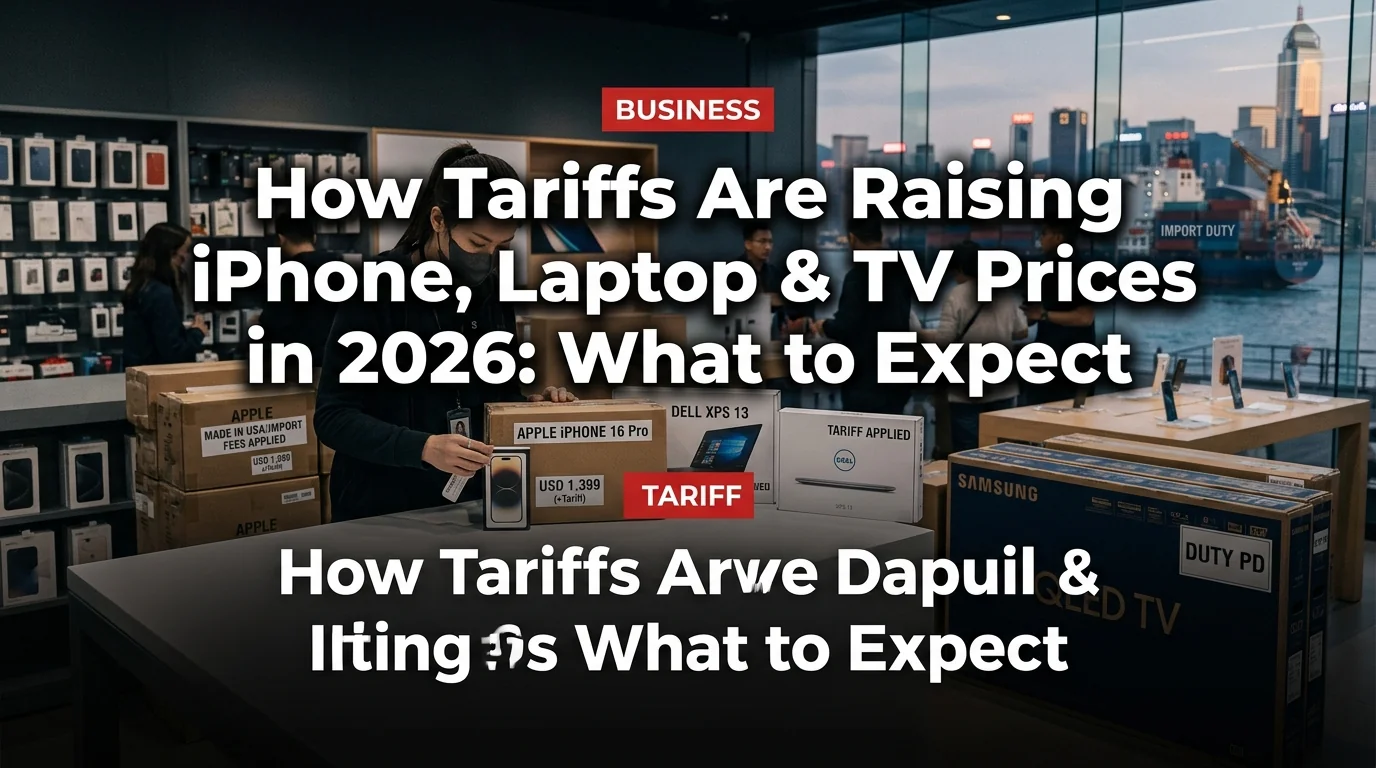
The tariffs that reshaped grocery and construction costs in early 2026 have now hit consumer electronics just as hard. If you're still deciding on a laptop purchase, our best laptops 2026 guide accounts for current prices. iPhones, MacBooks, Windows laptops, televisions, and gaming consoles are all getting more expensive — and the price increases aren't uniform. Here's the category-by-category breakdown of what tariffs are doing to tech prices in 2026 and when you should actually buy.
Why Are Tech Prices Rising in 2026?
The short version: most consumer electronics are still manufactured or assembled in China, Vietnam, or other countries hit by the 2025–2026 tariff rounds.
- China tariffs (up to 145% on some categories) hit the widest range of electronics
- Vietnam tariffs (20–46%) affect Samsung phones, LG TVs, and many Windows laptops
- Component tariffs on chips, displays, and batteries add cost even for devices assembled elsewhere
- Retaliatory tariffs from China on US-made components increase costs for American manufacturers
Not every product carries the full tariff rate — manufacturers absorb some costs, shift assembly, or reroute supply chains. But consumers are absorbing a meaningful portion.
iPhone Prices: What's Changed
Apple has responded to tariffs by accelerating manufacturing in India (for US-market iPhones) and raising prices on older models still assembled in China.
The strategic story: Apple front-ran tariffs by moving US-market iPhone production to India before the tariff rounds hit. New iPhone 17 models have seen minimal direct price increases. The pain is more visible in older/refurbished iPhones and accessories.
Accessories are getting hit harder than the phones themselves. Apple-branded cables, cases, and AirPods still manufactured in China show 15–25% price increases. Third-party accessories from Chinese manufacturers have seen even steeper jumps.
- iPhone 17 line mostly protected by India manufacturing shift
- Apple absorbed some costs rather than fully passing them on
- Refurbished market still cheaper than new despite increases
- Accessories (AirPods, cables, cases) up 15-25%
- Older iPhone models on clearance are more expensive
- AppleCare and repair parts costs up
- International models may not work on all US carriers
MacBook and iPad Prices — See our Best Laptops 2026 Guide: The Bigger Impact
Macs and iPads are seeing more significant tariff impact than iPhones because Apple's Mac production hasn't shifted away from China as completely.
Apple hasn't issued official list price increases on its website, but third-party retailers have adjusted prices upward, and Apple's own pricing has shifted across product refreshes. The M4 MacBook Air that launched at $1,099 effectively costs $100–$200 more when purchased today.
Windows Laptops: Widest Range of Impact
The Windows laptop market is more complex because manufacturing is spread across China, Vietnam, Taiwan, and increasingly Mexico. Price impacts vary dramatically by brand and model.
- Budget Chromebooks and Windows laptops (sub-$400) — prices up 20–30%; hardest hit since margins were thin
- Mid-range laptops $500–$900 — up 10–20% depending on assembly location
- Premium Windows laptops (Dell XPS, HP Spectre, Lenovo ThinkPad) — up 8–15%
- Gaming laptops — up 15–25% due to GPU component tariffs
- Lenovo ThinkPads — relatively protected by diversified assembly in Mexico and Eastern Europe
The biggest tariff story in laptops is the budget segment. A Chromebook that cost $299 in 2024 now runs $349–$399. For families buying back-to-school laptops, this is a meaningful hit.
Best protection: Lenovo's ThinkPad line and Microsoft Surface devices (manufactured partly in the US and Mexico) have seen smaller price increases than HP Spectre or Dell XPS models.
TVs and Home Electronics
Televisions are among the hardest-hit categories because nearly all TV assembly remains in China, Vietnam, and South Korea — all subject to significant tariff rates.
The TV market had seen years of price deflation. Tariffs have reversed this — a 65-inch 4K TV that cost $500 in 2024 now runs $600–$650 at most major retailers.
Gaming Consoles
Sony and Microsoft both adjusted PlayStation 5 and Xbox Series X pricing in 2026 in response to tariff costs:
- PlayStation 5 — official price increased $50 (now $549.99)
- Xbox Series X — held price; Microsoft absorbed costs, citing competitive pressure
- Nintendo Switch 2 — launched at $449.99; Nintendo explicitly cited tariffs in pricing announcement
- Gaming accessories (controllers, headsets, storage) — up 15–25%
When to Buy: The Practical Guide
How to Get the Best Prices Despite Tariffs
- Buy Apple from Apple Certified Refurbished — same warranty as new, 20–30% cheaper even after tariff-adjusted pricing
- Use Amazon Warehouse Deals — open-box electronics often at pre-tariff equivalent prices
- Consider last-generation models — iPhone 16 or M3 MacBook Air may now be better value than flagships
- Check Costco and Sam's Club — warehouse clubs often negotiate fixed pricing that changes less with tariff cycles
- Employee purchase programs — Many companies have tech purchase programs with corporate pricing that partially shields from retail tariff increases
What's Next for Tech Pricing
Analysts expect the tariff picture to remain unstable through at least mid-2027. Key things to watch:
- Trade negotiations — Any US-China trade deal could reverse electronics tariffs quickly; markets would price in the change before shelves do
- Manufacturing shifts — Apple and Samsung continue moving production to India, Vietnam, and Mexico; devices from these factories eventually hit shelves at lower tariff rates
- Component tariffs — Even if finished goods tariffs ease, component-level tariffs on chips and displays may persist longer
- Back-to-school 2026 — The July–September window will show whether retailers are eating margin or passing costs to consumers for the critical fall season
For now, expect tech purchases to cost 10–25% more than they did in 2024, with the biggest impact on budget laptops, TVs, and accessories. Premium flagships from Apple have navigated tariffs better than most — but not entirely.