
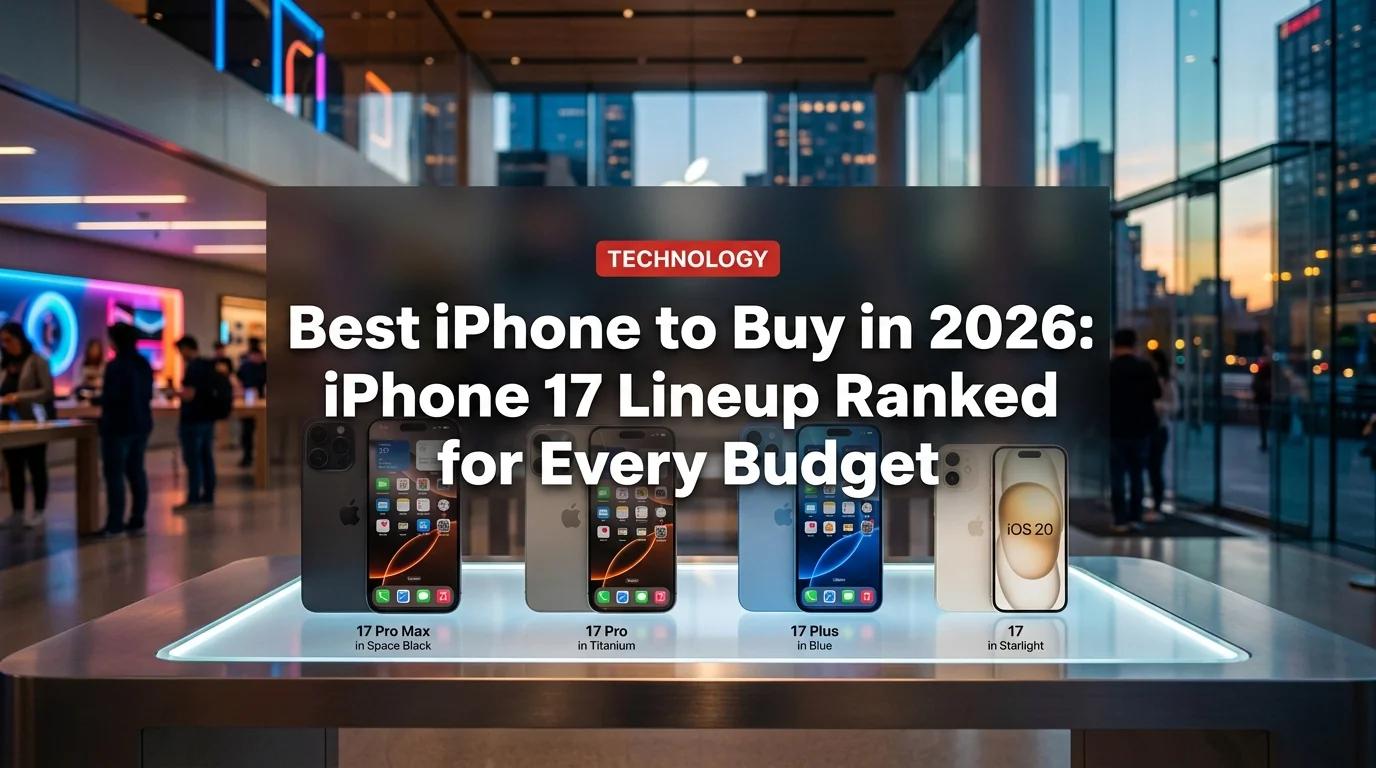
Apple's iPhone 17 lineup arrived in fall 2025, and by mid-2026 prices have settled, deals are appearing, and the right choice depends entirely on what you actually need. Picking the wrong iPhone is an expensive mistake you'll live with for 3-4 years. If you're also weighing Android, our Samsung Galaxy S26 Ultra vs iPhone 17 Pro Max comparison has the full flagship head-to-head.
Here's the complete ranking, with honest verdicts by use case — not just specs.
The iPhone 17 Lineup at a Glance
1. Best Budget iPhone: iPhone SE (4th Generation) — $429
The iPhone SE 4 is the biggest value surprise in Apple's lineup. Once you pick your iPhone, make sure you know how to back up your iPhone properly. It uses the same A18 chip found in the base iPhone 16, pairs it with Apple Intelligence support, and starts at $429 — the lowest price for a new iPhone Apple has offered in years.
What you get:
- A18 chip — the same performance core as iPhone 16
- 6.1-inch OLED display with Face ID (finally — no more Touch ID)
- Single rear camera (48MP) — solid for everyday photos, not a photography powerhouse
- Apple Intelligence features fully supported
- USB-C charging
- Action button
What you give up:
- No telephoto lens — one camera only
- No ProMotion (60Hz display, not 120Hz)
- Smaller battery than the iPhone 17
- No always-on display
- Less refined chassis than the Pro models
- Cheapest iPhone with Apple Intelligence
- A18 chip stays relevant for 5+ years of updates
- Compact 6.1" size is ideal for one-handed use
- USB-C and Face ID modernize the experience
- Single rear camera — no zoom, no ultra-wide
- 60Hz display feels sluggish vs. Pro's 120Hz
- Battery life is the weakest in the 2026 lineup
- No ProMotion, no always-on display
Best for: Students, budget-conscious buyers, anyone upgrading from an iPhone X or older on a tight budget.
Skip if: You care about mobile photography or want the smoothest screen experience.
2. Best All-Rounder: iPhone 17 — $799
The standard iPhone 17 is the sweet spot for most people. New iPhone owners should also bookmark our guide on how to screen record on iPhone — it's a feature many miss. It adds a genuine upgrade over the SE: a dual-camera system with an ultra-wide lens, a larger battery, and the A19 chip — plus the same Apple Intelligence features.
What you get:
- A19 chip — faster than the A18 in the SE
- 6.1-inch OLED, 60Hz (non-ProMotion)
- Dual rear cameras: 48MP main + 12MP ultra-wide
- Significantly better battery life than the SE
- USB-C, Face ID, Action button
What you give up vs. Pro:
- No telephoto lens (no optical zoom)
- No ProMotion 120Hz display
- A19 chip vs. A19 Pro (slightly less headroom for AI tasks)
- Titanium chassis is a Pro-only feature
Skip if: You take a lot of telephoto photos, shoot video professionally, or want the smoothest display. Go Pro.
3. Best for Big Screens: iPhone 17 Plus — $899
The Plus is the iPhone 17 with a 6.7-inch screen and dramatically better battery life. That's essentially the entire pitch — and for some users, it's exactly what matters.
When Plus makes sense:
- You watch a lot of video on your phone
- You prefer larger text and more screen real estate
- Battery life is your top priority
- You want the big-screen experience without Pro prices
The Plus shares the same camera system and chip as the standard iPhone 17 — you're paying $100 more purely for the larger display and bigger battery. The Plus historically gets some of the best battery life in Apple's lineup, often beating even the Pro Max in endurance tests.
Best for: Heavy media consumers, people who travel frequently, anyone who constantly runs out of battery by end of day.
Skip if: Pocketability matters to you or you don't need the extra screen size. The standard 17 saves you $100.
4. Best Camera iPhone (Mid-Range): iPhone 17 Pro — $999
This is where the iPhone lineup makes a serious jump. The Pro adds three cameras, the A19 Pro chip, ProMotion 120Hz display, and a titanium build — features that genuinely matter for photography, video, and sustained performance.
What the Pro adds over standard:
- Telephoto lens — 5x optical zoom for portraits and distant subjects
- 120Hz ProMotion display — scrolling and animations feel notably smoother
- A19 Pro chip — better GPU, faster Neural Engine for AI photography
- Titanium chassis — lighter and stronger than aluminum
- More RAM — benefits video editing and multitasking
- Log video recording — for serious filmmakers
- Triple camera with 5x telephoto is a major real-world upgrade
- ProMotion 120Hz makes the display feel premium
- Most powerful chip in a manageable 6.3" size
- Better sustained performance for gaming and AI tasks
- $200 more than iPhone 17 for the camera upgrade
- 6.3" size won't fit all pockets as comfortably
- Pro Max has better battery and larger screen for $200 more
Best for: Photography enthusiasts, content creators, people who want the best camera in a non-oversized phone.
Skip if: You rarely use zoom or shoot video. The $200 premium over the standard 17 is hard to justify on camera alone.
5. Best Overall iPhone: iPhone 17 Pro Max — $1,199
The Pro Max is the best iPhone Apple makes — no caveats. It has the largest display, longest battery life, best camera system, and the most powerful chip. The question isn't whether it's the best; it's whether the premium is worth it to you.
What the Pro Max adds over Pro:
- 6.9-inch display — the largest iPhone screen ever
- Superior battery life — consistently the longest in Apple's lineup
- Possibly improved camera system — some refinements to the periscope telephoto
- More internal space — starts at 256GB (vs. 128GB on Pro)
Who should buy the Pro Max:
- Anyone who wants the absolute best iPhone and has the budget
- Mobile filmmakers — the largest screen and best video capabilities
- Power users who need all-day-and-then-some battery
- People coming from Android flagships who expect a premium experience
Who shouldn't buy the Pro Max:
- Anyone who finds large phones uncomfortable — 6.9" is genuinely big
- Budget-conscious buyers — the $200 Pro tax over Pro is real
- People who don't care about cameras — you're paying mostly for screen and battery
Best for: Power users, photographers, anyone who wants to buy once and not think about it again for 4+ years.
Which iPhone Should You Buy?
- You're on a budget ($429-$799)
- You want Apple Intelligence without overpaying
- You don't care much about zoom photography
- You want a compact or mid-size phone
- You use your phone camera seriously
- ProMotion 120Hz display matters to you
- You want the best performance for 5+ years
- Battery life and screen size are top priorities (Pro Max)
Which iPhones to Skip in 2026
iPhone 16 series (2024): Still available at discount, but the A18 chip isn't significantly older and the price gap with iPhone SE 4 is now narrow. The SE makes more sense at the budget end; the 17 makes more sense at the standard end. iPhone 16 is stuck in the middle.
iPhone 15 or older: At this point, avoid buying iPhone 15 or earlier unless the price is genuinely exceptional ($300 or under). These models are approaching the end of their software update lifecycle and lack Apple Intelligence.
Where to Buy for the Best Price
- Carrier trade-in promotions — Verizon, AT&T, and T-Mobile regularly offer $400-$800 off with eligible trade-ins. This is almost always the cheapest path to a new iPhone.
- Apple Refurbished Store — Certified refurbished iPhones come with a one-year warranty and are often $100-200 cheaper than new.
- Amazon and Best Buy — Frequently discount iPhones by $50-100, especially around holiday sales.
- Apple — Full price, but you get carrier unlocking and the cleanest buying experience.
The Bottom Line
For most people in 2026: iPhone 17 at $799. It's the right balance of performance, cameras, and price for daily use.
On a tight budget: iPhone SE 4 at $429 — still gets you Apple Intelligence and the A18 chip.
For the best camera and display: iPhone 17 Pro at $999 — the telephoto and ProMotion are worth it if you take your phone photography seriously.
For the absolute best: iPhone 17 Pro Max at $1,199 — no compromises, but make sure the size works for you before committing.