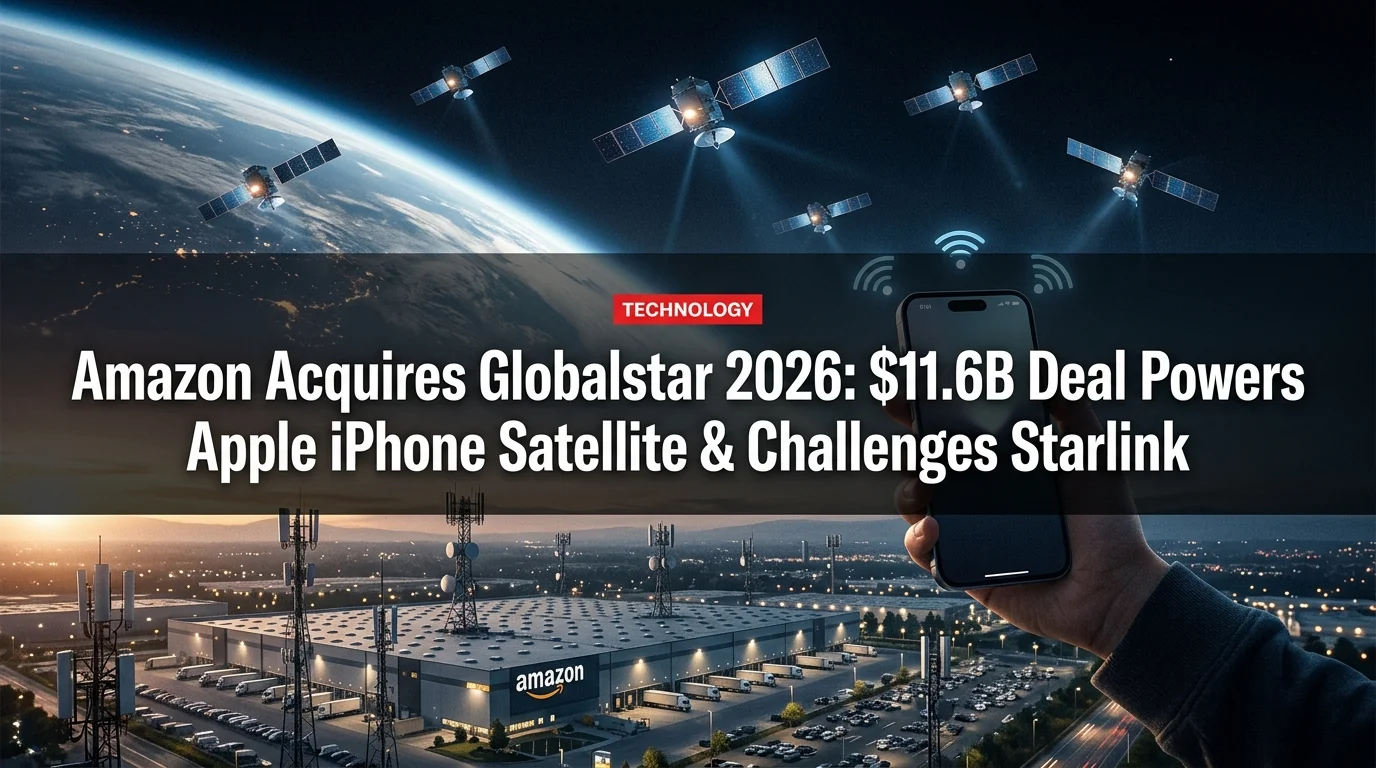
Amazon just made its boldest move in the satellite internet race. On April 14, 2026, the company announced it would acquire Globalstar — the satellite communications firm that already powers Apple's iPhone emergency features — in a deal worth approximately $11.57 billion. The acquisition reshapes the competitive landscape, hands Amazon scarce orbital spectrum it couldn't easily build from scratch, and locks in a long-term partnership with Apple to power satellite connectivity on future iPhone and Apple Watch models.
For anyone watching the slow-motion collision between Big Tech and the final frontier, this is the moment Amazon stopped playing catch-up.
What Amazon Is Actually Buying
On paper, Amazon is buying a satellite company. In practice, it's buying three things that money alone can't easily replicate: spectrum, infrastructure, and an Apple relationship.
Spectrum is the most valuable piece. Globalstar holds licensed mobile-satellite spectrum — a tightly regulated, finite resource that regulators rarely give out to newcomers. For Amazon, which has launched roughly 200 satellites but hasn't started consumer service yet, this acquisition is the fastest path to operating at scale without waiting years for spectrum allocation fights.
Infrastructure means Globalstar's existing satellite fleet and ground stations, currently being expanded from about 24 satellites to 54 as part of an Apple-backed buildout. Amazon can fold this into its planned constellation of thousands of satellites, instantly gaining operational experience and coverage.
The Apple relationship is the headline. Under a separate long-term agreement announced alongside the acquisition, Amazon's Leo network will power satellite features on future iPhone and Apple Watch models — including Emergency SOS, messaging, Find My location sharing, and roadside assistance. Amazon also committed to maintaining service for existing Apple devices already running on Globalstar's network.
Deal Terms: Cash, Stock, and a 2027 Closing
Globalstar stockholders have a choice: $90 per share in cash or an equivalent value in Amazon stock (0.3210 Amazon shares per Globalstar share). There's a catch — cash payouts are capped at 40% of total shares outstanding. Any elections beyond that threshold automatically convert to stock, meaning the majority of Globalstar shareholders will end up holding Amazon equity.
The deal is expected to close in 2027, subject to standard regulatory approvals and certain operational milestones. GSAT shares surged sharply on the announcement, as investors priced in the $90-per-share premium.
Amazon vs. Starlink: The Real Battle Begins
Before this deal, the satellite internet race looked like a foregone conclusion. SpaceX's Starlink operated over 10,000 satellites and served more than 9 million subscribers. Amazon's Project Kuiper — now rebranded as Amazon Leo — had launched about 200 satellites and hadn't started consumer service.
The Globalstar acquisition changes the math.
- Globalstar spectrum licenses (scarce, can't be replicated quickly)
- 54-satellite operational fleet + thousands planned
- Apple iPhone/Watch partnership (hundreds of millions of devices)
- Amazon logistics, AWS cloud, and Prime distribution
- 10,000+ satellites operational now
- 9M+ paying subscribers
- Direct-to-cell partnerships with T-Mobile
- First-mover advantage in rural broadband
Amazon doesn't need to match Starlink satellite-for-satellite. Its strategy is to control the consumer device layer — starting with Apple's billion-plus iPhone installed base — while building out the backend constellation over time. That's a fundamentally different approach from Starlink's direct-to-consumer broadband model, and it could prove just as lucrative.
Why This Matters for iPhone Users
If you've ever triggered Emergency SOS via satellite on an iPhone, you've used Globalstar's network. Apple first launched satellite SOS on iPhone 14 in 2022, relying entirely on Globalstar's infrastructure. The service has expanded to include Find My location sharing, messaging without cell service, and roadside assistance.
Apple's own satellite ambitions have always been infrastructure-light by design. Rather than building and operating satellites, Apple prefers to partner with operators and focus on the device and software experience. The Amazon deal extends that model, giving Apple a more capable long-term partner than Globalstar could be on its own.
What Happens to Globalstar Customers?
Globalstar serves its own direct customers — satellite phones, IoT trackers, and asset monitoring devices used in remote areas with no cellular coverage. Those services continue operating unchanged until the acquisition closes in 2027. After that, they're expected to migrate onto the broader Amazon Leo network, potentially with better coverage and capacity.
The Bigger Picture: Big Tech Owns Space Now
Amazon's Globalstar deal is the latest data point in a broader pattern: the infrastructure of space is consolidating into the hands of a small number of technology and aerospace giants.
- SpaceX (Starlink) dominates low Earth orbit internet with 10,000+ satellites
- Amazon Leo now has spectrum rights, an Apple partnership, and operational infrastructure
- AT&T and Verizon have satellite partnerships with AST SpaceMobile
- T-Mobile runs direct-to-satellite with SpaceX Starlink
- Google parent Alphabet has invested in satellite connectivity ventures
For regulators, the question is whether Amazon's acquisition of licensed spectrum — combined with its cloud dominance through AWS and consumer reach through Prime — creates an unfair advantage in the emerging satellite broadband market. The FCC and DOJ are expected to scrutinize the deal before it clears.
For consumers, the picture looks more optimistic: more competition in satellite internet means more pressure on Starlink to lower prices and improve service in rural and underserved markets.
Bottom Line
Amazon just bought its way into the satellite internet race with one of the biggest moves in the industry's history. The $11.57 billion price tag gets it spectrum, operational satellites, and a locked-in partnership with Apple. Starlink's lead is real — 10,000 satellites and 9 million subscribers don't evaporate overnight — but Amazon has the resources, the distribution, and now the spectrum to mount a genuine challenge.
The space internet war just got a lot more interesting.