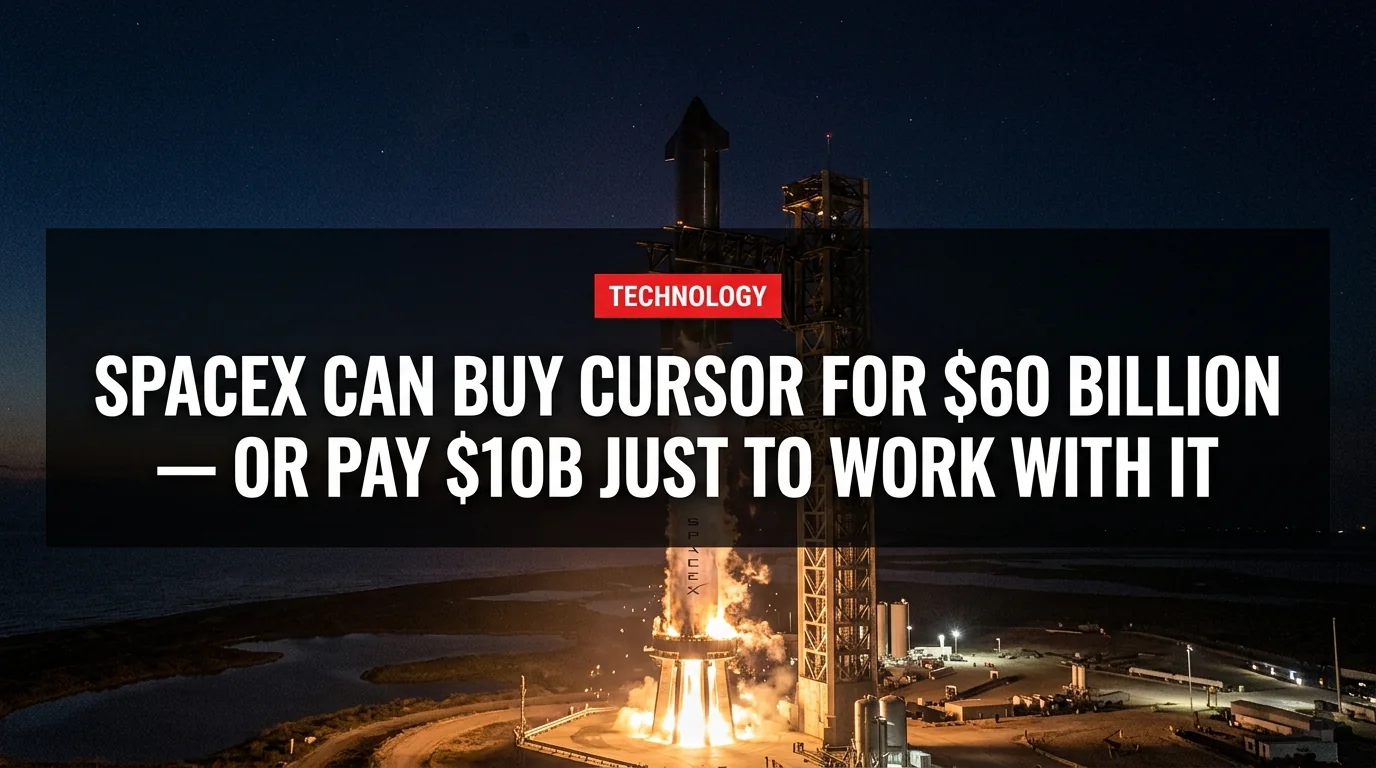
SpaceX has struck one of the most unusual deals in tech history with Cursor, the AI coding assistant that surpassed $1 billion in annual revenue last year. The company has two options: pay $10 billion simply for the right to collaborate, or acquire Cursor outright for $60 billion later in 2026. Either way, the $10 billion flows to Cursor regardless.
The deal, first reported by CNBC and TechCrunch on April 21–22, rewrites the rules on what a startup acquisition even looks like. Cursor was in the middle of closing a $2 billion fundraising round — with Andreessen Horowitz, Thrive Capital, Nvidia, and Battery Ventures lined up as investors — when SpaceX stepped in and made both terms impossible to refuse.
What Is Cursor — and Why Does SpaceX Want It?
Cursor is an AI-powered code editor built on top of Visual Studio Code, made by San Francisco startup Anysphere. Founded in 2022 by four MIT graduates — Michael Truell (CEO, 25), Sualeh Asif, Aman Sanger, and Arvid Lunnemark — the product became the go-to AI coding tool for professional engineers almost overnight.
Valuation trajectory tells the story fast: $2.5 billion in January 2025, $9 billion by May, $29.3 billion after a $2.3 billion Series D in November. In barely 18 months, Cursor went from well-funded startup to one of the most valuable private companies in the world. It competes directly with Anthropic's Claude Code and OpenAI's Codex.
SpaceX's interest is strategic — and personal. The company recently merged with xAI, Elon Musk's AI venture. The combined entity wants to be seen as an AI company, not merely an aerospace and satellite business. That distinction commands dramatically higher valuation multiples on Wall Street, something that matters a great deal ahead of SpaceX's planned summer 2026 IPO.
The Deal Structure Explained
The mechanics are unusual by any standard.
The delay on the full acquisition is deliberate. SpaceX's summer 2026 IPO filing is already locked. Acquiring a $60 billion company right now would force a restatement of pre-IPO financials — a legal and logistical nightmare. The cleaner path: go public, issue stock, then exercise the option using newly minted public shares.
For Cursor, the math was obvious. A standalone $2 billion fundraising round would not have covered the company's burn rate given intensifying competition from Anthropic and OpenAI. The $10 billion cash injection from SpaceX dwarfs what any venture round could provide — with team preservation guaranteed and no acqui-hire structure.
The xAI Angle: Compute + Product
The deal is not just financial. It reflects an existing technical partnership that has been deepening for months.
xAI has already been supplying Cursor with compute — tens of thousands of xAI chips for model training and inference. Two senior Cursor engineers, Andrew Milich and Jason Ginsberg, have already moved to xAI full-time, reporting directly to Musk. The lines between the companies are already blurring.
SpaceX controls the Colossus supercomputer cluster — described as equivalent to approximately one million H100 GPUs — across facilities in Mississippi and Tennessee. The long-term vision is to combine Cursor's product distribution and engineering culture with Colossus-scale compute, with a goal of building, in SpaceX's words, "the world's most useful models" for coding and knowledge work.
- Instant AI product credibility before IPO
- Access to Cursor's 1B+ ARR distribution
- $10B buys collaboration without commitment
- Closes frontier AI gap vs Anthropic/OpenAI
- $60B is a huge bet on one product category
- Cursor faces fierce competition from Claude Code, Codex
- xAI-SpaceX integration is still untested at scale
- IPO timeline adds complexity to deal execution
Neither xAI nor SpaceX has proprietary frontier AI models that match Anthropic's Claude or OpenAI's GPT-4o class systems. The deal is at least partly an attempt to close that gap through distribution and engineering talent rather than pure research.
Microsoft Was Looking Too
SpaceX was not the only suitor. Multiple sources told CNBC that Microsoft had examined a Cursor acquisition before the SpaceX deal was struck — and passed. The reasons are not officially confirmed, but the timing suggests Microsoft may have balked at Cursor's $29 billion-plus valuation trajectory.
For context: Microsoft paid $7.5 billion for GitHub in 2018. Cursor at $60 billion would be the largest software acquisition in history — eight times the GitHub price, executed in an era when AI coding tools are fundamentally reshaping how software gets written.
What Happens to the $2B Fundraise?
The venture round is effectively shelved. Andreessen Horowitz, Thrive Capital, Nvidia, and Battery Ventures were all positioned as investors in the round. Those terms are now superseded by SpaceX's offer.
For the four MIT graduates who founded Anysphere three years ago, the outcome represents one of the fastest wealth-creation events in Silicon Valley history — potentially $60 billion for a company that did not exist in 2021.
Industry Reaction: Consolidation Accelerates
- SpaceX-xAI merger created the platform for this deal
- Cursor surpassed $1B ARR in under 3 years — among the fastest ever
- The deal delays full acquisition until after SpaceX's summer 2026 IPO
- Microsoft examined but declined to pursue the acquisition
- If exercised at $60B, it would be the largest software acquisition on record
The deal accelerates a broader pattern in AI tooling: the biggest compute-rich players are hoovering up distribution. Microsoft owns GitHub Copilot. Google has Gemini Code Assist. Amazon has CodeWhisperer. OpenAI has Codex. Now SpaceX-xAI would have Cursor.
For developers and engineering teams, the question is whether Cursor remains the independent, fast-moving tool they signed up for — or becomes a vehicle for xAI's broader ambitions. The $10 billion collaboration fee is a vote of confidence that the team stays intact. Whether it stays independent in spirit is a different question.
SpaceX has until later in 2026 to decide. The clock is running.