NASA Artemis II Splashdown: Orion Capsule Returns After Historic Moon Mission
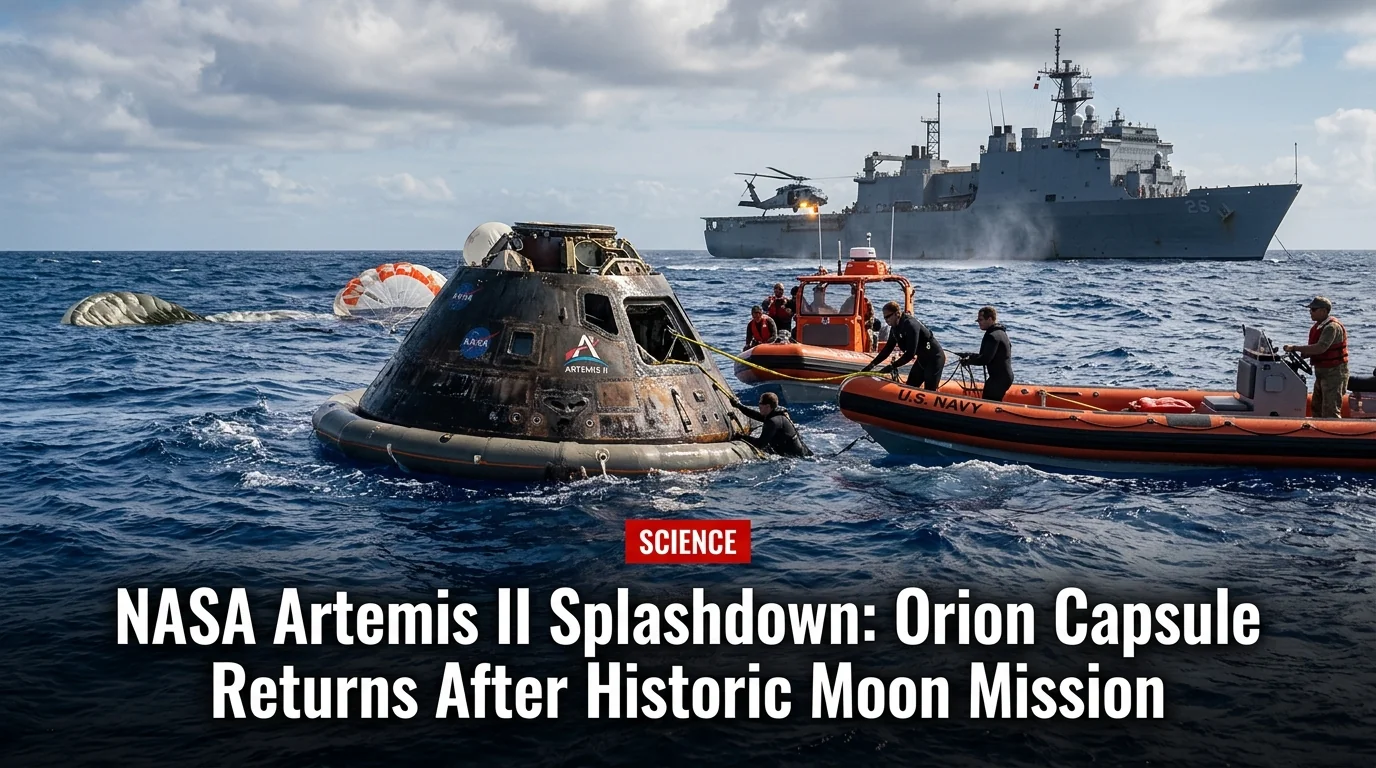
NASA's Orion spacecraft Integrity splashed down in the Pacific Ocean at approximately 8:07 p.m. EDT on Friday, April 10, 2026, marking the successful conclusion of the Artemis II mission — the first crewed voyage to the Moon's vicinity in more than 50 years.
The four-member crew traveled 695,081 miles over 10 days, reaching a maximum distance of 252,760 miles from Earth and breaking the distance record set by Apollo 13 in 1970.
- Mission duration: 10 days (April 1–10, 2026)
- Total distance traveled: 695,081 miles
- Maximum distance from Earth: 252,760 miles (new crewed record)
- Closest lunar approach: 4,070 miles from the Moon's surface
- Reentry speed: 23,864 mph (Mach 32)
- Heat shield temperature: 5,000°F during reentry
The Crew
Artemis II carried four astronauts into deep space:
- G. Reid Wiseman — Commander (NASA). Former Navy test pilot and ISS veteran with over 165 days in space prior to this mission.
- Victor J. Glover — Pilot (NASA). Navy fighter pilot who previously served as pilot on SpaceX Crew-1 to the ISS. With Artemis II, Glover became the first Black astronaut to travel beyond low Earth orbit.
- Christina Hammock Koch — Mission Specialist (NASA). Holds the record for the longest single spaceflight by a woman (328 days aboard the ISS). She also participated in the first all-female spacewalk in 2019.
- Jeremy Hansen — Mission Specialist (Canadian Space Agency). Former CF-18 fighter pilot and the first non-American to fly on a lunar mission, representing Canada's contribution to the Artemis program through the Canadarm3 agreement.
Mission Timeline
The crew launched from Kennedy Space Center's Pad 39B on April 1 at 6:35 p.m. EDT aboard NASA's Space Launch System (SLS) rocket — the most powerful rocket ever flown. The SLS generated 8.8 million pounds of thrust at liftoff, clearing the tower in just eight seconds.
After entering a high Earth orbit to test life support systems over two days, Orion performed a trans-lunar injection burn on April 3. The spacecraft completed a lunar flyby on April 6, passing behind the far side of the Moon at a distance of 4,070 miles — briefly losing all radio contact with Earth for 34 minutes.
Christina Koch described the flyby as producing an "overwhelming sense of being moved by looking at the moon," while noting the crew was "bumping into each other 100% of the time" inside the compact capsule.
Reentry and Splashdown
The return sequence on April 10 tested the most critical phase of any deep-space mission: reentry. Orion entered Earth's atmosphere at 23,864 mph — nearly Mach 32 — far faster than any return from the ISS. The heat shield endured temperatures reaching 5,000°F during reentry.
Engineers paid close attention to heat shield performance. During the uncrewed Artemis I flight in 2022, unexpected charring patterns appeared on the ablative heat shield material. NASA made no design changes for Artemis II but added additional sensors to better understand the phenomenon. Post-flight analysis of the Artemis II heat shield will take several months.
The spacecraft slowed from 23,864 mph to about 20 mph in roughly 14 minutes — shedding 99.97% of its velocity through atmospheric drag and parachute deployment.
Recovery Operations
The USS John P. Murtha (LPD 26) led recovery operations in the Pacific, supported by two MH-60S Seahawk helicopters from Helicopter Sea Combat Squadron 23. A specialized four-person dive medical recovery team, led by Lt. Cmdr. Jesse Wang, was assigned one medic per astronaut to monitor crew health immediately after splashdown.
Frogmen from the Navy's Explosive Ordnance Disposal teams reached the capsule within minutes to attach a sea anchor and stabilize it in the water. The crew remained inside Orion for approximately 90 minutes while the capsule was hoisted into the ship's well deck — a procedure rehearsed dozens of times.
"Our four Artemis II astronauts took humanity on an incredible journey around the moon and brought back images so exquisite they will inspire generations to come," said Nicky Fox, NASA's Associate Administrator for the Science Mission Directorate.
Cost and Criticism
The Artemis program has cost approximately $93 billion through 2025, with each SLS launch estimated at $4.1 billion. During the mission itself, a White House budget proposal described the SLS rocket as "grossly expensive" and suggested pursuing more cost-effective commercial alternatives for future deep-space missions.
Despite the cost debate, public support for the mission ran high. Television viewership for the splashdown exceeded 14 million across major networks, and social media engagement around #Artemis2 trended globally for three consecutive days.
Public interest in space and science is high this month — Earth Day 2026 falls later in April with its own focus on scientific investment.
What Comes Next
The crew will undergo post-mission medical evaluations aboard the recovery vessel before returning to Johnson Space Center in Houston. Debriefings are expected to last several weeks as NASA gathers crew feedback on capsule habitability, life support, and workload during the mission.
NASA's next step is Artemis III, expected in late 2027 or 2028. That mission aims to land the first woman and the first person of color on the lunar South Pole using SpaceX's Starship Human Landing System. Starship must first complete an uncrewed lunar landing demonstration — a test currently scheduled for mid-2027.
Beyond Artemis III, NASA plans to establish the Lunar Gateway — a small space station orbiting the Moon — to support sustained exploration of the lunar surface through the 2030s.
Sources: NASA, ESA, U.S. Navy, Space.com