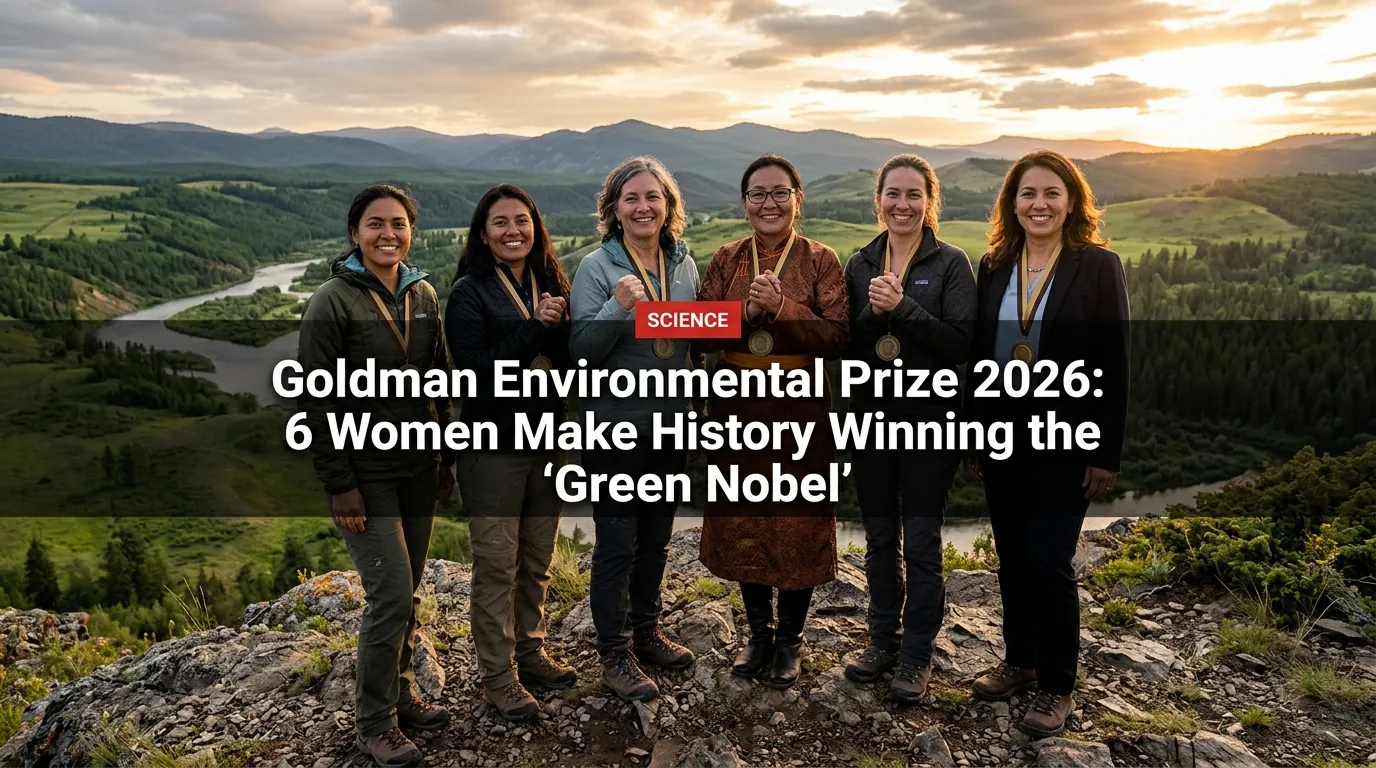
For the first time since the Goldman Environmental Prize was founded in 1989, every winner is a woman. Six activists from six continents were honored on April 21, 2026, each awarded $200,000 for victories that reshaped environmental law, blocked billion-dollar extraction projects, and protected ecosystems that span continents.
The prize — often called the "Green Nobel" — is the world's largest prize for grassroots environmental activists. This year's all-female cohort represents one of the most significant lineups in the award's 37-year history.
The Six Winners
Iroro Tanshi — Nigeria (Africa)
Conservation ecologist Iroro Tanshi, 41, co-executive director of the Small Mammal Conservation Organization (SMACON), rediscovered a small colony of the short-tailed roundleaf bat in Nigeria's Afi Mountain Wildlife Sanctuary in 2016 — the first confirmed sighting in the country in 45 years. The species had been presumed locally extinct.
But Tanshi didn't stop at discovery. She organized community fire brigades that prevented major wildfires in Afi Mountain between 2022 and 2025, protecting the sanctuary and the bats she had spent years fighting to save. Her work bridges conservation science with on-the-ground community organizing in one of West Africa's most biodiverse regions.
Borim Kim — South Korea (Asia)
At 31, Borim Kim is one of the youngest Goldman Prize winners in history. She founded Youth 4 Climate Action (Y4CA) after a record-breaking 2018 heat wave in Seoul led to the death of a woman around her mother's age — from heat illness, inside her own home.
In March 2020, Kim organized 19 youth plaintiffs to file the first youth-led climate constitutional complaint in Asia. The case challenged South Korea's climate policies as unconstitutional violations of the right to life. It was a legal strategy that has since inspired similar suits across the region.
Sarah Finch — United Kingdom (Europe)
Sarah Finch spent more than a decade fighting oil drilling in the Weald, southeastern England's rural heartland. Working alongside the Weald Action Group, she took the battle all the way to the UK Supreme Court — and won.
The 2024 "Finch ruling" established that planning authorities must consider the downstream climate impact of fossil fuel extraction before granting permits. In other words: burning the oil counts. It was a landmark legal shift with implications far beyond England's countryside.
Theonila Roka Matbob — Papua New Guinea (Islands Region)
Theonila Roka Matbob led the longest and most complex campaign of this year's cohort. For decades, the Panguna copper mine on the island of Bougainville left a trail of environmental and social devastation — contaminated rivers, displaced communities, a civil war. The mine was closed in 1989 following an armed uprising.
Matbob organized communities across Bougainville to demand that Rio Tinto, the world's second-largest mining company, return and address the damage. After years of pressure, Rio Tinto agreed in 2025 to fund an independent environmental and social assessment — the first step toward accountability that communities had sought for 35 years.
Alannah Acaq Hurley — United States (North America)
Alannah Acaq Hurley led a coalition of 15 tribal nations in Alaska in a decade-long fight against the proposed Pebble Mine — a massive copper and gold project that would have been built at the headwaters of Bristol Bay, home to the world's largest sockeye salmon fishery.
In 2023, the EPA issued a veto under the Clean Water Act, permanently blocking the mine and protecting 25 million acres of wilderness and the wild salmon runs that Indigenous communities have depended on for thousands of years. It was one of the most consequential environmental victories in recent US history.
Yuvelis Morales Blanco — Colombia (South & Central America)
At just 24 years old, Yuvelis Morales Blanco is the youngest winner of this year's prize. She grew up in Puerto Wilches, an Afro-Colombian fishing community on the banks of the Magdalena River, where her family's livelihood depended on the river staying clean.
When oil companies began lobbying the Colombian government to permit commercial fracking, Morales Blanco organized resistance that stretched from her riverside community to Colombia's Constitutional Court. She won. Colombia became one of the few major oil-producing countries to constitutionally ban fracking — a victory that took on some of the world's largest energy corporations.
- Historic all-women cohort — first in 37 years
- Winners represent six continents with distinct ecosystems
- Legal victories from the UK to South Korea set new precedents
- Indigenous and frontline communities centered in every win
- Many battles are ongoing — mining firms and oil companies remain in legal challenges
- $200,000 awards, while significant, are small relative to the legal costs winners often face
Why This Year Stands Out
Prize administrators noted that the all-women slate was not intentional — the annual selection process considers nominees from all backgrounds, with winners chosen region by region. The outcome reflects who is actually doing the most consequential environmental work on the ground right now.
"This is a fight for humanity," said one winner in remarks shared by the Goldman Foundation. "The ecosystems we're protecting aren't just wildlife habitats. They're the water, the air, and the food systems that billions of people depend on."
The 2026 cohort spans bat conservation in Nigeria, youth climate litigation in South Korea, landmark Supreme Court rulings in England, Indigenous-led mining accountability in Papua New Guinea, Clean Water Act victories in Alaska, and anti-fracking campaigns in Colombia. Taken together, they represent a new wave of environmental activism — legally sophisticated, community-rooted, and increasingly winning.
- First all-women cohort in the prize's 37-year history
- Prize founded in 1989 by Richard and Rhoda Goldman of San Francisco
- Each of the six winners received $200,000
- Winners represent Africa, Asia, Europe, Islands, North America, and South/Central America
- Combined, the 2026 winners' campaigns protected tens of millions of acres of land and water
The announcement ceremony was held in San Francisco, the prize's home city. Previous Goldman Prize winners have gone on to influence national legislation, international climate agreements, and corporate environmental policy at the highest levels. The 2026 class has already done the same.