
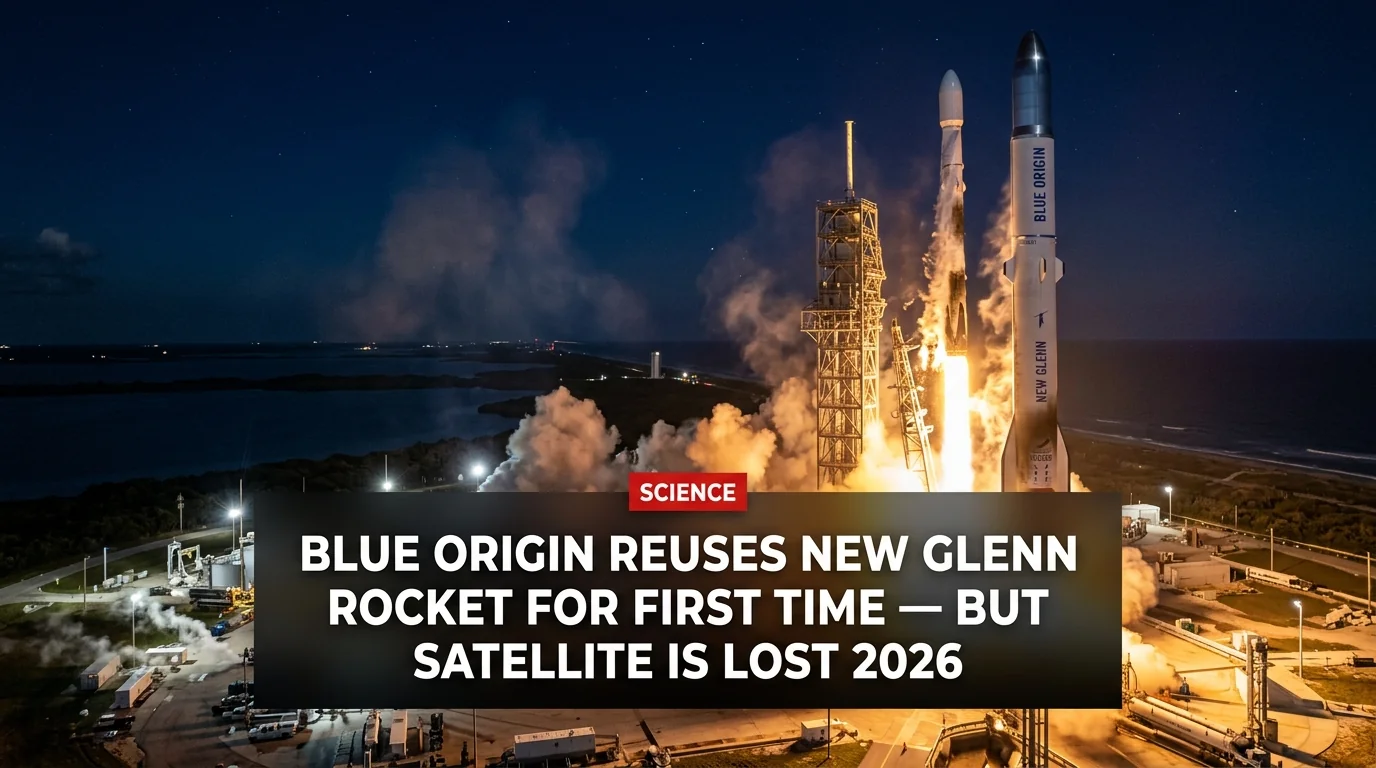
Blue Origin made a genuine leap forward on April 19, 2026 — and then immediately ran into one of the messiest rocket failures in the company's short orbital history. On the third ever launch of the New Glenn rocket, Jeff Bezos's space company successfully recovered and reflew a previously flown booster for the first time. It was a milestone that put Blue Origin squarely in SpaceX territory. Then the upper stage malfunctioned, the satellite went to the wrong orbit, and the FAA grounded the rocket.
One launch, two very different headlines.
The Milestone: First Booster Reuse
The booster that flew NG-3 was the same one that powered New Glenn's second mission in November 2025. Blue Origin engineers replaced all seven BE-4 engines — a full engine swap, not just refurbishment — and added upgrades including an improved thermal protection system on one of the engine nozzles.
At T+10 minutes, the booster came back down and stuck its landing on a drone ship at sea. Clean. Controlled. Right on target.
For context: SpaceX has been reusing Falcon 9 boosters since 2017 and regularly lands the same booster 15–20 times. Blue Origin getting here in three flights is genuinely fast. The New Glenn booster is also much larger — it's a heavy-lift vehicle designed to carry big commercial and government payloads — so the technical challenge is different in scale.
Blue Origin CEO Dave Limp called the booster recovery "exactly what we planned." For a few minutes, it felt like a clean win.
The Failure: BlueBird 7 Is Gone
Then the upper stage data came in wrong.
AST SpaceMobile's BlueBird 7 satellite — the payload for the NG-3 mission — separated from the rocket and powered on. Initial telemetry showed it was alive. But the orbit was significantly lower than planned. One of the upper stage engines had failed to produce enough thrust during the burn, leaving the satellite stranded in an altitude too low to sustain operations.
::alert error AST SpaceMobile confirmed BlueBird 7 cannot be saved. The satellite's on-board thrusters lack the delta-v to raise its orbit, and the spacecraft will be de-orbited. The loss is covered by insurance. ::end
Blue Origin's Dave Limp confirmed in a post-flight statement that "one of the upper stage's engines didn't produce sufficient thrust to reach our target orbit." The company said it is conducting a full failure investigation.
The FAA classified the event as a mishap — standard protocol when a rocket fails to deliver its payload to the intended orbit — and grounded New Glenn pending the outcome of the investigation and approval of corrective actions.
What This Means for AST SpaceMobile
AST SpaceMobile builds BlueBird satellites to provide cellular broadband from space directly to standard mobile phones — no special hardware required on the ground. The company has been in a rapid deployment phase, racing to build out its constellation to achieve commercial service at scale.
Losing BlueBird 7 hurts, but AST SpaceMobile moved quickly to reassure investors. The next batch of BlueBird satellites is expected to be ready in roughly a month, and the company reiterated its target of an orbital launch every one to two months throughout 2026. The insurance payout on BlueBird 7 helps offset the financial damage.
Blue Origin vs. SpaceX: The Rivalry Gets Real
For years, Blue Origin was the punchline in rocket comparisons — New Shepard, the suborbital tourist vehicle, was mocked as a dilettante project while SpaceX ran operational missions for NASA, the DoD, and commercial customers. New Glenn changed that narrative when it reached orbit on its first try in January 2025.
A first booster reuse on the third flight puts Blue Origin on an accelerated cadence. SpaceX's Falcon 9 took three flights before its first successful landing attempt and many more before it became routine. New Glenn appears to be progressing faster on the reuse curve.
But the upper stage failure is a real problem. SpaceX had its own upper-stage and payload anomalies early in Falcon 9's history — most notably the 2016 Amos-6 explosion and the 2015 CRS-7 mission failure. Both grounded the rocket for months and required extensive investigations. Blue Origin now faces a similar reckoning.
- First booster reuse achieved on just the third flight
- Booster landing was clean and on-target
- Rapid maturation compared to SpaceX's early timeline
- Strong insurance coverage protected AST SpaceMobile
- Next BlueBird batch ready in ~30 days
- Satellite declared total loss — first major payload failure for New Glenn
- FAA grounded the rocket pending full investigation
- Upper stage reliability now in question
- Setback for AST SpaceMobile's constellation buildout timeline
- Reuse milestone overshadowed by high-profile mission failure
What Happens Next
Blue Origin must complete a mishap investigation — the FAA will review the findings and approve corrective actions before New Glenn can fly again. The timeline is uncertain. Previous FAA mishap reviews for SpaceX Starship have run anywhere from a few weeks to several months, depending on the complexity of the failure and how transparent the company is with regulators.
The NG-4 mission, whenever it launches, will be under intense scrutiny. AST SpaceMobile needs its next batch of BlueBird satellites to reach the right orbit. Blue Origin needs to show that the upper stage fix is real and that New Glenn can deliver payloads reliably — not just land boosters cleanly.
The booster reuse was real progress. The satellite loss was a real setback. Blue Origin now has to prove that one was a trend and the other was a one-off.
- New Glenn is a two-stage heavy-lift rocket capable of carrying up to 45 metric tons to low-Earth orbit
- The BE-4 engine burns liquid oxygen and liquid natural gas — the same engine powers ULA's Vulcan Centaur
- AST SpaceMobile is one of several companies (alongside SpaceX Starlink, Amazon Kuiper) racing to build a direct-to-device satellite network
- Blue Origin was founded by Jeff Bezos in 2000; New Glenn is named after astronaut John Glenn
- The FAA mishap investigation process requires the launch provider to submit a report and corrective action plan before return-to-flight approval
Blue Origin got the reuse. Now it has to get the reliability.