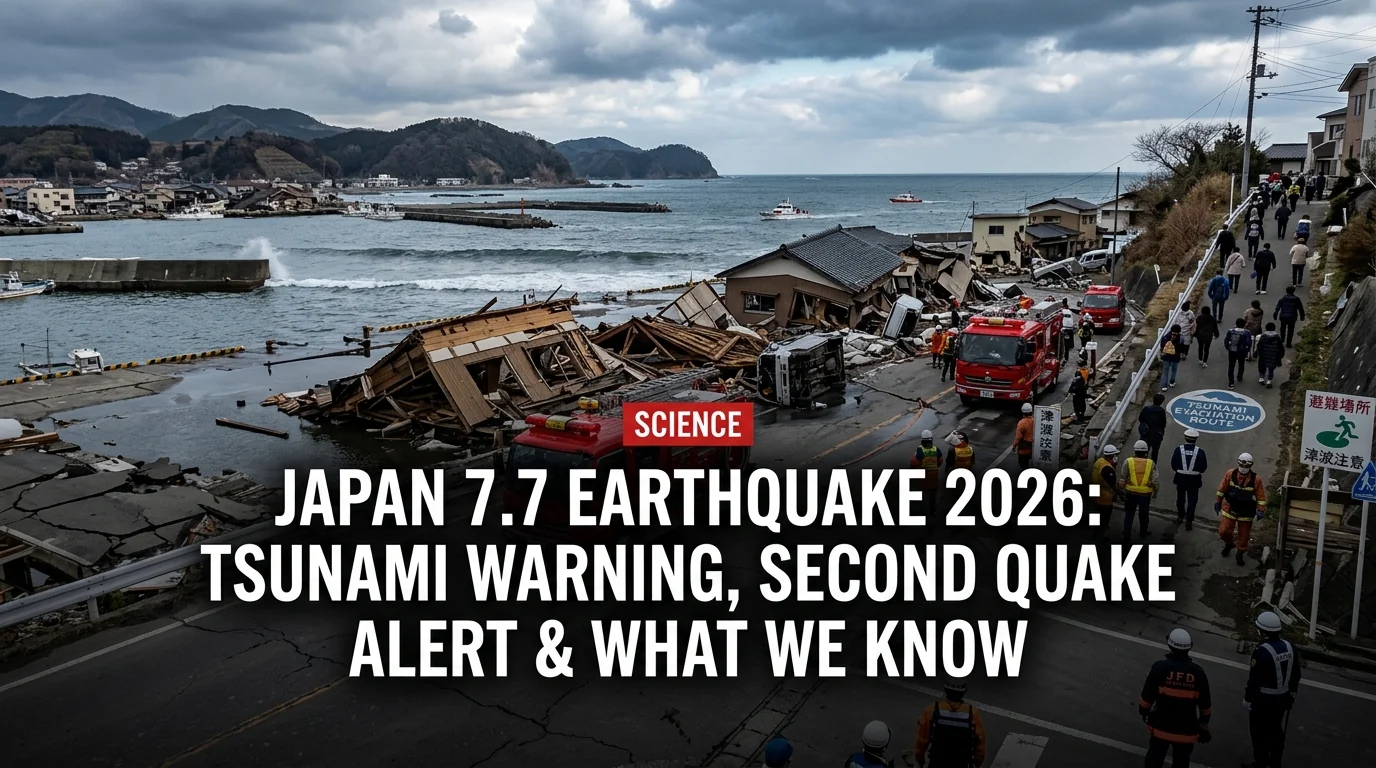
A powerful 7.7 magnitude earthquake struck off the northeast coast of Japan on Monday, triggering tsunami evacuation orders for thousands of coastal residents and a stark government warning: a second, potentially larger quake may be coming within the next week.
The quake hit at 16:52 local time (08:52 UTC) in waters off Iwate prefecture — 530km (330 miles) north of Tokyo — at a depth of 10km (6.2 miles). Tremors were felt as far away as the capital.
Evacuation Orders and Tsunami Waves
Within minutes of the earthquake, Japan's Meteorological Agency (JMA) issued a tsunami warning — the second-highest of three alert levels — covering parts of Japan's east coast, including areas of Honshu and Hokkaido. Residents were ordered to leave coastal and riverside areas immediately and move to higher ground or designated evacuation buildings.
"Tsunami waves are expected to hit repeatedly. Do not leave safe ground until the warning is lifted," the JMA told reporters in the immediate aftermath.
Prime Minister Sanae Takaichi echoed the warning, urging citizens to get to "higher, safer places."
The largest waves recorded measured 80cm — well below the initial warnings of up to 3-meter waves — and the tsunami warning was eventually downgraded to an alert, then lifted entirely shortly before midnight local time. However, officials have stressed that the ongoing threat of a stronger follow-up quake keeps the risk elevated.
"Higher Than Normal" Risk of a Massive Follow-Up Quake
The most alarming development is not Monday's quake itself, but what may follow. The JMA issued an unusual advisory stating the probability of an earthquake measuring 8.0 or higher occurring in the next week is now "relatively higher than during normal times."
While such advisories do not mean a larger quake is certain, Japanese authorities take them seriously. The country has protocols in place to handle cascading seismic events, and emergency services have been put on heightened alert.
Bullet train services on several lines were temporarily suspended as a safety precaution, and around 100 homes were left without electricity. Japan's Cabinet Secretary Minoru Kihara said there were no immediate reports of major damage or casualties — a relief given the quake's magnitude.
"As soon as we heard the earthquake alert, everyone ran downstairs," Chaw Su Thwe, a Myanmar national living in Hokkaido, told BBC News. "Right now, local authorities are using loudspeakers in the neighbourhood to warn people about a possible tsunami and to stay alert. Office workers have been allowed to leave work early."
Why Japan Lives Under Constant Seismic Watch
Japan sits at the intersection of four tectonic plates on the Pacific Ring of Fire — one of the most seismically active zones on Earth. The country experiences roughly 1,500 earthquakes per year, and accounts for about 10% of all earthquakes measuring 6.0 or higher globally.
The 2011 Tōhoku disaster remains etched in national memory. A 9.0-magnitude quake off the same northeast coast generated a tsunami that reached 40 meters in height in some areas, killing over 18,000 people and triggering the Fukushima Daiichi nuclear meltdown — one of the worst nuclear accidents since Chernobyl.
Monday's quake occurred near the same region, and the psychological weight of 2011 shaped how both officials and ordinary citizens responded — quickly and seriously.
How Japan's Three-Level Tsunami Warning System Works
- Tsunami Watch — Minor waves (0.2m–1m) expected; limited evacuation recommended
- Tsunami Warning — Waves up to 3m expected; full coastal evacuation ordered (this level was issued Monday)
- Major Tsunami Warning — Waves over 3m, possibly 10m+; maximum emergency, rare and catastrophic
Monday's warning was the middle tier — serious enough to trigger mass evacuations but not the catastrophic top-tier warning. The fact that actual wave heights remained under 1 meter is a best-case outcome for the coastal communities involved, but authorities have made clear that the risk window has not closed.
What Happens Next
Residents in Iwate, Hokkaido, and other affected prefectures are being advised to stay prepared to evacuate quickly over the coming days. Emergency supplies, evacuation routes, and shelter locations have been reinforced.
- Wave heights stayed below 1 meter — no major tsunami damage
- No immediate casualties or major structural damage reported
- Japan's early warning system functioned and evacuations happened quickly
- Fukushima and other nuclear plants reported no safety incidents
- Elevated risk of 8.0+ follow-up quake in the next 7 days
- Coastal communities remain on high alert
- Bullet train disruptions and power outages affected residents
- Psychological toll significant given 2011 memories
The government has urged residents not to return to coastal zones until further notice and to keep emergency kits accessible.
For real-time updates, follow Japan's Meteorological Agency (JMA) directly, as the situation may evolve significantly in the coming days.
Key Takeaway
Japan has some of the most sophisticated earthquake preparedness infrastructure in the world. But as 2011 showed, no amount of preparation fully removes the danger when the earth decides to move.