
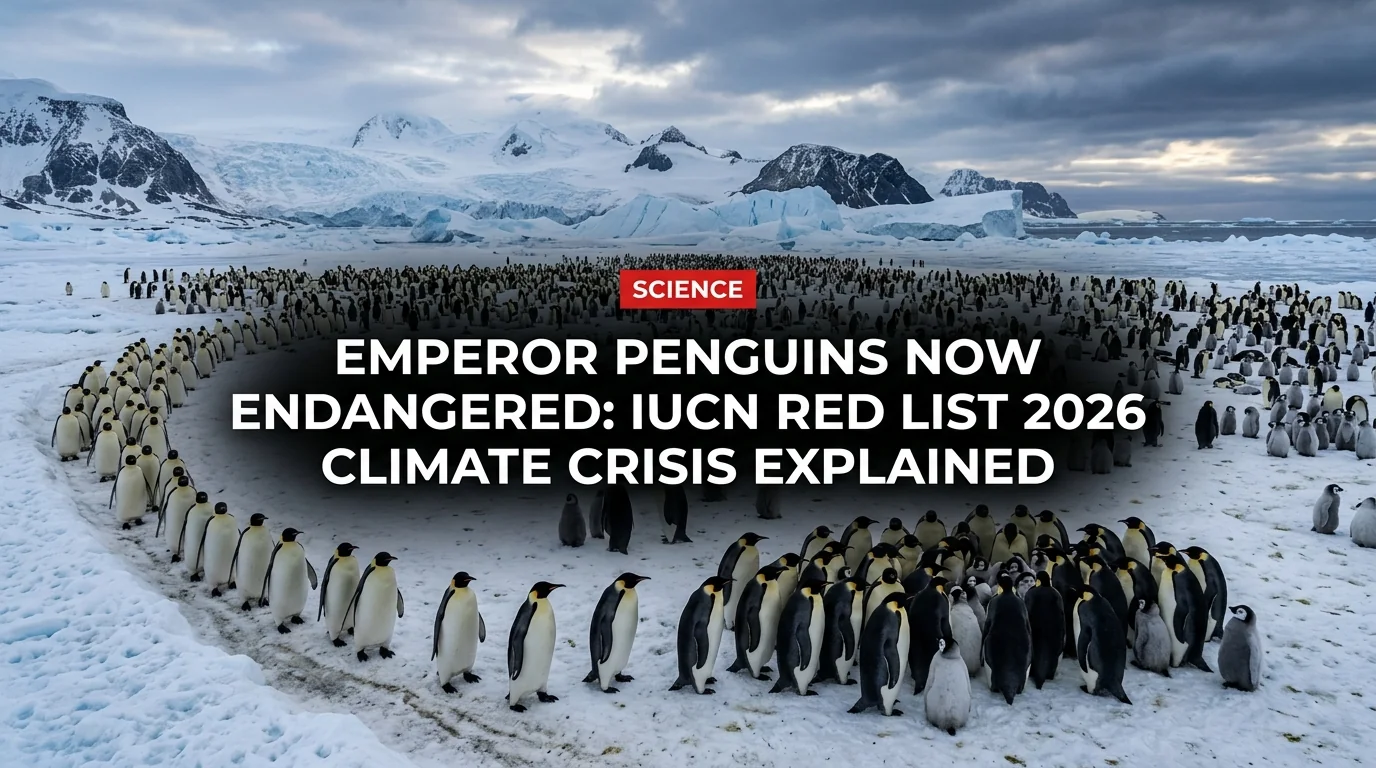
The most iconic animal in Antarctica just got a dire new label. On April 9, 2026, the International Union for Conservation of Nature (IUCN) upgraded the emperor penguin from Near Threatened to Endangered on its Red List of Threatened Species — the world's most authoritative measure of species survival risk. The cause: climate change is melting the sea ice emperor penguins depend on to breed, feed, and survive.
The Antarctic fur seal was simultaneously elevated to Endangered status — the first time both species have been listed together in the same IUCN update.
Why Emperor Penguins Are Now Endangered
Emperor penguins don't just live near the ocean — they live on sea ice. They breed on it, raise chicks on it, moult on it, and rely on it to access the fish, squid, and krill below. When sea ice breaks up too early in spring, the consequences are catastrophic:
- Chick mortality surges — Penguin chicks haven't developed waterproof feathers by the time the ice breaks up prematurely, causing mass drownings
- Breeding colonies fail — Adults abandon breeding grounds when conditions become unstable
- Food access decreases — Sea ice supports the krill and fish that make up emperor penguins' diet
In 2022, satellite imagery revealed a catastrophic breeding failure in the Bellingshausen Sea region, where four of five emperor penguin colonies produced zero surviving chicks — the first recorded event of its kind.
What the IUCN Red List Status Means
The IUCN Red List uses a seven-tier classification system, from Least Concern to Extinct. "Endangered" is the third-most severe, meaning the species faces a very high risk of extinction if current trends continue.
The emperor penguin's progression on the list reflects how fast conditions are deteriorating:
The IUCN listing doesn't trigger legal protections the way U.S. or national laws do — but it carries enormous scientific and diplomatic weight. It's the benchmark governments, conservationists, and international bodies use to prioritize action.
Antarctic Fur Seals Listed Too
The emperor penguin wasn't alone in April's IUCN update. The Antarctic fur seal — which had rebounded from near-extinction after commercial hunting bans in the 20th century — has now been listed as Endangered.
The fur seal population, once considered a conservation success story, has declined by more than 50% in recent decades due to:
- Warming waters reducing krill availability
- Changing weather patterns disrupting pup-rearing on land
- Competition from fishing industries
The Driving Force: Sea Ice Loss
Antarctica's sea ice reached record-low extents in 2023 and 2024. In February 2023, Antarctic sea ice was approximately 1 million square kilometers below the previous record low — an area roughly the size of Egypt.
The IPCC projects that under a high-emissions scenario (3°C+ of global warming), emperor penguin sea ice habitat could decline by 50–70% by the end of the century. At 2°C of warming, many colonies face significant stress. Only by holding warming below 1.5°C can emperor penguin population losses be substantially limited — an increasingly difficult target.
What Happens Now?
The IUCN Endangered listing won't automatically trigger new protections — but it carries weight in several ways:
International policy: The listing strengthens arguments for more aggressive carbon emission targets and Antarctic conservation zones at forums like COP climate summits.
Research funding: Endangered status typically unlocks additional conservation research dollars, both privately and through governments.
Marine Protected Areas: Environmental groups have renewed calls for expanded Antarctic Marine Protected Areas (MPAs) in the wake of the listing. An MPA in the East Antarctic — the world's largest proposed marine reserve — has been stalled at the Commission for the Conservation of Antarctic Marine Living Resources (CCAMLR) for over a decade.
Tourism regulations: Growing Antarctic tourism now faces renewed scrutiny, as ships and visitors can disturb breeding colonies.
Emperor Penguins vs. Other Penguin Species
Emperor penguins are one of 18 recognized penguin species, and they're not the only one under pressure:
- Emperor penguin: Endangered (IUCN 2026) — climate/sea ice loss
- African penguin: Endangered — bait fish competition, oil spills
- Yellow-eyed penguin: Endangered — habitat loss in New Zealand
- Galapagos penguin: Endangered — El Niño events, climate shift
- Little (fairy) penguin: Least Concern, but declining in some regions
Of 18 species, at least 10 are considered threatened or near threatened — making penguins one of the most imperiled bird families on the planet.
What Can Be Done
Conservationists say the emperor penguin's trajectory is not inevitable — but the window is narrowing:
- Aggressive emissions reductions — Limiting global warming to 1.5°C dramatically changes the outcome for sea ice-dependent species
- Expanding Antarctic MPAs — Protecting feeding grounds from industrial fishing reduces food competition stress
- Monitoring and early warning systems — Satellite-based colony monitoring (pioneered since 2009) allows scientists to detect breeding failures faster
- Reducing pollution — Microplastics are increasingly found in Antarctic waters and penguin tissue; limiting plastic waste has downstream effects
The emperor penguin's Endangered listing is a stark reminder that climate change isn't a future problem — it's reshaping Antarctica right now, breeding season by breeding season. Whether the species recovers depends less on Antarctic conservation efforts than on what the world does about carbon emissions in the next decade.