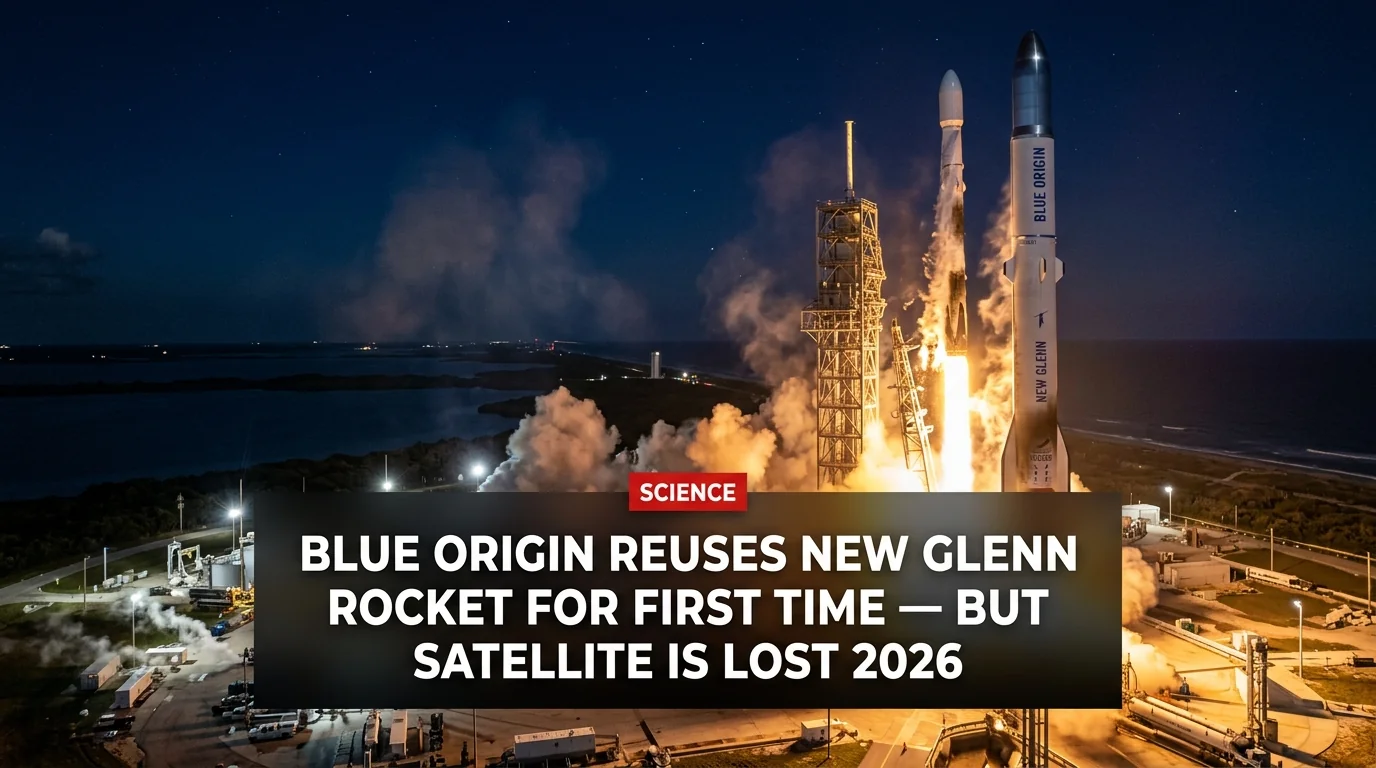
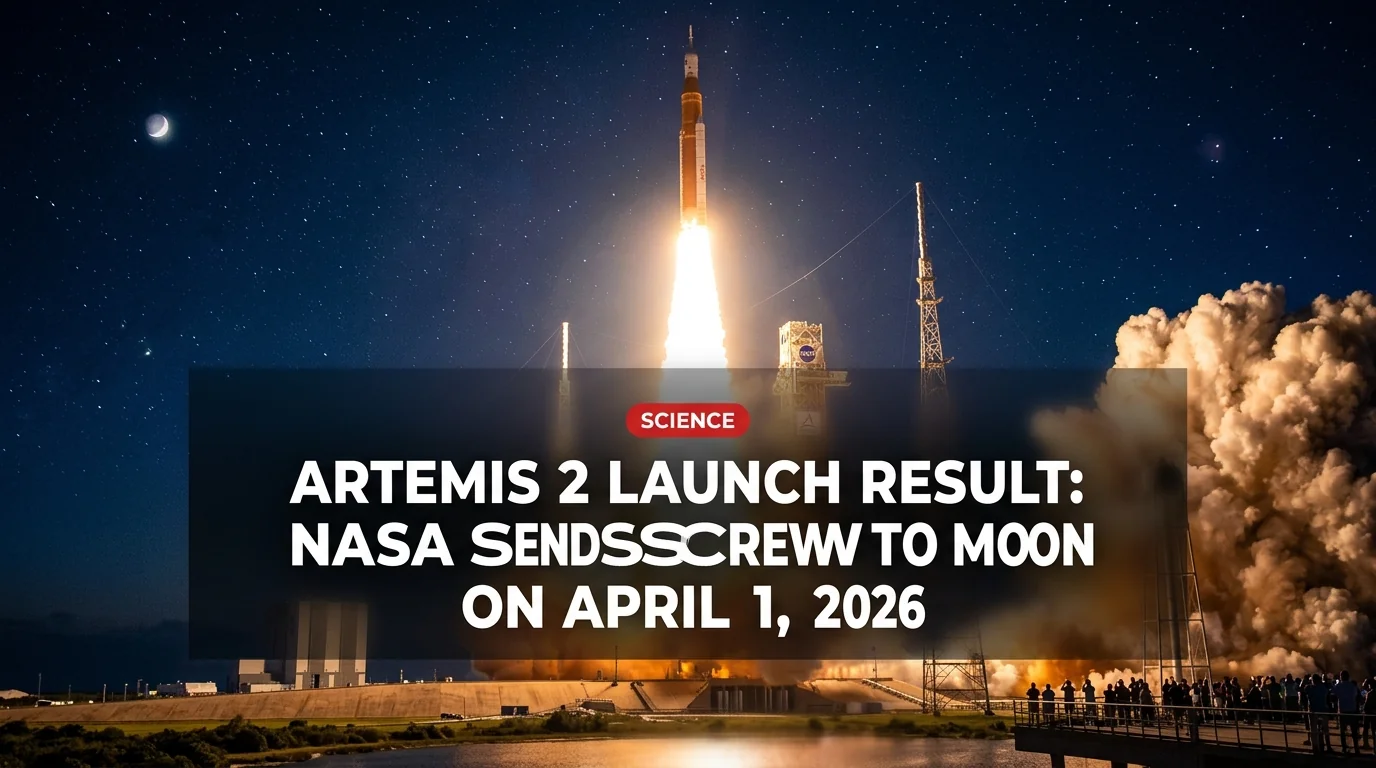
NASA's Artemis 2 mission lifted off successfully on April 1, 2026, at 6:24 p.m. EDT (22:24 UTC) from Kennedy Space Center's Launch Complex 39B — sending four astronauts toward the Moon for the first time in more than 50 years.
The Space Launch System (SLS) rocket, the most powerful ever flown, cleared the launch tower in near-perfect conditions. Weather forecasters rated the day 80% favorable, with only thin clouds and mild wind shear monitored during the final countdown. Liftoff proceeded without a scrub.
The Crew Making History
Four astronauts are aboard Orion for the 10-day free-return lunar flyby:
- Reid Wiseman (NASA) — Commander, veteran ISS astronaut and Navy test pilot who previously spent 165 days aboard the International Space Station in 2014
- Victor Glover (NASA) — Pilot, first person of color to fly around the Moon. Glover served as pilot on SpaceX Crew-1 in 2020-2021 and logged 168 days in orbit
- Christina Koch (NASA) — Mission Specialist, first woman to fly a lunar trajectory. Koch holds the record for the longest single spaceflight by a woman at 328 consecutive days aboard the ISS (2019-2020) and participated in the first all-female spacewalk
- Jeremy Hansen (Canadian Space Agency) — Mission Specialist, first non-American to travel around the Moon. A former CF-18 fighter pilot, Hansen was selected as a CSA astronaut in 2009 but had not flown in space before this mission
All four entered medical quarantine at Johnson Space Center on March 18 before transferring to Kennedy Space Center ahead of the launch date.
- First crewed SLS rocket and Orion spacecraft flight
- First humans beyond low Earth orbit since Apollo 17, 1972
- Victor Glover: first person of color around the Moon
- Christina Koch: first woman on a lunar trajectory
- Jeremy Hansen: first non-American to fly around the Moon
- Mission duration: 10 days, splashdown in Pacific Ocean
What's Happening on the Mission
Artemis 2 is not a lunar landing — it's a critical proving flight designed to stress-test every system with humans on board before Artemis 3 attempts the surface. The mission profile follows a free-return trajectory: Orion swings around the Moon and uses lunar gravity to slingshot back to Earth, requiring no dedicated lunar-orbit insertion burn.
Key milestones in the 10-day flight:
- Solar array deployment — Within minutes of launch, Orion's four solar arrays unfurled to power the spacecraft
- Earth orbit checkout — Crew tests manual control, life support, navigation, and communications in low Earth orbit
- Perigee raise burn — Engine firing to adjust Orion's orbit altitude
- Trans-lunar injection (TLI) — Approximately 25 hours after launch, the European Service Module fires to send Orion out of Earth orbit toward the Moon
- Lunar flyby — Orion passes within 6,400 miles of the lunar surface at peak distance, then loops back
- Re-entry and splashdown — Orion hits Earth's atmosphere at roughly 25,000 mph (Mach 32), testing the redesigned heat shield before parachute deployment and Pacific Ocean recovery
Orion is expected to reach a maximum distance of 252,799 miles (406,841 km) from Earth — farther than any human has ever traveled.
The Heat Shield Question
The single biggest technical risk of Artemis 2 was the one NASA spent two extra years addressing: Orion's heat shield.
During Artemis 1's uncrewed test flight in November 2022, the ablative heat shield lost material in unexpected patterns during re-entry. Chunks of the AVCOAT material charred and separated in ways engineers had not predicted. While Artemis 1 splashed down safely, NASA concluded that sending a crew through the same re-entry profile without understanding — and fixing — the problem was unacceptable.
The investigation took most of 2023 and 2024. Engineers determined that trapped gases within the heat shield's honeycomb structure were expanding during the extreme heating of re-entry, causing sections to pop off. The fix involved modifying the AVCOAT application process to reduce gas pockets and adding venting channels to manage pressure buildup.
Ground testing of the redesigned shield ran through 2025, and NASA leadership declared it flight-ready in January 2026. The Artemis 2 re-entry will be the first real-world validation of that fix — with four humans behind it.
Why This Mission Matters
Artemis 2 is the dress rehearsal for the Moon landing. Every major system — Orion's life support, the European Service Module's propulsion, deep space communications, and crew procedures — must perform flawlessly before NASA commits to putting boots on the lunar surface with Artemis 3.
The mission tests things that simply can't be validated with robots: how humans perform during multi-day deep space transit, how Orion's thermal protection system handles the high-speed re-entry after a lunar return, and whether the spacecraft's emergency abort procedures work as designed.
The crew will also manually pilot Orion during several phases of the mission — something no astronaut has done in deep space since the Apollo program. This manual flying data is critical for training future Artemis crews.
If Artemis 2 succeeds, NASA's Artemis 3 mission — targeting a south pole landing with the first woman and first person of color on the lunar surface — moves one step closer to reality.
The Bigger Picture
Artemis 2 caps years of delay and controversy. The SLS program has been criticized for its $23 billion development cost and years of schedule slippage. The original Artemis 2 launch date slipped from 2024 to 2025 and finally to 2026 following the heat shield anomaly discovered after Artemis 1's 2022 flight.
The mission also arrives in a different space industry than the one that conceived it. SpaceX's Starship has completed multiple orbital tests and is the vehicle contracted to serve as Artemis 3's lunar lander. Blue Origin is developing its own lunar lander under the Sustaining Lunar Development contract. China has announced plans for crewed lunar missions by 2030. The competitive pressure on NASA to deliver results — not just plans — has never been higher.
For a generation that grew up after the Space Shuttle era, Artemis 2 is the first time in their lifetimes that humans have pointed themselves at the Moon. The sight of SLS lifting off from the same launch complex as the Saturn V rockets brought comparisons that NASA — and millions of viewers — were happy to make.
Whether the mission proceeds nominally or surfaces new issues for the program, the data collected over 10 days will define the pace of America's return to the lunar surface.
- First crewed deep space mission in 54 years validates critical systems
- Diverse crew sets multiple historic firsts
- Tests redesigned heat shield with humans aboard
- Generates irreplaceable data for Artemis 3 landing mission
- International partnership (CSA crew, ESA service module)
- SLS costs $23 billion+ and years of schedule delays
- Single-use rocket in an era of reusable launch vehicles
- Heat shield fix is untested in actual lunar return conditions
- Artemis 3 landing still depends on Starship HLS readiness
- No lunar orbit insertion — limited time near the Moon