
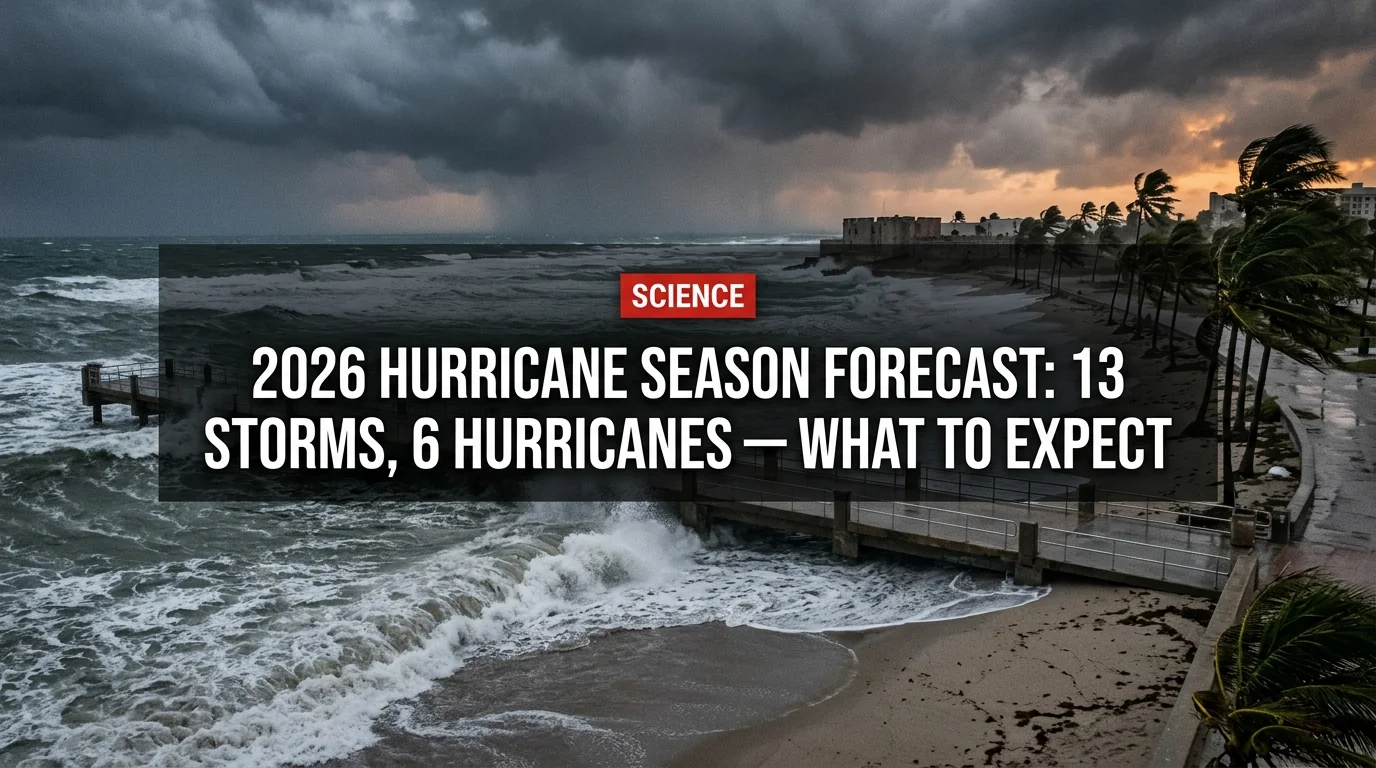
Colorado State University's Tropical Weather & Climate Research team has released its first forecast for the 2026 Atlantic hurricane season, and the outlook is relatively calm: 13 named storms, 6 hurricanes, and 2 major hurricanes — a below-average season driven largely by a developing El Niño pattern.
Here's what the forecast means, why El Niño matters, and what residents in hurricane-prone areas should expect between June 1 and November 30.
The Numbers: What CSU Is Predicting
For context: the long-term historical averages are 14 named storms, 7 hurricanes, and 3 major hurricanes per season. CSU is forecasting below that baseline across every metric — but "below average" does not mean "harmless." Even a quiet season can produce devastating storms. 2020 had a record 30 named storms and still hit the Gulf Coast hard.
Why Below Average? El Niño Is the Key Driver
The dominant factor in CSU's forecast is El Niño — a warming of sea surface temperatures in the central and eastern Pacific Ocean that happens to be bad news for Atlantic hurricane formation.
El Niño increases vertical wind shear over the Atlantic — essentially strong winds at different altitudes that tear apart forming tropical systems before they can organize into hurricanes. When wind shear is high, even warm sea surface temperatures struggle to produce major storms.
CSU's models show El Niño strengthening through the summer of 2026, suppressing tropical activity in the Atlantic basin through the peak of hurricane season (August–October).
- El Niño increases Atlantic wind shear, disrupting storm formation
- Higher wind shear = fewer, weaker hurricanes in the Atlantic
- El Niño's opposite (La Niña) was a key factor in the hyperactive 2024-2025 seasons
- Sea surface temperatures remain above average but El Niño offsets this
Landfall Probabilities: Your Actual Risk
Being in a "below average" season doesn't reduce your personal risk to zero. CSU calculates specific landfall probabilities:
- 32% chance of a major hurricane hitting the U.S. coastline (historical average: 43%)
- 20% chance of a major hurricane hitting the Gulf Coast (Texas to Florida panhandle) (average: 27%)
- 35% chance of a major hurricane hitting the Caribbean (average: 47%)
Translated: the Gulf Coast is looking at roughly a 1-in-5 chance of a major hurricane strike this season. That's lower than average, but still significant enough that preparation is non-negotiable.
When Is Hurricane Season? Key Dates for 2026
Note that storms can form outside these official dates. In recent years, pre-season named storms (in May) have become more common. The official dates simply reflect when the majority of activity typically occurs.
How Does 2026 Compare to Recent Seasons?
The last several Atlantic hurricane seasons have been punishing:
- 2024: 18 named storms, 11 hurricanes — hyperactive season driven by record warm Atlantic SSTs
- 2025: 20 named storms, 9 hurricanes — second consecutive above-average season with La Niña boost
- 2026: 13 named storms, 6 hurricanes projected — El Niño-driven cooldown
After back-to-back above-average seasons, 2026 looks to give Gulf Coast and East Coast residents a relative breather. "Relative" being the key word.
What You Should Still Do to Prepare
Below-average forecasts don't change the preparation calculus for residents of Florida, Texas, Louisiana, the Carolinas, or the Caribbean. A single major hurricane can cause catastrophic damage regardless of whether the overall season is active.
Before hurricane season starts (by June 1):
- Review and update your evacuation plan and know your local evacuation zones
- Stock at least 7 days of water and food (FEMA recommends 72 hours minimum, but 7 days is more realistic for major events)
- Check your homeowners or renters insurance — standard policies don't cover flooding; you need a separate flood policy through the NFIP
- Prepare a go bag with documents (ID, insurance papers, medications), cash, and a phone charger
- Download your local National Weather Service app and enable emergency alerts
Resources to bookmark:
- nhc.noaa.gov — NOAA's National Hurricane Center (official storm tracking)
- ready.gov/hurricanes — Federal preparedness guidelines
- tropical.colostate.edu — CSU's updated forecasts as the season progresses
When Is the Next Forecast Update?
CSU updates its seasonal forecast three times:
- April: Initial forecast (just released)
- June: Updated forecast as sea surface temperature and El Niño patterns firm up
- July: Final pre-peak forecast
NOAA's Climate Prediction Center releases its own outlook in May 2026, which will either reinforce or diverge from CSU's numbers. NOAA forecasts tend to be slightly more conservative and carry the official government weight for emergency planning purposes.
The Bottom Line
CSU is calling for a quiet 2026 Atlantic hurricane season — 13 named storms, 6 hurricanes, 2 major hurricanes, all below the long-term average. El Niño is doing the heavy lifting, suppressing the wind shear conditions Atlantic storms need to intensify.
For most of the U.S. coastline, this is good news. But Gulf Coast and Southeast residents should remember: every season has the potential to produce a storm that changes everything. The time to prepare is now, before June 1, not when a storm is three days out.