Israel & Lebanon Hold First Direct Talks Since 1993 — What It Means in 2026
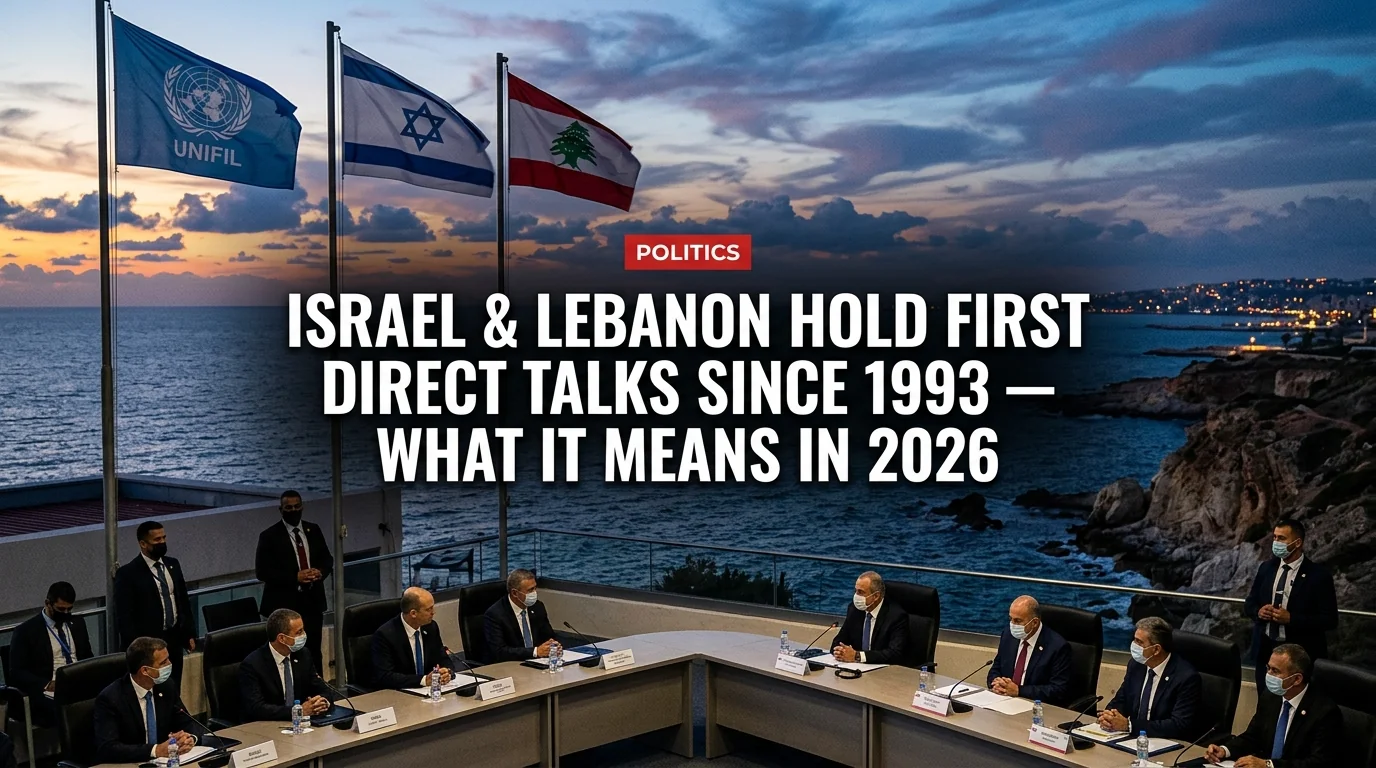
For the first time in more than three decades, Israeli and Lebanese officials sat across the table from each other in formal diplomatic negotiations. The historic meeting — brokered by Secretary of State Marco Rubio at the U.S. State Department in Washington, D.C. on April 14, 2026 — marks a potential turning point in a conflict that has simmered, and at times exploded, since the 1980s.
What Happened in the Room
The trilateral meeting brought together Secretary Rubio, Israeli Ambassador to the United States Yechiel Leiter, and Lebanese Ambassador Nada Hamadeh Moawad. Rubio's counselor Michael Needham and U.S. Ambassador to Lebanon Michel Issa also attended.
Talks began at 11:00 a.m. Eastern (15:00 GMT) and lasted several hours. The official readout from the State Department described "productive discussions on steps toward launching direct negotiations" between the two countries — carefully worded language that stops short of declaring a breakthrough, but signals real progress.
All three sides agreed in principle to hold formal direct negotiations at a "mutually agreed time and venue" — meaning the real talks have not started yet, but today's meeting established that they will.
Why This Matters Now
The timing is not coincidental. The broader Middle East is in flux:
- The U.S. military blockade of US-Iran Hormuz blockade 2026ian ports is now in its second day, putting maximum pressure on Tehran.
- A two-week truce between Washington and Iran is set to expire within a week.
- The war between Israel and Hezbollah — which reignited last month — has pushed Lebanon to the edge of a new humanitarian crisis.
For Lebanon's president, the meeting carries both hope and urgency. He told reporters before entering the State Department that stability will not return to the south if Israel continues to occupy its lands — a pointed reference to Israeli troop presence in Lebanese border territory that has persisted since 2024.
Israel, for its part, is pushing for something far broader than a ceasefire. Israeli officials used the meeting to call for full disarmament of all non-state terror groups — meaning Hezbollah — and the dismantling of what they called terror infrastructure across Lebanon. That demand is a non-starter for Hezbollah and for parts of the Lebanese government, but Israel's presence at the table at all is significant.
What Each Side Wants
- Full disarmament of Hezbollah
- Destruction of cross-border tunnel networks
- Formal recognition of border demarcation
- Long-term security buffer in southern Lebanon
- Full Israeli military withdrawal from Lebanese territory
- Immediate ceasefire and end to airstrikes
- Implementation of November 2024 hostilities agreement
- Humanitarian aid access and reconstruction
The gap between these positions is enormous. But diplomats familiar with the region note that even sitting in the same room — something neither side was willing to do for 33 years — represents a significant shift in calculus.
Hezbollah's Reaction: Fierce Opposition
Hezbollah Secretary-General Naim Qassem wasted no time condemning the talks, calling them a "free concession" to Israel and the United States. His statement, released within hours of the meeting, described Lebanese participation as a betrayal of Palestinian rights and regional resistance.
The reaction underscores the core tension: the Lebanese government and Hezbollah are not the same entity, but Hezbollah operates as a state-within-a-state and maintains veto power over many of Lebanon's strategic decisions. Whether the Lebanese government can advance a diplomatic track over Hezbollah's objections — and survive politically — remains the central question.
- First direct Israel-Lebanon talks since 1993
- Meeting brokered by U.S. Secretary of State Marco Rubio
- Held at the U.S. State Department, Washington D.C.
- Hezbollah condemned the talks as a free concession
- Both sides agreed to hold formal negotiations at a future date and venue
- U.S. hopes talks will exceed the scope of the 2024 ceasefire agreement
What Comes Next
Today's meeting was a first step — a statement of intent. The real negotiations, whenever they occur, will face a long list of unresolved disputes: border demarcation, Hezbollah's weapons, Israeli troop withdrawal, prisoner exchanges, and the broader question of whether any Lebanese government can deliver commitments made in Washington.
The United States has made clear it wants more than another ceasefire. The State Department explicitly said it hopes talks will exceed the scope of the 2024 agreement — a signal that Washington is pushing for something closer to a permanent peace arrangement, possibly modeled on the Abraham Accords framework that normalized relations between Israel and Gulf states.
That is an ambitious goal. Lebanon is not the UAE or Bahrain. The country hosts Hezbollah, is deeply divided politically, and carries wounds from multiple wars with Israel. But for one afternoon in Washington, the two countries were at least in the same building — and that has not happened in a very long time.
The next 72 hours will be critical. With the Iran truce expiring soon and U.S. pressure on Tehran at a peak, the regional dynamic could shift rapidly in either direction. Diplomats warn that if the Iran situation deteriorates, any momentum from today's Lebanon talks could be quickly overtaken by events.