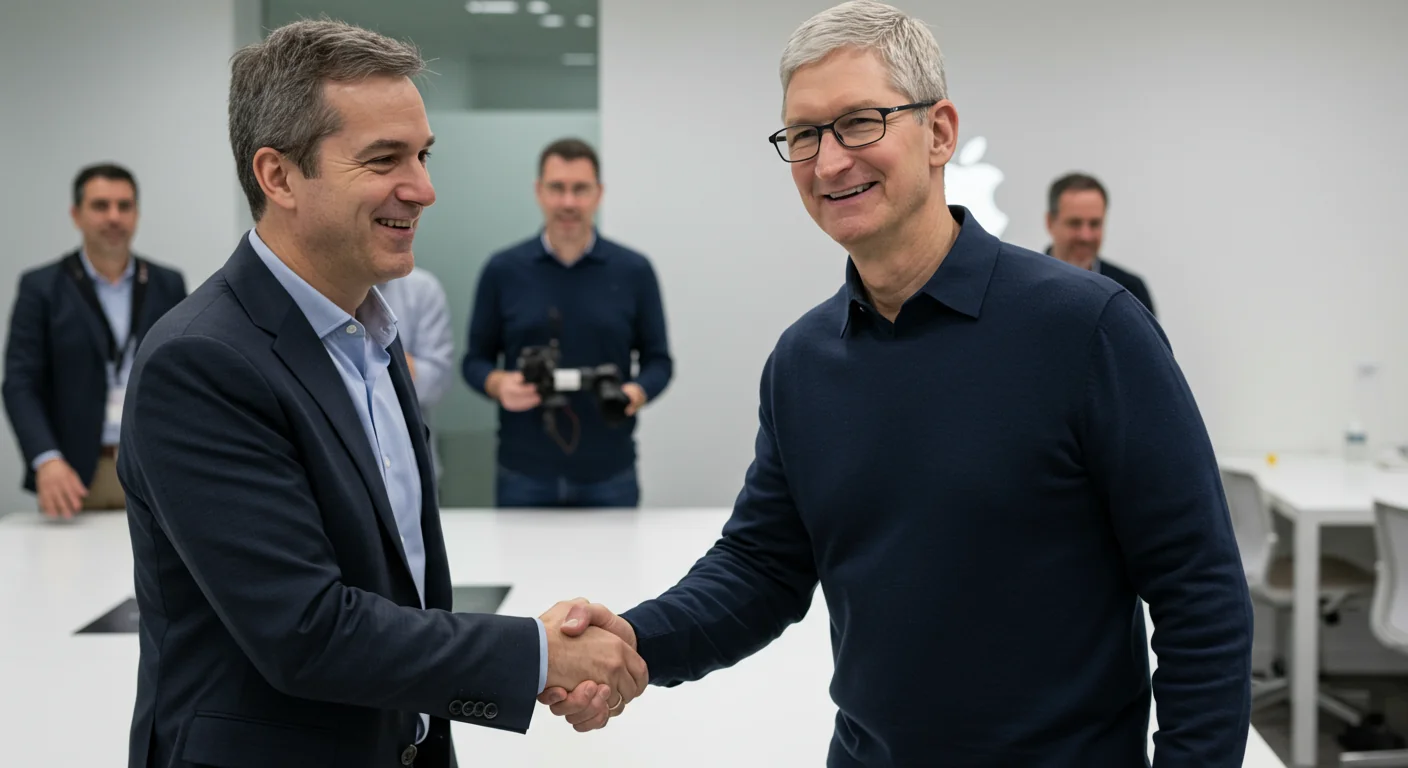
Apple confirmed on April 20, 2026 that Tim Cook will step down as CEO on September 1, 2026 — ending a 15-year run that turned the company into the most valuable business in history. John Ternus, Apple's senior vice president of Hardware Engineering, will become the third CEO in Apple's history.
Cook will stay on as Executive Chairman of the Board, helping Ternus with policy engagement and a smooth leadership transition. The change was approved unanimously by Apple's board of directors.
Why Now? The Pressure Behind the Transition
The timing isn't accidental. Apple has faced mounting criticism over its artificial intelligence strategy — or what critics say is the absence of one. While Microsoft, Google, Amazon, and Meta each committed hundreds of billions of dollars to AI infrastructure in 2025 and 2026, Apple moved cautiously, prioritizing privacy and margins over raw AI capability.
Apple Intelligence, launched in 2024, landed to mixed reviews. Its Siri overhaul was delayed. ChatGPT and Gemini dominated headlines. Investors grew restless.
Cook spent his tenure turning Apple into a services juggernaut — App Store, Apple TV+, Apple Music, iCloud — adding tens of billions in high-margin recurring revenue. But the next frontier is AI, and the board wants a new voice at the top to drive that chapter.
Who Is John Ternus?
If you haven't heard of John Ternus, you're not alone. He's been one of Apple's most quietly powerful executives for years — the person responsible for the hardware you hold in your hands.
Ternus, 50, joined Apple in 2001 as a product design engineer straight after earning a mechanical engineering degree from the University of Pennsylvania. He worked his way up, becoming VP of Hardware Engineering in 2013 and joining the senior executive team in 2021.
He's the person who oversaw:
- The transition from Intel to Apple Silicon (M1, M2, M3, M4 chips)
- The iPhone 15 Pro's titanium design
- Vision Pro's hardware architecture
- AirPods Pro's computational audio engine
- Joined Apple: 2001
- Became SVP Hardware Engineering: 2021
- Age: 50
- Education: Mechanical Engineering, University of Pennsylvania
- Products he oversaw: iPhone, Mac, iPad, Apple Watch, AirPods, Vision Pro
Ternus is known inside Apple as decisive and detail-obsessed — qualities Bloomberg called "Jobs-era decisiveness" in a headline that circulated widely after the announcement. Whether that comparison holds up under the scrutiny of being CEO remains to be seen.
What Changes Under Ternus — and What Doesn't
The obvious question: does a hardware engineering chief understand software, services, and AI well enough to run the world's most valuable company?
The optimistic view: Apple's greatest competitive advantages have always been hardware-software integration. The M-series chips, custom neural engines, and on-device processing are what make Apple Intelligence possible without sending your data to a cloud server. A hardware CEO could double down on that edge.
The skeptical view: services now generate over $100 billion annually for Apple. The App Store is under regulatory assault on three continents. Vision Pro needs a reason to exist. These aren't hardware problems.
- Deep product expertise across every Apple hardware line
- Trusted inside Apple — seen as Jobs-era decisiveness
- On-device AI focus plays to Apple's privacy brand
- No culture shock — internal promotion, not outside hire
- No public track record managing software or services
- Inherits a lagging AI strategy in a fast-moving race
- Regulatory battles (App Store, EU DMA) are his to fight
- Vision Pro still lacks a clear mainstream use case
Apple's AI Roadmap Under New Leadership
Ternus inherits a product pipeline that's reportedly more ambitious than Apple has let on publicly. Confirmed or credibly leaked projects include:
Siri-enabled smart glasses — competing directly with Meta Ray-Bans, expected late 2026 or 2027.
An AI pendant device — a small wearable that acts as an ambient AI assistant, described internally as "the next AirPods."
AirPods with cameras — embedding visual sensing into earbuds for real-time environmental awareness.
All three projects are hardware-first, which means Ternus comes in with a running start on the product roadmap he himself helped build.
Tim Cook's Legacy: The Numbers
It's worth pausing on what Cook actually built. When Steve Jobs died in October 2011, Apple was worth roughly $350 billion. Cook took over a company many analysts said was too dependent on Jobs's vision to survive without him.
He was wrong.
Under Cook, Apple became the first company to hit $1 trillion in market cap (2018), $2 trillion (2020), and $3 trillion (2022). He launched Apple Pay, Apple Watch, AirPods, and Apple TV+. He navigated trade wars, a global pandemic, and the most complex supply chain in consumer electronics.
His role as Executive Chairman means he won't disappear — particularly valuable for the geopolitical relationship management he's built with China over 15 years, at a time when US-China tech tensions remain high.
What This Means for Apple Investors
Short term, expect volatility. CEO transitions at trillion-dollar companies always create uncertainty. The key question analysts are asking: will Ternus continue Cook's capital return program (dividends + buybacks that returned over $150 billion to shareholders in 2025 alone), or will he redirect cash toward AI capex?
If Apple decides it needs its own AI data centers and chips at scale — competing head-on with Microsoft and Google — expect capital expenditure to balloon. If Ternus stays the course on on-device AI and privacy-first architecture, margins stay high.
The September 1 transition date gives the market roughly four months to price in the uncertainty. Watch Q3 earnings in August — likely the last major event under Cook's direct leadership — for any signals on how the board is thinking about AI investment going forward.
For consumers, the near-term answer is simpler: the iPhone 18, expected this fall, will be Ternus's first product launch as CEO. Its AI features will be the first real test of whether the new regime can answer the question that's been hanging over Apple for two years: is Apple Intelligence actually good?