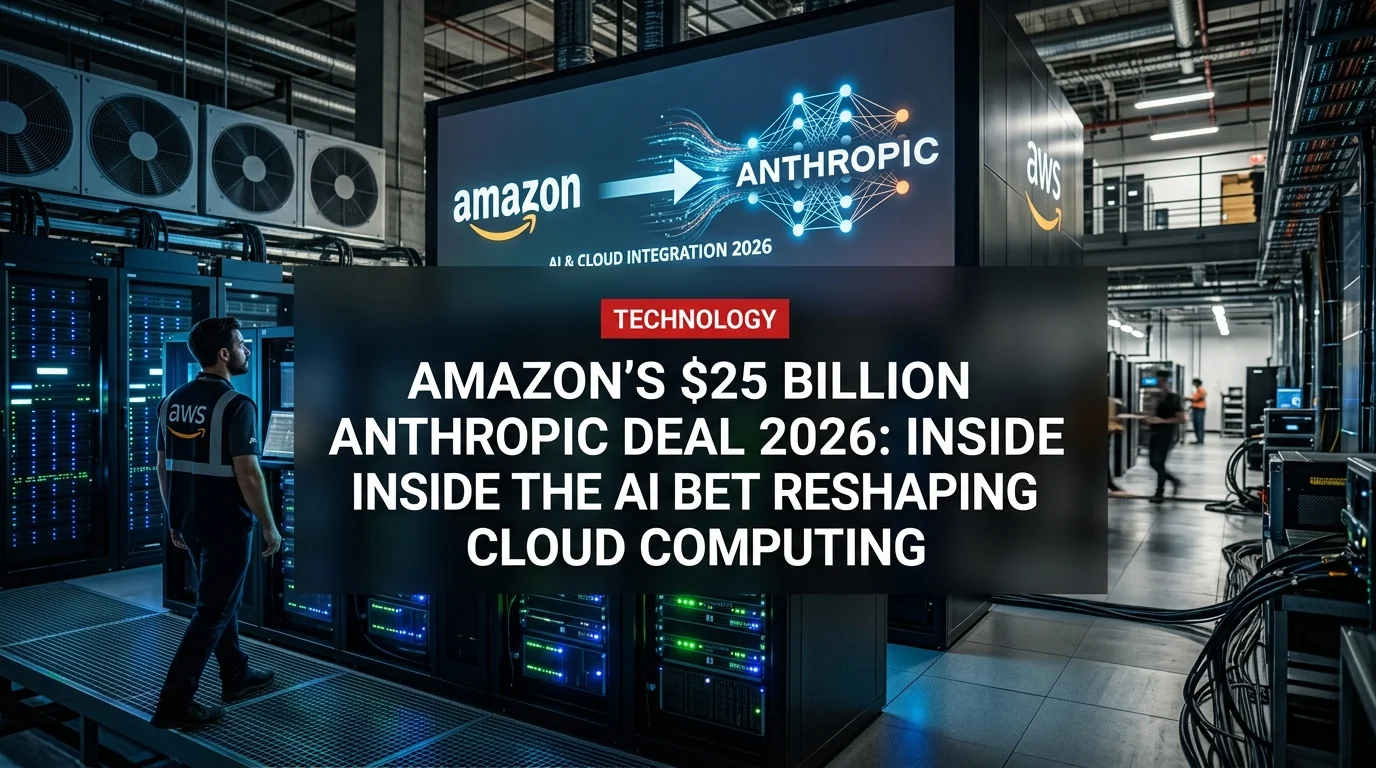
Amazon dropped one of the biggest AI infrastructure deals in history on Monday, announcing it will invest up to $25 billion in Anthropic — the maker of Claude AI — while the AI startup commits to spending more than $100 billion on AWS over the next decade. The move cements Amazon's position as the backbone of the AI economy and signals that the cloud war is now, fundamentally, an AI war.
What Amazon Is Actually Paying
The deal isn't a single check. Amazon is writing an immediate $5 billion investment in Anthropic at the company's current valuation of $380 billion — making Anthropic one of the most valuable private companies on Earth. The remaining $20 billion is conditional, tied to commercial milestones the two companies haven't fully disclosed.
That $380 billion valuation is staggering context. Two years ago, Anthropic was valued at $18 billion. The company has grown more than 20× in valuation in roughly 24 months — driven by Claude's rapid commercial adoption in enterprise and developer markets.
Amazon's total exposure to Anthropic now exceeds $33 billion when counting prior investments, making it by far the largest outside backer of any AI lab in history.
The $100 Billion AWS Lock-In
The more strategically significant number isn't the $25 billion investment — it's Anthropic's commitment to spend over $100 billion on AWS over 10 years. For Amazon Web Services, this is transformational.
That compute commitment covers Amazon's proprietary Trainium AI chips and Graviton processors — hardware Amazon has spent billions developing specifically to compete with Nvidia's dominance in AI infrastructure. Getting Anthropic to commit to Trainium at scale is a massive validation for chips that have struggled to gain broad third-party adoption.
Anthropics also secured access to 5 gigawatts of compute capacity — an almost incomprehensible amount of power for training and running frontier AI models. For reference, 5 gigawatts is roughly the output of five nuclear reactors running continuously.
What Customers Get
For AWS enterprise customers, the deal brings a tangible immediate benefit: the ability to access the full Anthropic-native Claude console directly from within AWS — using existing AWS contracts, credentials, and billing. No separate Anthropic account needed.
This is meaningful friction removal. Enterprise IT teams have historically pushed back on adopting new AI tools that require new vendor relationships. Embedding Claude into the AWS console makes it a first-class service rather than a third-party integration.
Why Amazon Is Doubling Down Now
The timing isn't coincidental. Two months ago, Amazon struck a comparable deal with Anthropic's biggest rival: a $50 billion investment in OpenAI paired with a $100 billion cloud commitment. That deal drew immediate criticism — Amazon was seen as paying top dollar to prop up the company most likely to commoditize AI and undercut AWS's margins.
The Anthropic deal answers that criticism directly. Amazon isn't picking winners in the AI model race — it's ensuring that whoever wins, the compute runs on AWS. It's the same playbook that made AWS dominant in the web era: be the infrastructure layer, not the application.
- Invest in multiple frontier labs (OpenAI + Anthropic)
- Lock in compute commitments on AWS
- Build proprietary chips (Trainium, Graviton)
- Embed AI natively into AWS console
- Deep exclusive bet on OpenAI
- Integrate AI into Office/Azure suite
- Build Azure AI Foundry ecosystem
- Copilot as the primary interface layer
Where Anthropic Stands in the AI Race
The deal reflects Anthropic's position as a genuine tier-1 AI lab — not a ChatGPT alternative, but a peer competitor with distinct enterprise advantages.
Anthropic released Claude Opus 4.7 on April 16, which currently leads SWE-bench Pro with a 64.3% score on real-world software engineering tasks — 6.6 points ahead of GPT-5.4's 57.7%. Claude's Constitutional AI approach, its emphasis on safety, and its strong reasoning capabilities have attracted significant enterprise contracts from companies in financial services, healthcare, and legal sectors.
With $100 billion in compute locked in and $25 billion in fresh capital, Anthropic can now train the next generation of models at a scale previously only available to OpenAI and Google DeepMind.
What This Means for the AI Industry
The broader implication is a structural shift in how AI development gets financed. Frontier model training now requires capital at the scale of sovereign wealth funds — and the companies with the balance sheets to write those checks (Amazon, Microsoft, Google) are increasingly using AI investment as a lever to lock in cloud commitments.
- Amazon has now committed $33B+ total to Anthropic across multiple rounds
- Anthropic's $100B AWS commitment rivals OpenAI's Microsoft Azure deal in scale
- The 5 GW compute agreement is one of the largest single AI infrastructure commitments ever
- Anthropic's valuation has grown 20× in roughly 24 months
- AWS customers get seamless Claude access without new vendor contracts
For enterprises evaluating AI vendor strategy, the message is clear: Claude and AWS are now deeply co-invested. For developers, it means Anthropic will have the compute headroom to train significantly more capable models over the next several years.
For Amazon, it's a calculated hedge — billions spent to ensure that no matter which AI lab writes the models powering the next decade of software, the electricity bill comes to AWS.
The Bottom Line
This is the largest AI infrastructure deal in history by most measures — and it signals that the AI industry's capital requirements have officially moved beyond what any single company can self-fund. The cloud giants aren't just customers of AI anymore. They are, structurally, co-owners of the AI frontier.