
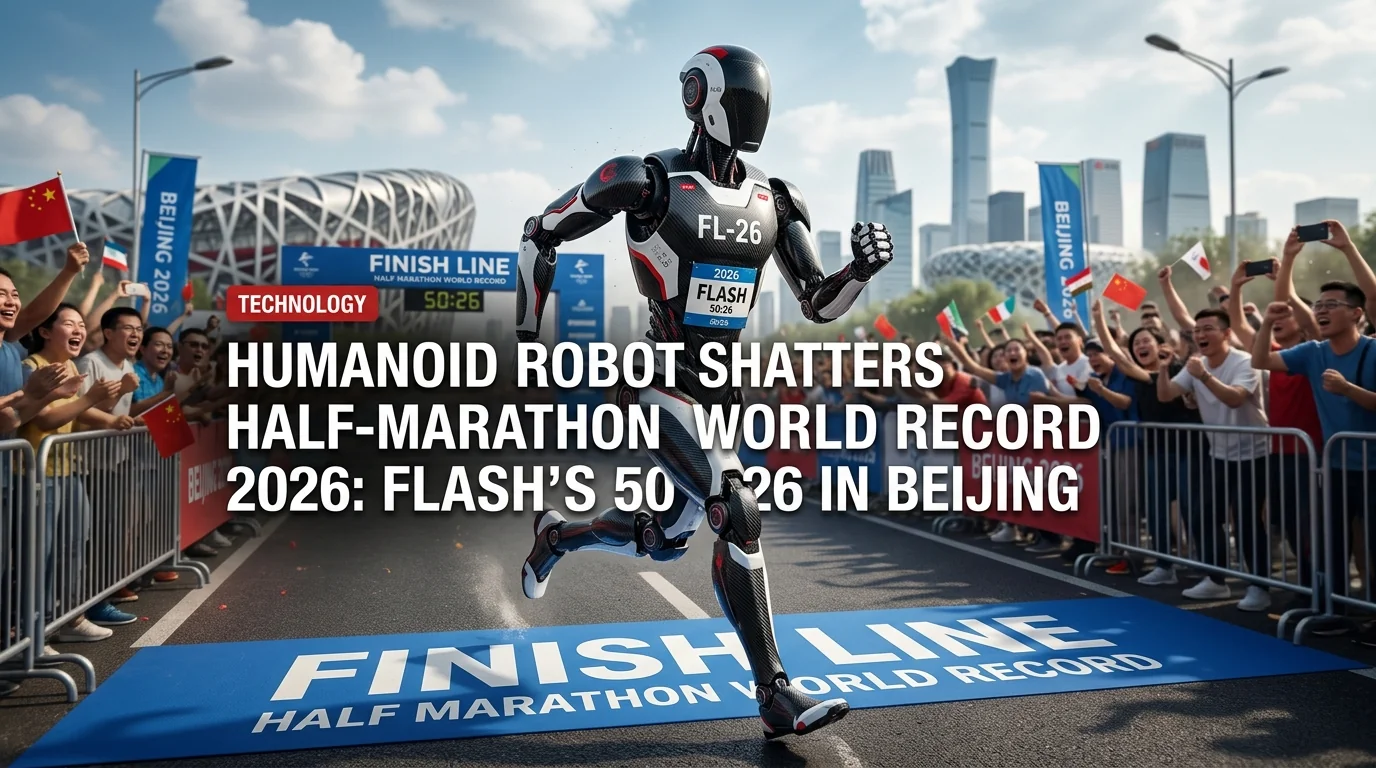
On Sunday, April 19, 2026, a humanoid robot named "Flash" did something no human has ever done: ran a half-marathon in under 51 minutes. Read our full in-depth analysis of the Beijing race for more details. Flash clocked 50 minutes and 26 seconds at the Beijing E-Town Half-Marathon — shattering the human world record of 57:20 by nearly 7 full minutes.
This isn't science fiction. It happened in front of thousands of spectators on the streets of Yizhuang, in Beijing's south. In what's becoming one of the most-watched athletic spectacles in Asia alongside events like the 2026 FIFA World Cup. And it represents a jaw-dropping leap in robotics that caught most of the world off guard.
What Happened
The 2026 Beijing E-Town Half-Marathon added a humanoid robot division for the second consecutive year. Robots and humans ran simultaneously but in separate lanes — a practical safety measure that also made for a striking visual: bipedal machines sprinting down the same course as elite human runners.
Flash, built by Shenzhen Honor Smart Technology — an arm of Chinese smartphone giant Honor — competed in the autonomous navigation category. This means the robot ran the full 21.1 km (13.1 miles) without any remote control from operators. It navigated obstacles, turns, and the crowd-lined course entirely on its own.
The result: 50 minutes, 26 seconds. Average speed: roughly 25 km/h (15.5 mph).
How Far Robots Have Come — In One Year
This result is even more astonishing in context. At the 2025 Beijing Half-Marathon, the winning robot clocked 2 hours, 40 minutes. That's more than double the time of the 2025 human winner.
In a single year, humanoid robot performance in long-distance running improved by over three hours.
For comparison: the improvement in the human world record for the half-marathon from 2020 to 2026 is measured in seconds. Flash's leap is measured in hours.
Who Built Flash?
Flash was developed by Shenzhen Honor Smart Technology Development Co., Ltd. — a subsidiary of Honor, the Chinese electronics company spun off from Huawei in 2020. Honor is best known for smartphones but has been quietly investing in humanoid robotics alongside dozens of other Chinese technology companies.
Honor robots actually claimed the top three positions in the autonomous navigation category at Sunday's race — an extraordinary sweep that signals a coordinated engineering effort, not a one-off result.
Two Ways Robots Competed
The robot division had two competition formats:
Remote control: Robots operated by human handlers via remote systems. Useful for demonstrating hardware, but not a test of AI autonomy.
Autonomous navigation: Robots run entirely independently, using onboard sensors and AI to navigate the course. Flash won this category — the more technologically significant of the two.
The autonomous format is the one that matters for the future of robotics. A robot that can navigate a 21 km course through a real urban environment without human input is doing something fundamentally different from a factory robot following programmed motions.
What This Actually Means for Robotics
The obvious headline is "robot beats human world record." But the deeper story is what this performance reveals about the pace of humanoid robot development in China.
Energy efficiency at scale. Running 21 km at 25 km/h requires sustained power output, thermal management, and joint mechanics that need to stay functional for 50 minutes. Industrial robots do repetitive tasks, not multi-kilometer endurance events. Flash's result shows engineering advances in battery density, actuation, and heat dissipation.
Real-world navigation. Controlled warehouse environments are easy. A real road course with curves, crowds, and varied terrain is much harder. Autonomous completion at competitive speed is a significant milestone.
Speed of progress. The 2025-to-2026 improvement — from 2:40 to 0:50 — suggests these systems are on an exponential improvement curve, not a linear one.
Chinese robotics dominance. China's humanoid robot push is systemic, not isolated. Companies like UBTECH, Unitree, and now Honor's division are producing commercially viable humanoid robots at a pace that has surprised Western competitors.
- Honor robots took all three top spots in the autonomous navigation category
- The robot and human divisions ran simultaneously but in separate lanes for safety
- Flash's time of 50:26 is faster than any human has ever run a half-marathon
- The event is officially called the Beijing E-Town Half-Marathon
- The improvement from 2025 to 2026 is more than 110 minutes of race time
The Human Record Flash Beat
For reference, the human half-marathon world record of 57:20 was set by Jacob Kiplimo of Uganda in 2021. Kiplimo is one of the finest distance runners in history — an Olympic medalist and world champion. The record has improved by only 13 seconds since he set it.
Flash ran the same distance 6 minutes and 54 seconds faster.
What Comes Next?
The Beijing E-Town Half-Marathon isn't trying to replace human athletics — the robot and human divisions are entirely separate. But the event has become an annual showcase for just how quickly humanoid robotics is advancing.
If the 2025-to-2026 improvement rate continued, robots would theoretically break the 35-minute barrier by 2027. Practically, improvements will slow as they approach mechanical and thermodynamic limits — but the direction is clear.
The more interesting question isn't whether robots can run fast. It's what the engineering behind Flash — autonomous navigation, sustained high-speed movement, real-world terrain handling — means for practical applications: disaster response, logistics, healthcare, and manufacturing.
A robot that can run a half-marathon through a city street is a robot that can do a lot of things humans currently do.
The race was just a demonstration. What it demonstrated was the future arriving ahead of schedule.