
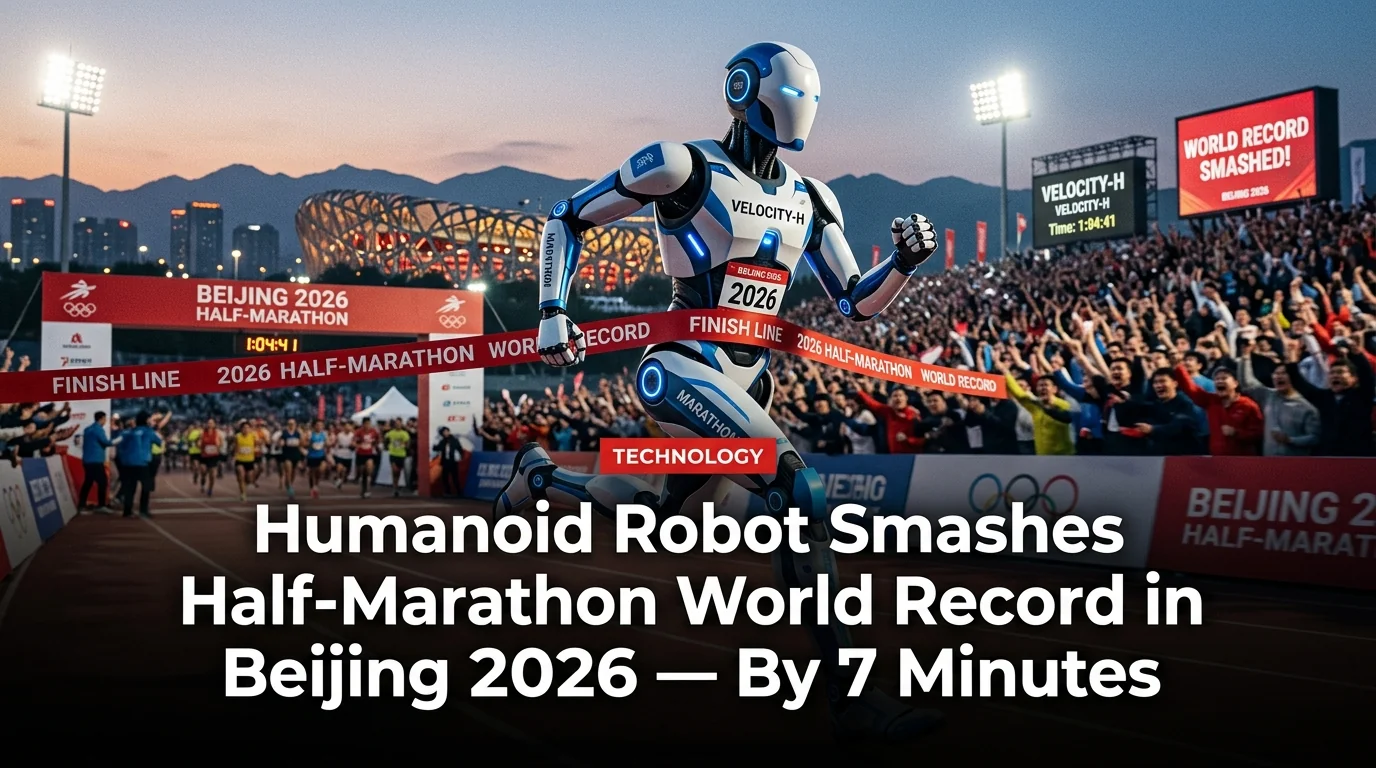
A humanoid robot just beat the human half-marathon world record — by nearly seven minutes.
On April 19, 2026, the streets of Beijing's E-Town district became the unlikely stage for one of robotics' most dramatic milestones. Honor's bright-red autonomous robot, nicknamed "Lightning," blazed through 21 kilometers in 50 minutes and 26 seconds — an event we first covered in our original race report, decisively outpacing Uganda's Jacob Kiplimo's human world record of roughly 57 minutes, set just weeks earlier in Lisbon.
What Actually Happened at the Race
The scale of the event was staggering. One hundred and twelve teams from 26 brands fielded more than 300 individual robots across the 13.1-mile course. This is one of the most-watched sporting events of 2026 — alongside the upcoming FIFA World Cup 2026. Five international teams — from Germany, France, and Brazil — joined Chinese competitors, though the podium was swept entirely by Honor.
Here's where it gets technically interesting: a separate Honor robot running via remote control crossed the finish line first with a time of 48 minutes and 19 seconds. But under race rules, remotely controlled entries had their net times multiplied by a 1.2 coefficient — a 20% penalty deliberately designed to push teams toward fully autonomous systems. That moved Lightning, which navigated the entire course independently, to the championship position.
Lightning did have one dramatic moment: it crashed into a railing near the finish line but recovered and completed the race. The crowd reportedly erupted.
How Honor's "Lightning" Was Built to Win
Lightning wasn't designed for marathons — it was engineered for them. Honor built the robot with legs measuring approximately 95 centimeters (about 37 inches), significantly longer than typical humanoid proportions. Longer legs mean longer stride and greater ground coverage per step, a fundamental biomechanical advantage.
The other key engineering choice: a powerful liquid-cooling system developed almost entirely in-house. Sustained high-speed locomotion generates enormous heat in the motors and actuators. Without active cooling, performance degrades rapidly — the robot slows, stumbles, or shuts down. Honor solved this to let Lightning maintain near-peak output for the full 21km.
China's Robotics Industry Is Not Playing Around
The race result didn't come from nowhere. It reflects years of systematic, government-backed investment in humanoid robotics and what China's tech sector calls "embodied AI" — artificial intelligence that operates in a physical body in the real world.
In 2025 alone, China invested 73.5 billion yuan (approximately $10.8 billion USD) in robotics and embodied AI, according to a government agency study. Developing humanoid robots and expanding their real-world applications is a core pillar of China's 2026–2030 economic plan.
The results are showing up in global rankings. London-based research group Omdia recently assessed the global humanoid robotics market and identified only three first-tier vendors by shipment volume — and all three are Chinese: AGIBOT, Unitree Robotics, and UBTech Robotics Corp.
What Changed Since Last Year
The contrast between the 2025 and 2026 races tells the real story of how fast this technology is moving.
At the inaugural 2025 event, 21 humanoid robots entered. Several stumbled at the starting line. Others veered off course. Some simply lay down and stopped. Only six managed to cross the finish line at all. The winner took 2 hours, 40 minutes.
One year later: 300+ robots completed the course, times were shattering human world records, and roughly 40% of teams competed in the fully autonomous category — meaning no human operator guiding the robot in real time.
What This Means Going Forward
The immediate question racing through the robotics community: how much faster can they get?
The human half-marathon world record represents something close to the absolute biological ceiling — decades of elite training, nutrition science, and selection of the world's most physiologically gifted runners. A humanoid robot beat it on its second attempt at a standardized race, having been nowhere close a year earlier.
The autonomous navigation aspect matters as much as the speed. These robots didn't have a human joystick operator threading them through 12,000 human runners. They perceived the course, avoided obstacles, maintained pace, and made real-time decisions independently. That's the capability that translates to real-world use cases: warehouses, hospitals, construction sites, disaster response.
- Fully autonomous navigation over 21km proved at scale
- Improvement trajectory suggests ongoing rapid gains
- Chinese manufacturers now lead global shipment rankings
- Race format (with autonomous bonus) incentivizes the right capabilities
- Performance in controlled race conditions doesn't equal industrial readiness
- Liquid cooling systems add weight and complexity for real-world deployment
- Robot crashed into railing near finish — edge-case handling still imperfect
- Cost of competition-grade humanoids remains prohibitive for mass deployment
For context, Boston Dynamics' Atlas — widely considered the gold standard of Western humanoid development — can run, jump, and perform backflips, but it has never entered a public race against human competitors at this scale.
China's approach has been different: high-volume competition, public benchmarking, and government incentives aligned with performance milestones. The Beijing half-marathon is less a sporting event and more a national capability demonstration, run annually in front of cameras to signal where the technology stands.
Based on last year's trajectory, that's going to be somewhere considerably faster by April 2027.
The 2026 Beijing E-Town Humanoid Half Marathon took place on April 19, 2026. Honor's autonomous robot "Lightning" won with a time of 50 minutes and 26 seconds.