
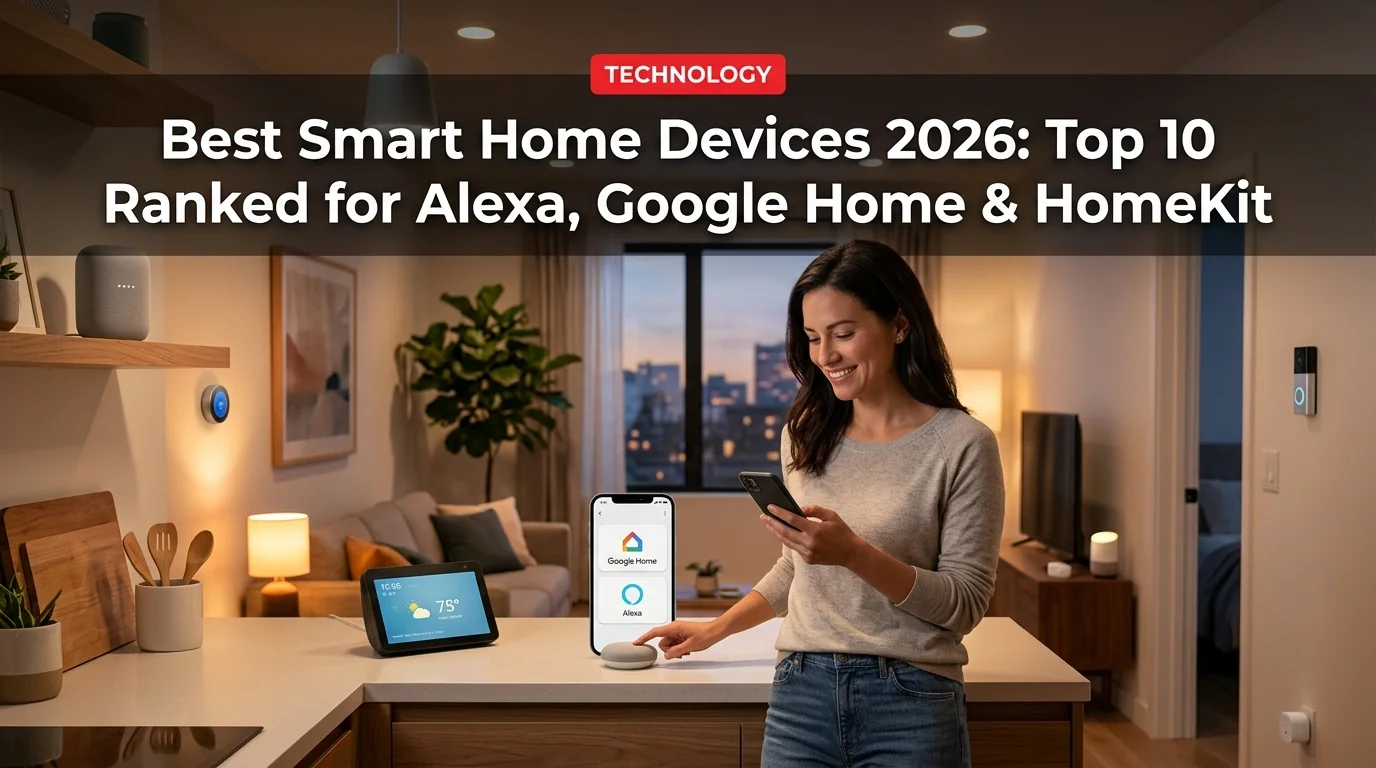
Building a smart home in 2026 is easier than ever — but choosing the wrong devices means fighting with incompatible ecosystems or replacing everything in two years. This guide ranks the 10 best smart home devices by category, covers which platforms they work with, and tells you exactly what to buy first if you're starting from scratch.
Which Smart Home Platform Should You Use?
Before buying a single device, pick your ecosystem. Almost everything else flows from this choice.
- Amazon Alexa — Widest device compatibility, best for budget buyers, strongest shopping integration. Works with 140,000+ devices.
- Google Home — Best voice search and AI features, tight Nest integration, strong for Android/Google Workspace users.
- Apple HomeKit — Most private (all processing stays on-device), best for iPhone households, stricter but growing device support.
- Matter — The new universal standard. Devices with Matter work across Alexa, Google Home, and HomeKit simultaneously. Look for the Matter logo when buying — it future-proofs your purchase.
The 10 Best Smart Home Devices of 2026
1. Amazon Echo Hub — Best Smart Home Controller
The Echo Hub is an 8-inch wall-mounted smart home control panel that replaces the need for a separate smart home app. It shows all your device statuses, security cameras, and routines in one place — and controls everything via touch or voice.
Price: ~$179
Works with: Alexa, Matter, Zigbee, Z-Wave, Bluetooth
Best for: Households with 10+ smart devices who want a central control point
2. Google Nest Learning Thermostat (4th Gen) — Best Smart Thermostat
The 4th-gen Nest Learning Thermostat added a full-colour display, improved AI scheduling that adapts to your routine in about a week, and tighter integration with Google Home's energy dashboard. It pays for itself in most homes within 12–18 months.
Price: ~$279
Works with: Google Home, Alexa, Apple HomeKit (via Matter bridge)
Best for: Homeowners who want hands-off energy savings
3. Ring Battery Doorbell Pro 2 — Best Video Doorbell
Ring's Battery Doorbell Pro 2 delivers 1536p head-to-toe video, colour night vision, and package detection without requiring hardwired installation. The rechargeable battery lasts 6–12 months, and it integrates with Alexa for live view on Echo Show devices.
Price: ~$199 (+ optional Ring Protect subscription for cloud storage at $4.99/month)
Works with: Alexa, Google Home (limited), IFTTT
Best for: Renters or homeowners who can't hardwire a doorbell
4. Arlo Pro 5S — Best Outdoor Security Camera
The Arlo Pro 5S is the top-rated outdoor camera in 2026 for a reason: 4K HDR resolution, colour night vision, 180° field of view, integrated spotlight, and a 6-month rechargeable battery. It works across Alexa, Google Home, and Apple HomeKit — a rare trifecta.
Price: ~$229 per camera
Works with: Alexa, Google Home, Apple HomeKit
Best for: Anyone who wants premium outdoor security without monthly fees (local storage included)
5. Amazon Echo Show 10 — Best Smart Display
The Echo Show 10 has a motorized screen that tracks you as you move around the kitchen — genuinely useful for video calls and recipe walkthroughs. 13MP camera, 10-inch display, and full Alexa hub functionality make it the best all-around smart display.
Price: ~$249
Works with: Alexa, Matter, Zigbee
Best for: Kitchen hub, video calls, monitoring other smart home devices visually
- Matter support means 2026 devices work across all ecosystems
- Smart thermostats typically pay for themselves within 18 months
- Battery-powered cameras and doorbells work in rentals with no wiring
- Voice control has become genuinely reliable — far fewer misfire commands than in 2021
- Entry-level smart plugs and bulbs still cost under $10 each
- Premium smart home setups (hub + cameras + thermostat + locks) easily hit $800–$1500
- Ring and Nest cameras push monthly subscriptions for full cloud storage
- Smart locks still require careful installation and compatible deadbolt hardware
- Apple HomeKit still has the most limited device selection despite growth
6. Yale Assure Lock 2 — Best Smart Lock
The Yale Assure Lock 2 is the most compatible smart lock on the market — supporting Alexa, Google Home, Apple HomeKit, Samsung SmartThings, and Matter simultaneously. It has a keypad, auto-lock, and activity log, and doesn't require a hub.
Price: ~$199
Works with: Alexa, Google Home, Apple HomeKit, SmartThings, Matter
Best for: Smart lock newcomers who want maximum compatibility
7. Philips Hue Starter Kit (E27, 4 bulbs) — Best Smart Lighting
Philips Hue remains the gold standard for smart lighting: 16 million colours, scene syncing with TV and music, and an ecosystem of switches, motion sensors, and gradient strips. The Hue Bridge enables local processing (no cloud dependency) and works across all major platforms.
Price: ~$149 (4-bulb starter kit with Bridge)
Works with: Alexa, Google Home, Apple HomeKit, Matter
Best for: Anyone who wants serious smart lighting beyond basic on/off scheduling
8. Kasa Smart Plug (EP25) — Best Smart Plug
The Kasa EP25 is an energy-monitoring smart plug that works with Alexa and Google Home, fits a standard outlet without blocking the second socket, and costs under $15 each. It shows real-time and monthly energy usage — useful for identifying appliances that waste power on standby.
Price: ~$13–15 each
Works with: Alexa, Google Home
Best for: Budget-conscious buyers starting their smart home without spending much
9. Google Nest Protect — Best Smart Smoke Detector
Nest Protect does what basic smoke detectors can't: it speaks out loud to tell you what's wrong and where ("Smoke detected in the kitchen"), sends phone notifications, and self-tests monthly. It integrates with Google Home and can shut off your furnace automatically when smoke is detected.
Price: ~$119
Works with: Google Home, Alexa (limited)
Best for: Homeowners who want a safety upgrade that actually improves on cheap detectors
10. Amazon Echo Dot (5th Gen) — Best Budget Smart Speaker
At $49, the Echo Dot 5th Gen packs a surprisingly good speaker, Alexa built in, and a temperature sensor that can trigger automations when it gets too hot or cold. It's the best entry point for Alexa households or anyone who just wants basic voice control without spending much.
Price: ~$49
Works with: Alexa, Matter (limited)
Best for: Bedrooms, kids' rooms, or anyone new to smart home voice control
Best Smart Home Starter Setup by Budget
- Under $100: Echo Dot (5th Gen) + 2x Kasa Smart Plugs — voice control and smart scheduling for two outlets
- Under $300: Echo Dot + Nest Thermostat + 2 Kasa plugs — the energy-saving core of any smart home
- Under $600: Add Ring doorbell + Arlo camera for security, plus Philips Hue starter kit
- Full setup: Add Yale smart lock, Echo Hub, and Nest Protect for a comprehensive system (~$900–$1,200)
- Single best first purchase: Smart thermostat — pays for itself, works immediately, no ecosystem lock-in
Matter vs Zigbee vs Z-Wave: Which Should You Care About?
- Works across Alexa, Google, Apple, SmartThings simultaneously
- No hub required for most devices
- Open standard — future-proof
- Requires Wi-Fi or Thread network
- Still growing — not all devices support it yet
- Proven, stable mesh networks
- Low power consumption — great for battery devices
- Requires a compatible hub (Echo, SmartThings, Hue Bridge)
- Ecosystem-locked — less flexible than Matter
- Large existing device library
For new buyers in 2026: prioritise Matter-certified devices. For existing Zigbee/Z-Wave setups, stay — switching everything over isn't worth it yet unless you're replacing anyway.
The Bottom Line
The best smart home setup in 2026 starts with an ecosystem choice (Alexa for budget flexibility, Google for Android users, Apple HomeKit for iPhone households), then builds around Matter-certified devices that work across all of them.
Start with a smart thermostat and a voice assistant — those two changes deliver the most tangible day-to-day value. Add a doorbell, outdoor camera, and smart lighting as budget allows. Within $600, you have a genuinely smart home that saves energy, improves security, and doesn't require picking up your phone for everyday tasks.