OpenAI is on track for one of the largest IPOs in American history — potentially valued at up to $1 trillion. Anthropic is not far behind. But a remarkable shift in public opinion is threatening to cloud both debuts, and the timing could not be worse.
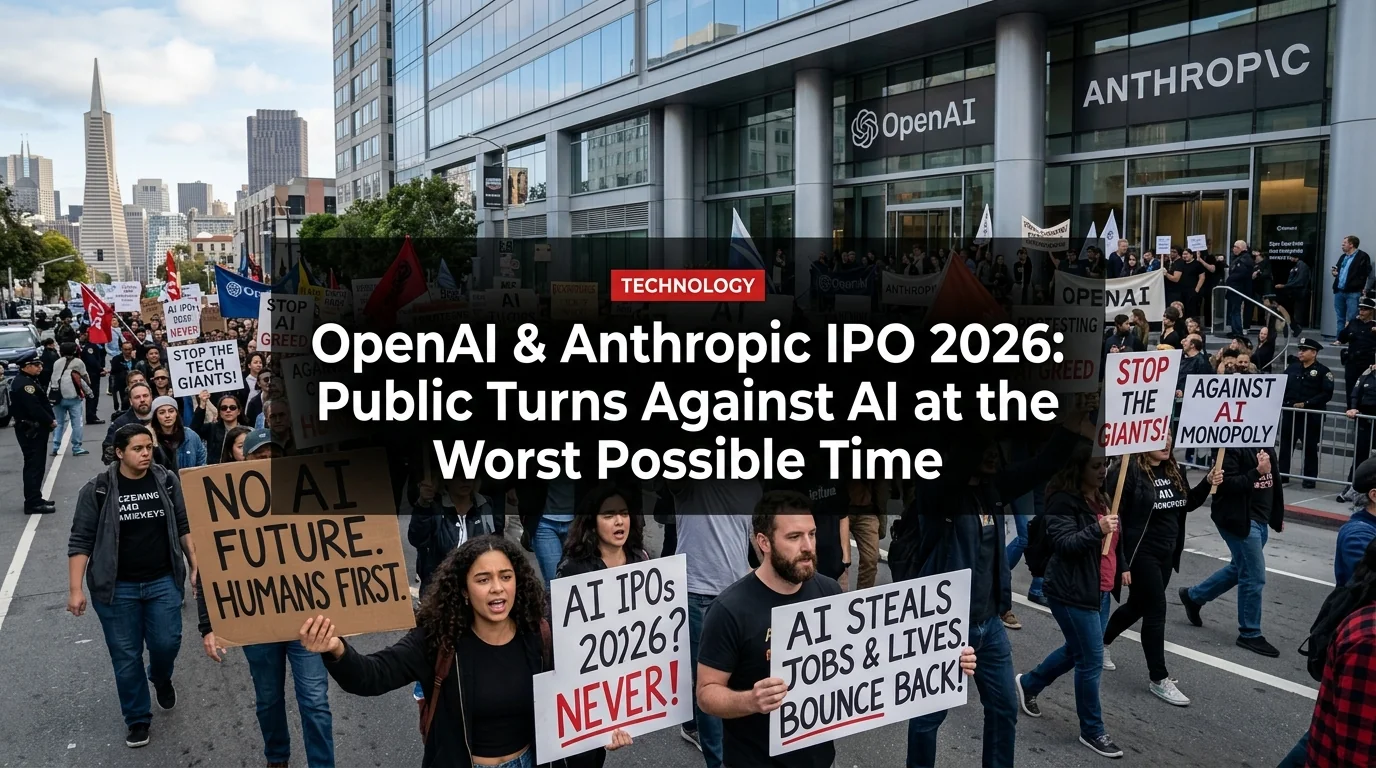
New polling data shows that 58% of Americans now view artificial intelligence negatively, up from 42% just a year ago. Gallup puts public approval of AI technologies at just 38% in 2026. Meanwhile, 57% of registered voters believe the risks of AI outweigh its benefits. For companies preparing landmark Wall Street listings, those numbers matter.
OpenAI Revenue vs. Reality Gap
On paper, OpenAI is a rocket ship. The company surpassed $25 billion in annualized revenue in February 2026, hitting that milestone in roughly 39 months — faster than Google, Salesforce, or Facebook at comparable stages. It closed the largest private funding round in history at $110 billion, and SoftBank committed a $40 billion bridge loan to smooth the path to a public listing.
But the financial picture is more complicated beneath the surface.
Projecting $14 billion in losses against $25 billion in revenue is not a typical growth-stage profile. It reflects the staggering compute costs of training and serving frontier AI models. For retail investors being offered IPO shares — OpenAI CFO Sarah Friar confirmed in April that retail allocation is planned — that is a number worth scrutinizing.
Why Public Opinion Has Turned
The backlash is being driven by three distinct forces that have converged in 2026.
Energy and environment. AI data centers are consuming power at a scale that is reshaping electricity grids across the United States and Europe. Environmentalists and local communities have become vocal opponents of new construction, and a growing number of states are introducing legislation to constrain expansion. This alone has shifted the political valence of AI from neutral to contested.
Job displacement fears. Approximately 78,557 tech workers have been laid off year-to-date in 2026, with nearly 48% of those layoffs directly linked to AI-driven automation. The abstraction that AI will create new jobs is wearing thin as real job losses mount in real communities.
Privacy and surveillance concerns. A survey found that 65% of respondents link AI to privacy violations. High-profile incidents — including a Molotov cocktail attack on OpenAI CEO Sam Altman's home by an individual motivated by anti-AI sentiment — have underscored how deeply personal these anxieties have become.
- OpenAI revenue growth is historically fast
- Enterprise demand shows no signs of slowing
- Anthropic Claude models are gaining market share
- $14B losses on $25B revenue is a tough sell
- 58% of Americans view AI negatively
- 40% of investor surveys show hesitation tied to public sentiment
The Anthropic Angle
Anthropic situation adds another layer of complexity. Fortune reported in April that Anthropic release of a model deemed too dangerous to publish has raised uncomfortable questions about what exactly is being built and who is accountable. TechCrunch noted that Anthropic rising profile is already giving some OpenAI investors second thoughts about where to allocate capital.
For Anthropic, its safety-first brand positioning was supposed to be a differentiator. But disclosing that you have built something too dangerous to release, right before an IPO, is a communications challenge that no amount of responsible AI framing can fully neutralize.
What the IPO Timing Means
OpenAI is targeting Q4 2026 for its public listing. Anthropic is weighing a similar window. That means both companies have roughly six months to either reverse the public sentiment slide or convince institutional investors that retail opinion does not move the needle on enterprise AI adoption.
The second argument has merit. The companies buying OpenAI API access and Anthropic Amazon's $25B Anthropic deal are enterprises — law firms, healthcare systems, financial institutions — not individual consumers who respond to Gallup polls. Enterprise demand has not softened; if anything, it is accelerating.
But public markets are different from private ones. Retail sentiment, press coverage, and political attention all feed into stock price volatility in ways that do not affect private valuations. An AI company trading on the NYSE in a period of broad anti-AI sentiment faces a different risk profile than the same company raising a private round from Tiger Global.
- OpenAI IPO target window: Q4 2026
- Targeting valuation: up to $1 trillion
- Public approval of AI (Gallup 2026): 38%
- Negative public view of AI: 58% (up from 42% in 2025)
- Tech layoffs YTD linked to AI automation: approximately 37,000 jobs
The Path Forward
For OpenAI and Anthropic to succeed in public markets, they likely need to do two things simultaneously: demonstrate a credible path to profitability, not just revenue growth, and proactively engage with the concerns driving negative public sentiment rather than hoping they fade.
The energy question, in particular, is not going away. Both companies are massive compute consumers. Until AI data centers can credibly point to renewable energy commitments with real timelines, the environmental critique will remain a live political issue — and a ready-made short thesis for anyone who wants to bet against the sector.
The trillion-dollar question is not whether OpenAI or Anthropic can generate revenue. They clearly can. The question is whether Wall Street — and the American public — will decide the costs are worth it.