
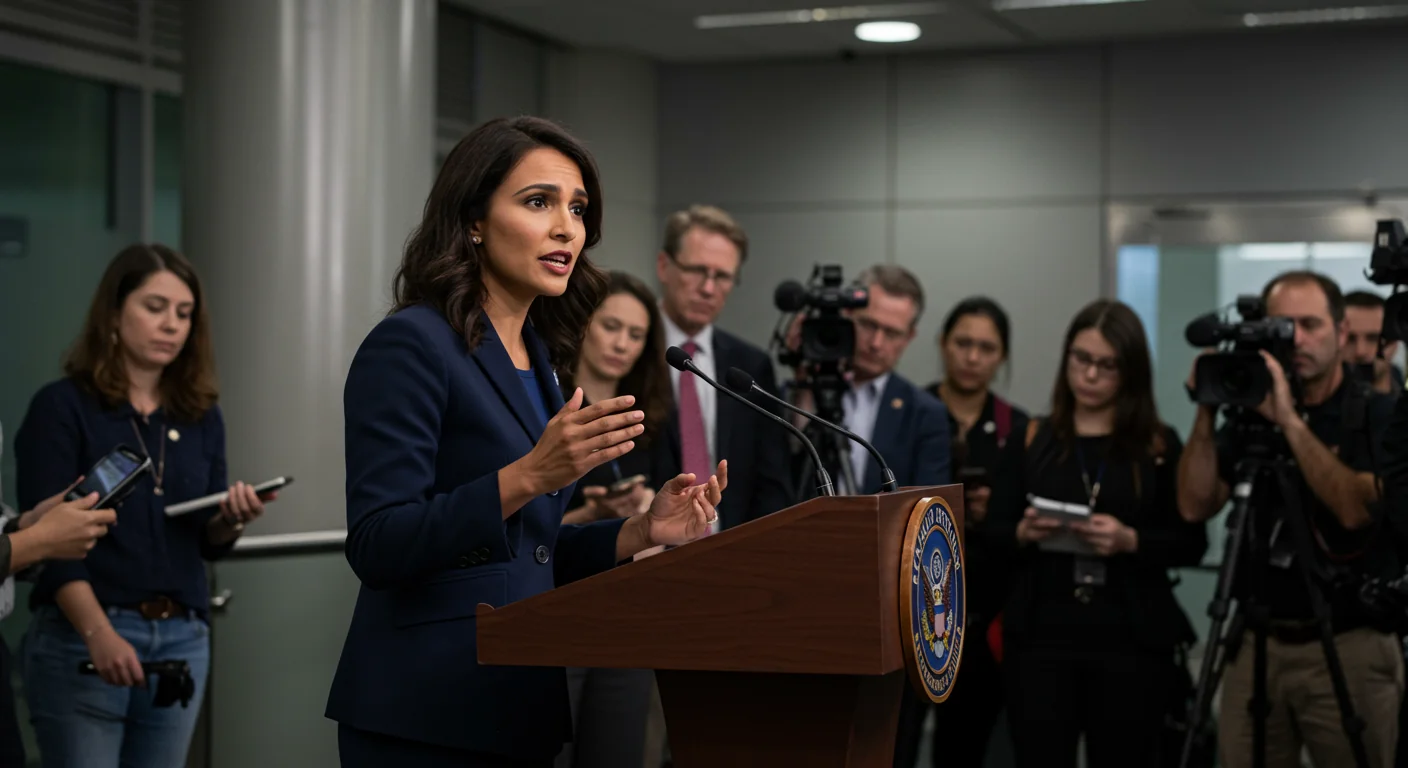
Director of National Intelligence Tulsi Gabbard has sent criminal referrals to the Justice Department targeting the whistleblower whose complaint triggered President Donald Trump's first impeachment in 2019 — escalating a years-long effort to relitigate one of the most consequential episodes in recent American political history.
The referrals name former CIA analyst Eric Ciaramella, widely identified as the whistleblower despite legal protections shielding his identity, and former Intelligence Community Inspector General Michael Atkinson, who initially deemed Ciaramella's complaint "urgent and credible" before forwarding it to Congress.
What Gabbard Released
Alongside the referrals, the Office of the Director of National Intelligence published a cache of previously classified documents that Gabbard described as proof of "a coordinated effort by elements within the Intelligence Community to manufacture a conspiracy" used as the basis for Trump's 2019 impeachment.
The impeachment centered on a phone call in which Trump pressured Ukrainian President Volodymyr Zelenskyy to investigate Joe Biden and his son Hunter. Ciaramella's complaint, filed in August 2019, set off a chain of events that led to the House voting to impeach Trump in December of that year. The Senate acquitted him in February 2020.
The released documents include internal communications, personnel evaluations, and procedural records from the intelligence community during the period surrounding the complaint. Gabbard's office said the materials had been improperly withheld from public review for over six years.
- Referrals target Eric Ciaramella (whistleblower) and Michael Atkinson (ex-ICIG)
- Ciaramella's 2019 complaint triggered Trump's first impeachment
- Atkinson forwarded the complaint to Congress after deeming it credible
- Specific criminal statutes cited in the referrals were not publicly disclosed
- DOJ will evaluate whether to open a formal investigation
What the Documents Actually Show
Independent review of the released documents tells a more complicated story than Gabbard's characterization. The materials do not substantiate a coordinated conspiracy to fabricate the underlying allegations. In fact, several documents include positive assessments of Ciaramella himself — colleagues described him as a "star performer," credible, and trustworthy.
Critics immediately pushed back on the framing. Legal experts and former intelligence officials noted that Atkinson followed the standard statutory process for handling whistleblower complaints, and that the Inspector General Reform Act required him to notify Congress after Trump initially blocked the complaint's transmission.
Some former national security officials also pointed out that the complaint's central allegation — that Trump sought foreign interference in a U.S. election — was later corroborated by the call transcript the White House itself released. Multiple witnesses who testified during the impeachment inquiry confirmed key details of the complaint independently.
The Legal Stakes for the Whistleblower
The move against Ciaramella is particularly charged. Whistleblower protection statutes were designed specifically to shield government employees who report potential misconduct from retaliation — including criminal prosecution. Legal scholars are divided on whether the protections Ciaramella received during the Trump impeachment proceedings extend to potential DOJ action now.
If prosecutors do pursue charges, the case would likely face immediate constitutional challenges. Defense attorneys would argue that prosecution itself constitutes illegal retaliation under existing whistleblower statutes, regardless of the outcome. The case could ultimately reach the Supreme Court, where the scope of whistleblower protections has never been tested in this specific context.
- Accountability for alleged IC overreach
- New document releases enable public scrutiny
- Referrals do not equal charges
- Whistleblower protections exist to prevent exactly this type of retaliation
- Documents released do not prove coordination or fabrication
- Chilling effect on future government whistleblowers
Atkinson's Role Under Scrutiny
Michael Atkinson served as the Intelligence Community Inspector General from 2018 to 2020, when Trump fired him — a move Trump attributed to a "lack of confidence." Atkinson has consistently maintained that he followed the law in processing Ciaramella's complaint. His supporters argue the referral is retaliatory and legally unfounded.
The specific statutes cited in the referrals against Atkinson have not been publicly disclosed by ODNI as of this writing. Former inspectors general from multiple federal agencies released a joint statement calling the referral "an attack on the independence of the inspector general system."
Broader Context: Revisiting the Impeachments
Gabbard's action is the latest in a series of moves by the Trump administration to revisit both of Trump's impeachments. Shortly after returning to office, the administration signaled interest in declassifying materials related to the Ukraine investigation.
The timing — more than six years after the original complaint — has drawn scrutiny from legal observers, some of whom question whether charges could survive statute of limitations challenges depending on which statutes prosecutors might invoke.
Previous attempts to identify and publicly name the whistleblower were blocked by bipartisan Senate agreement during the impeachment trial. That consensus has clearly broken down.
What Happens Next
The Justice Department will now review the referrals and decide whether to open a formal investigation. DOJ typically evaluates such referrals internally without public announcement. Given that the current administration is led by Trump, observers on both sides of the political spectrum expect the referrals to receive serious attention from prosecutors.
Civil liberties groups including the Government Accountability Project have signaled they are prepared to mount a legal defense of Ciaramella's whistleblower protections if prosecutors move forward.
Congressional reaction has split along party lines. Republican leaders praised Gabbard for what they called long-overdue transparency, while Democrats accused the administration of weaponizing the intelligence apparatus to settle political scores. Several Democratic members of the House Intelligence Committee have requested a classified briefing on the documents' handling and release.
Linos.ai will update this article as the Justice Department responds.