
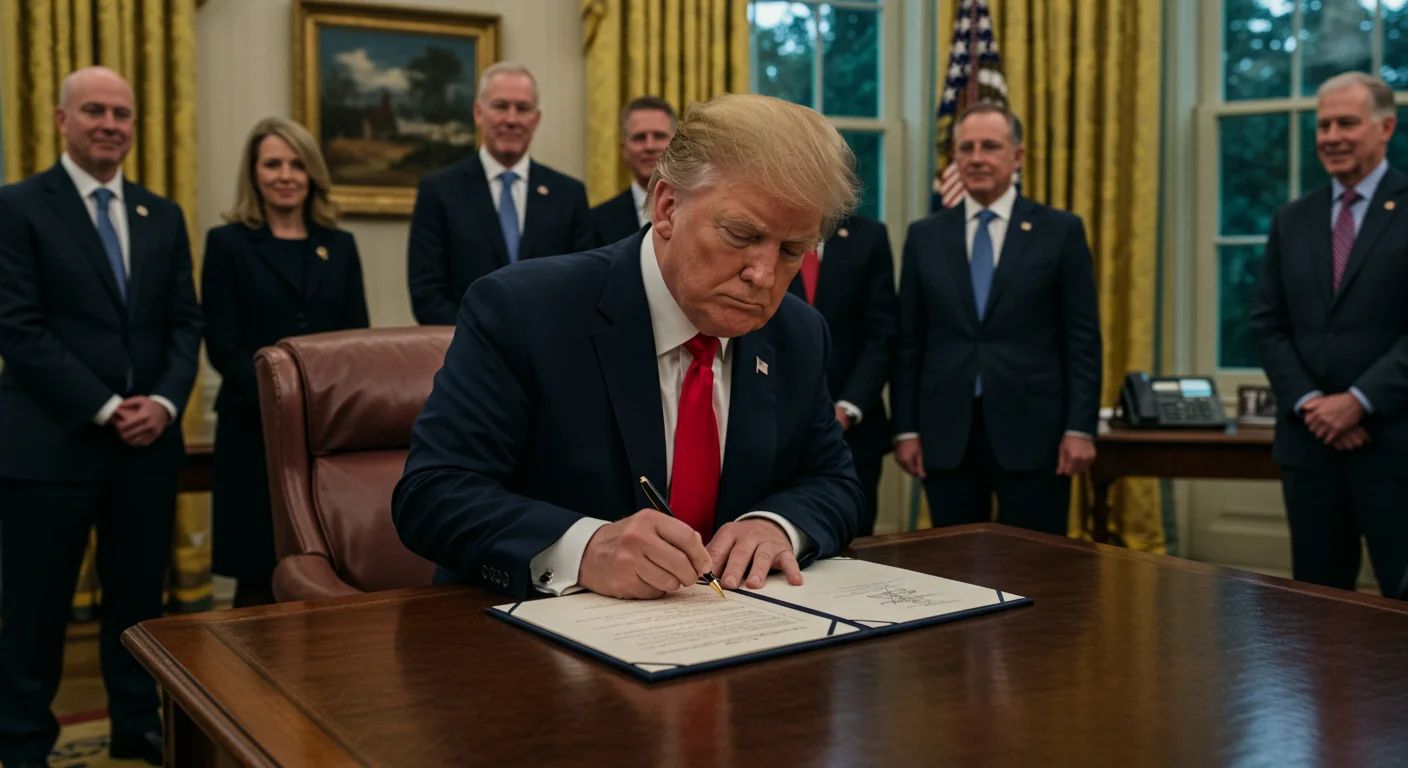
President Donald Trump signed a sweeping executive order on April 17, 2026, directing federal agencies to fast-track the review of psychedelic drugs — including psilocybin and ibogaine — for treating mental health conditions in veterans and active-duty military personnel. The move marks one of the most significant shifts in federal drug policy in decades.
What the Executive Order Does
The order, signed at the White House on Friday, instructs the Food and Drug Administration and the Drug Enforcement Agency to jointly establish a new pathway for eligible patients — primarily veterans and active military — to access investigational psychedelic compounds currently under FDA review. Drugs that have cleared basic safety thresholds under Trump's Right to Try Act are eligible for the expedited pathway.
The order also directs at least $50 million in federal funding toward research and access programs, and requires the Department of Veterans Affairs to expand its participation in psychedelic clinical trials.
The Drugs: What Are Psilocybin and Ibogaine?
The two compounds at the center of the order are not new — they are both decades-old substances that have recently attracted serious clinical interest.
Psilocybin is the active compound in so-called "magic mushrooms." Clinical trials funded by Johns Hopkins University and NYU have repeatedly found it effective at treating treatment-resistant depression, end-of-life anxiety, and PTSD when administered in supervised settings. The FDA granted it "Breakthrough Therapy" designation in 2018.
Ibogaine is extracted from the iboga plant native to Central Africa and has a longer history of use in addiction treatment, particularly for opioid dependency. A landmark Stanford Medicine study published in 2025 found that ibogaine — combined with magnesium to protect the heart — safely and significantly reduced PTSD symptoms, anxiety, and depression in veterans, with effects lasting six months after a single dose.
Why Veterans?
Trump framed the order explicitly around the veteran mental health crisis. The United States loses an estimated 6,000 veterans to suicide every year — more than 16 per day. Existing treatments, including SSRIs and cognitive behavioral therapy, fail a significant portion of combat veterans with severe, treatment-resistant PTSD.
"We owe it to the men and women who served this country to give them every tool available," Trump said during the signing ceremony. "If these medicines work — and the science is showing they do — we're going to get them to our heroes fast."
Several high-profile veteran advocacy groups, including the Veterans of Foreign Wars and the Mission 22 Foundation, issued statements supporting the order.
The Science Behind the Push
The momentum behind the executive order is backed by a growing body of peer-reviewed research. A 2024 multi-site trial published in The New England Journal of Medicine found that MDMA-assisted therapy produced a 67% response rate in veterans with severe PTSD versus 32% for therapy with placebo. The Stanford ibogaine study, which examined 30 special operations veterans, found an 88% reduction in PTSD severity scores one month after treatment.
The FDA's existing Breakthrough Therapy designation for psilocybin in depression means regulators have already signaled the drug merits accelerated development. The new executive order essentially demands the agency move faster.
- The order covers psilocybin, ibogaine, MDMA, ketamine, and other Schedule I/II compounds under active FDA review
- Eligible patients must first fail at least two standard treatments before accessing the pathway
- The VA must now participate in at least five active clinical trials at any given time
- DEA is directed to review scheduling classifications of compounds showing "significant therapeutic benefit"
- States can apply for federal matching grants to establish supervised psychedelic therapy centers for veterans
Political Context: A Bipartisan Surprise
The executive order drew rare bipartisan praise. Democratic senators from Oregon and Colorado — both states with existing state-level psychedelic frameworks — welcomed the federal alignment. Republican senators focused on the veteran-care rationale.
The order builds on momentum from the previous administration, which had allowed the VA to fund psychedelic research for the first time in 2024. But the scale of Trump's order — the direct funding mandate, the FDA pathway requirement, and the DEA scheduling review — goes significantly further.
Critics, including some medical associations, raised concerns about moving too fast given limited long-term safety data. The American Medical Association issued a statement urging "careful, evidence-based implementation" rather than broad access expansion before Phase III trials are complete.
- Addresses a genuine veteran mental health crisis with promising new treatments
- Backed by growing peer-reviewed evidence from top institutions
- Provides structured pathway rather than unregulated self-medication
- $50M in funding could accelerate trials and produce faster approvals
- Long-term safety data is still limited for most compounds
- Risk of rushing access before large-scale Phase III trials conclude
- Ibogaine carries cardiac risks that require careful screening
- Schedule I status still limits research infrastructure despite order
What Happens Next
The FDA has 60 days to publish a proposed framework for the new access pathway. The DEA must deliver a scheduling review report within 90 days. The VA has 30 days to submit a plan for expanding its trial participation.
For veterans seeking access, the order does not immediately open up treatments. The pathway must first be formalized through regulatory processes. Experts say the earliest practical access under the new framework is likely 12 to 18 months away — but the political and regulatory signal is clear.
For the psychedelic therapy industry, the order is a watershed moment. Companies including MAPS Public Benefit Corporation, Compass Pathways, and MindMed saw significant stock gains following Friday's announcement.
Whether this translates into treatments on the ground for the veterans it targets depends on how quickly the FDA and DEA move — and whether political winds remain favorable through the implementation timeline.