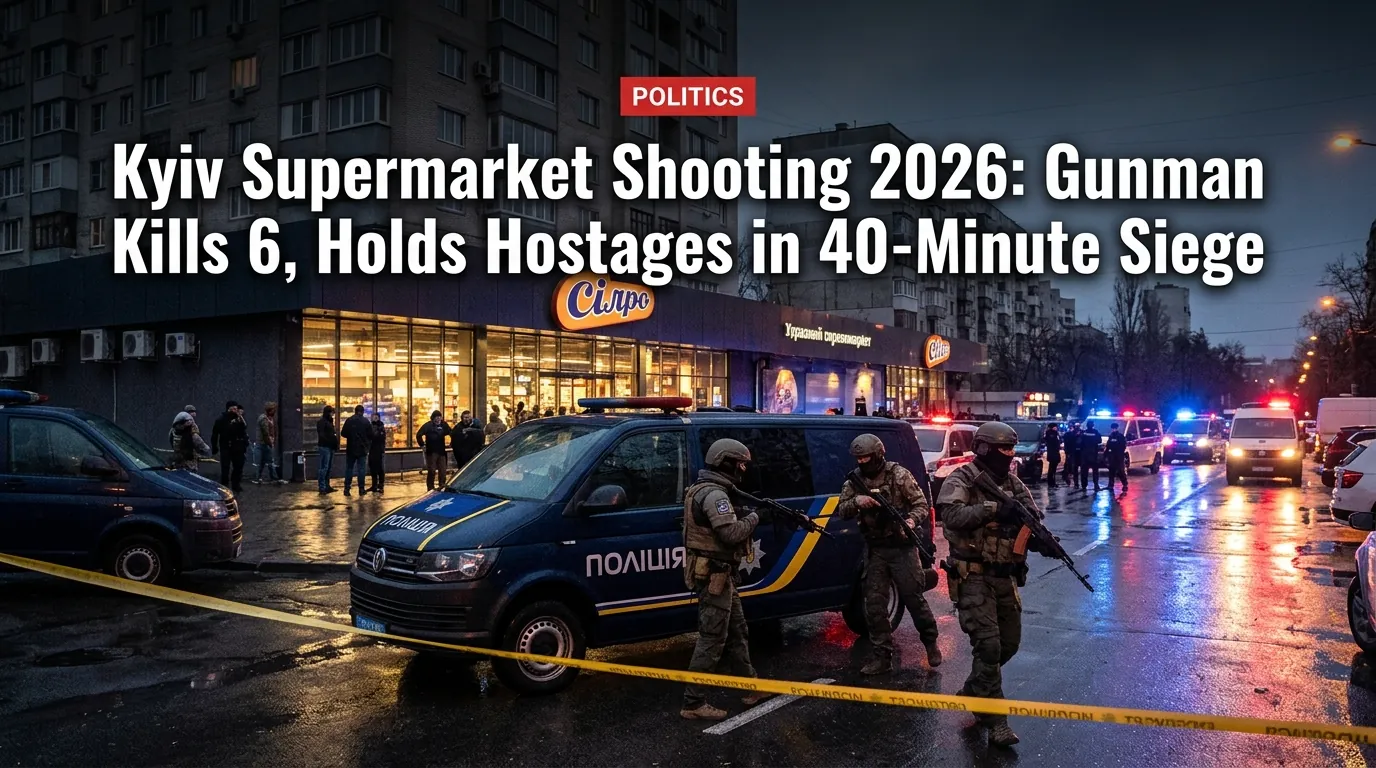
A gunman opened fire on civilians in Ukraine's capital on Saturday, killing six people and wounding at least 14 before barricading himself inside a supermarket with hostages. Ukrainian special police ended the siege in roughly 40 minutes, shooting the attacker dead. President Volodymyr Zelenskyy confirmed four hostages were rescued alive. Ukraine's security service, the SBU, classified the attack as an act of terrorism.
The shooting sent shockwaves through a city already under the psychological strain of more than four years of war — but this time, the threat came from inside the country.
What Happened on April 18
The attack unfolded in Kyiv's Holosiivskyi district on a Saturday afternoon. According to Interior Minister Ihor Klymenko, the gunman emerged on a residential street and opened fire on passersby without warning or apparent provocation.
"He was simply shooting people at close range. He approached and shot them," Klymenko told reporters.
After killing six people on the street and wounding more, the suspect moved into a nearby supermarket and took hostages. Special tactical police units established a perimeter while negotiators attempted to communicate with the attacker.
A female negotiator — visible in footage wearing body armor — used a loudspeaker to call out to the assailant and urge him to release the hostages. After approximately 40 minutes of failed negotiations, police moved in. The gunman opened fire on officers during the entry. He was shot and killed.
Who Was the Attacker?
Ukrainian authorities identified the suspect as a 58-year-old man born in Moscow. He held a valid Ukrainian weapons permit and had obtained a medical certificate authorizing firearm ownership.
No clear motive has been established. Investigators found that before the rampage, the suspect had set fire to the apartment where he was registered — a detail authorities say may point to a personal crisis or premeditated intent.
- Attacker: 58-year-old man born in Moscow
- Location: Holosiivskyi district, Kyiv, Ukraine
- Date: Saturday, April 18, 2026
- Deaths: 6 confirmed
- Injured: 14+, including one child
- Hostages rescued: 4
- Siege duration: Approximately 40 minutes
- Classification: Act of terrorism (SBU)
The suspect had a prior criminal record. Ukrainian authorities have not disclosed the nature of previous offenses or whether the attack had any connection to the ongoing war with Russia.
Zelenskyy Responds
President Zelenskyy addressed the nation following the shooting, confirming the casualty figures and praising police for rescuing the remaining hostages. He offered condolences to the families of the victims.
The attack adds to the psychological burden faced by Kyiv residents. While the city has adapted to air raid sirens and drone threats over the course of the war, civilian mass shootings of this nature are exceptionally rare in Ukraine.
Ukraine Labels It Terrorism — But Why?
Ukraine's SBU classified the shooting as an act of terrorism under Ukrainian law. The designation is significant: it escalates the legal severity of the case and grants intelligence authorities broader investigative powers.
However, analysts caution that the terrorism label can be applied broadly in wartime Ukraine and does not necessarily imply a connection to Russian state actors or organized militant groups. No group has claimed responsibility for the attack.
Context: Gun Violence in Wartime Ukraine
Mass civilian shootings are unusual in Ukraine even in wartime. The country has strict gun regulations on paper — ownership requires medical clearance and registration — yet weapons have proliferated significantly since Russia's full-scale invasion began in February 2022.
Ukrainian authorities and international observers have raised concerns about the long-term implications of widespread arms availability once the conflict ends. This attack, carried out with a legally registered weapon, underscores those concerns.
A City That Has Learned to Live With Danger
Kyiv has survived years of aerial bombardment, missile strikes, and drone attacks. Its residents have developed routines built around air raid alerts — subway platforms doubling as shelters, apps pinging warnings at 3 a.m.
But Saturday's attack was different. It was close-range. It was civilian-on-civilian. It happened on a street, not from the sky.
For a city conditioned to look upward for threats, a gunman walking down a residential block and shooting people at point-blank range is a jarring, different kind of horror.
What Happens Next
Ukrainian police and the SBU continue to investigate the attacker's background, possible motivations, and any connections to external parties. Authorities are examining his phone records, communications, and movements in the days leading up to the attack.
The Prosecutor General's office has opened a terrorism investigation. Given the suspect was killed during the police entry, the criminal proceedings will focus on establishing motive and any potential accomplices rather than prosecuting the shooter himself.
The Bottom Line
Six people are dead. Fourteen more are wounded. A 58-year-old man — legally armed, Moscow-born, and for now without a clear motive — carried out what Ukrainian authorities are calling an act of terrorism in the heart of the country's capital.
In a nation that has grown almost numb to war, Saturday's shooting was something different: intimate, domestic, and deeply unsettling. For Kyiv, a city that has learned to endure almost anything, this was a reminder that not every threat arrives by missile.