Viktor Orbán — the Hungarian strongman who spent 16 years transforming his country into a template for illiberal democracy — conceded defeat on April 12, 2026, after challenger Péter Magyar delivered one of the most decisive electoral upsets in post-communist European history.
The result sent shockwaves through European capitals, Washington, and the global network of populist movements that Orbán helped inspire. With 97.35 percent of precincts counted, Magyar's centre-right Tisza party secured 138 seats in the 199-seat parliament on 53.6 percent of the vote. Orbán's Fidesz was reduced to 55 seats with just 37.8 percent — a collapse of historic proportions for a party that had dominated Hungarian politics since 2010.
Who Is Péter Magyar?
The man who ended Orbán's era is not the opposition figure you might expect. Magyar, 43, is a lawyer and former regime insider — he was once married to Orbán's ex-justice minister, Judit Varga. That insider status gave him credibility with voters who were wary of traditional opposition parties but had soured on Orbán's corruption-soaked system.
Magyar burst onto the political scene in early 2024 after publishing leaked voice recordings that appeared to show government officials discussing a cover-up of a child abuse scandal at a state-affiliated children's home. His willingness to expose the rot from within galvanized hundreds of thousands of Hungarians. By late 2024, his Tisza party had eclipsed Fidesz in polls — something the opposition had failed to achieve for a decade.
Why Orbán Lost
The reasons behind Orbán's fall are layered. Hungary under Fidesz became a demonstration project for how to consolidate power within a democracy's institutional shell — but the cracks in the model had been showing for years.
Economic stagnation hit voters hard. Despite Orbán's nationalist rhetoric, Hungarian wages remained among the lowest in the EU while inflation spiked. Oligarchs with ties to Fidesz accumulated vast wealth, and stories like a €1.5 million government-funded roundabout connecting nothing to nothing became symbols of systemic corruption.
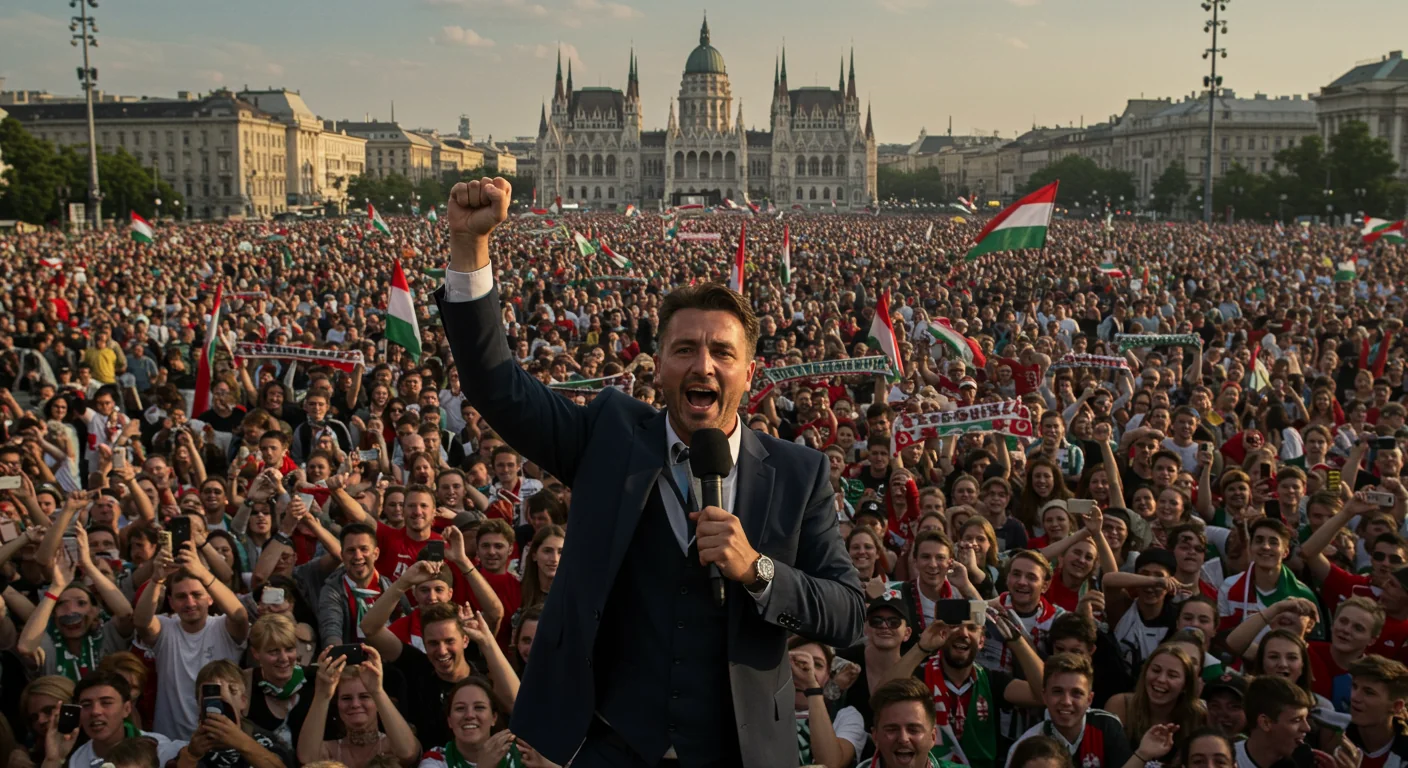
Youth mobilization proved decisive. Magyar's campaign drew massive crowds in cities that had long been Fidesz strongholds. First-time voters and younger Hungarians — who had never known political adulthood under any prime minister other than Orbán — turned out in record numbers.
EU alienation also played a role. Since 2022, the European Commission had frozen €17 billion in EU cohesion and recovery funds over rule-of-law violations. Many Hungarians concluded that Orbán's confrontational approach with Brussels was costing them money they desperately needed.
- Tisza's supermajority allows constitutional reform without coalition deals
- EU relations likely to warm quickly, unlocking billions in frozen funds
- Hungary expected to end its blocking posture inside EU institutions
- NATO commitment reaffirmed — Hungary's allies relieved
- Magyar has signaled he won't fast-track Ukraine's EU membership bid
- Hungary's opt-out from the EU's €90bn Ukraine loan stays in place
- Dismantling 16 years of Fidesz-engineered institutional control will take years
- Fidesz retains a substantial voter base; Orbán is not going quietly
What Changes for the EU?
Hungary under Orbán was the EU's most disruptive member state. He vetoed Ukraine aid packages, blocked rule-of-law proceedings, and cultivated ties with Russia's Vladimir Putin even after the 2022 invasion of Ukraine. Brussels will be relieved to see him go.
Magyar's immediate priorities include securing those frozen EU funds — €17 billion of the €27 billion allocated to Hungary remains locked up. His government is expected to meet EU conditions on judicial independence and anti-corruption measures that Orbán refused to implement.
"Securing EU funds is the top priority," Magyar said in his first post-election press conference. "We cannot afford to waste another year."
For the broader EU, the shift could prove significant. Hungary's veto had been a regular wrench in the machinery of Brussels decision-making. With Magyar committed to a cooperative stance, landmark measures — including further military aid to Ukraine and the long-delayed €90 billion EU loan to Kyiv — face fewer procedural obstacles.
What Changes for Ukraine?
The picture here is more nuanced than simple Fidesz-to-friend-of-Ukraine.
Magyar confirmed that Hungary will not block the EU's €90 billion loan to Ukraine — a decision that was already taken and only required Orbán-era Hungary to stop its obstruction. However, Magyar also confirmed that Hungary will not participate in the loan, citing the country's poor fiscal position.
On peace negotiations, Magyar struck a notably different tone from Orbán's pro-Moscow posture: he has said he is willing to meet President Zelenskyy and insists that Ukraine "cannot be compelled to accept a deal requiring it to cede territory." But he also said Ukraine's EU membership within the next ten years is "not realistic" — a position closer to mainstream EU thinking than to Kyiv's ambitions.
What Happens to Orbán?
Orbán's concession speech was brief, calling the result "painful" but pledging that Fidesz would remain a force in Hungarian politics. With 55 parliamentary seats, Fidesz is not eliminated — but it loses its ability to block constitutional changes, control parliamentary committees, or appoint loyalists to key judicial and institutional posts.
Orbán himself faces a complicated future. He retains significant influence over state media he spent years building, a network of allied oligarchs, and a genuine voter base that remains loyal. There is also the question of legal exposure: a new government with prosecutorial independence could investigate corruption allegations that were suppressed under Fidesz.
International implications are significant too. Orbán had cultivated himself as a bridge between Trump's Washington and a skeptical EU. With him gone, the transatlantic conversation around the war in Ukraine and European defense loses one of its most vocal disruptors.
The Bigger Picture
For observers of European politics, Hungary's result is part of a broader pattern emerging across the continent in 2025 and 2026. Populist parties that rode a wave of anti-establishment sentiment have encountered the harsh realities of governance: inflation, corruption exposure, and a younger electorate that grew up online and is harder to control through state media.
Orbán's model — often called "illiberal democracy" — was studied and partially replicated in Poland, Serbia, Turkey, and beyond. His defeat does not erase those experiments, but it does puncture the narrative of inevitability that surrounded them. An Orbán who loses an election is a less useful template than one who wins every time.
For the 10 million people of Hungary, the stakes are more immediate: whether a new government can deliver on promises of wage growth, EU fund access, and institutional reform before the next election cycle tempts disillusionment. Magyar has a two-thirds majority and a mandate — tools Orbán himself once wielded. What he builds with them will define Hungary's next decade.