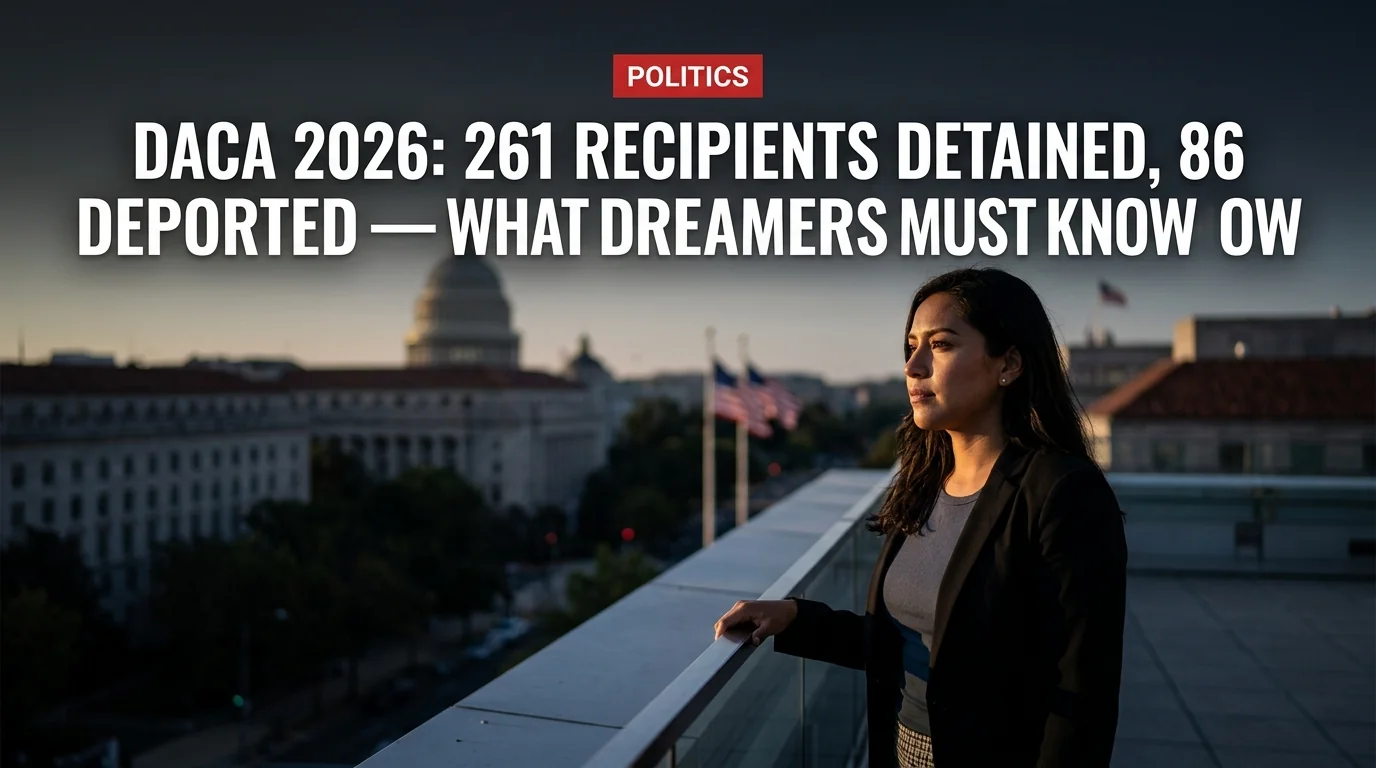
Hundreds of DACA recipients — people who grew up in the United States and have lived legally under the Deferred Action for Childhood Arrivals program for years — are being swept up in the Trump administration's sweeping immigration enforcement campaign. Government data confirms at least 261 arrests and 86 deportations of DACA holders since January 2025, and advocates say the true numbers may be higher.
Here's everything you need to know about DACA's status in 2026, who is at risk, and what legal options remain.
What Is Happening to DACA Recipients Right Now?
The Trump administration began detaining DACA recipients shortly after taking office in January 2025. Unlike the previous administration, which generally treated active DACA status as protection from removal, current Department of Homeland Security leadership has taken the position that DACA provides no legal protection whatsoever.
HHS Assistant Secretary Tricia McLaughlin told NBC News in plain terms: "DACA does not confer any form of legal status in this country," adding that any DACA recipient may be detained and deported at ICE's discretion.
The numbers tell a stark story:
Notable individual cases include Norma Guzman, a DACA recipient with no criminal record who spent four months at the Adelanto ICE Processing Center after agents detained her in September 2025.
What Do the Courts Say?
The legal status of DACA itself is precarious. In January 2025, the U.S. Court of Appeals for the Fifth Circuit ruled that DACA and the DACA Final Rule are unlawful — but ordered that the program continue under a limited injunction while legal challenges play out.
The key points from the Fifth Circuit ruling:
- Current DACA recipients nationwide can continue to hold and renew their DACA status
- New DACA applicants in Texas no longer qualify for work authorization
- The stay on the judgment remains in place for current recipients due to, in the court's words, "the immense reliance interests that DACA has created"
- The deferred action (protection from removal) and work authorization components were legally severed — meaning a Texas DACA holder could theoretically retain removal protection but lose work authorization
Despite the court's ruling that DACA should proceed, the Trump administration has not issued updated guidance and ICE continues detaining recipients — leading to the 21 court petitions filed by detained DACA holders in the first 15 months of 2025.
Why Is This Happening? The Administration's Legal Theory
The Trump administration's position rests on the Fifth Circuit's finding that DACA was originally created unlawfully by executive action under Obama in 2012. Because the program was never passed by Congress, DHS argues it can be unwound — and that existing DACA holders have no enforceable right to protection from removal.
The administration has not moved to formally end DACA by regulation (a process that would trigger additional court challenges), but has instead pursued enforcement that treats active DACA status as legally meaningless at the operational level.
Advocates counter that the Fifth Circuit's injunction explicitly protects current recipients and that detaining them violates the court's order. The 21 habeas corpus petitions filed in federal court are testing exactly that argument.
- Fifth Circuit injunction still in place — provides some protection
- USCIS still processing renewals
- Federal courts actively reviewing individual detention cases
- 21 habeas petitions mean growing legal record against detentions
- Administration openly ignores DACA status as a protection factor
- Renewal processing is 5x slower — lapsed status = immediate risk
- No Congressional legislation has passed to protect Dreamers
- Deportation pace is at historic highs — 460,000 projected for FY2026
How Many People Are Affected?
Approximately 535,000 people currently hold active DACA status, according to USCIS data. The program peaked at around 800,000 recipients; many aged out, voluntarily left the country, or did not renew after the program's legal status became uncertain.
Of the 535,000 active holders, the vast majority have lived in the United States for more than a decade. Many own businesses, pay taxes, have U.S.-citizen children, and have no criminal history. The administration's enforcement actions have not been limited to those with criminal records.
What Should DACA Recipients Do Right Now?
Immigration lawyers are urging DACA recipients to take immediate action:
- Renew DACA immediately if your status expires within 6 months — processing now takes 2.3 months
- Do not travel internationally — Advance Parole has become significantly riskier
- Consult an immigration attorney about your specific situation and any criminal history, even minor offenses
- Document all ties to the U.S. — property ownership, U.S.-citizen family members, employment records
- Know your rights: you have the right to remain silent and the right to speak with an attorney if detained
- Do not open the door to ICE without a warrant signed by a judge
Several organizations are providing emergency legal support, including the American Immigration Council, United We Dream, and local immigrant rights coalitions.
What Would It Take to Protect DACA Long-Term?
The only permanent solution for DACA recipients is a Congressional act — something lawmakers have failed to deliver despite multiple bipartisan attempts over 15 years. The Dream Act has been introduced repeatedly and has never passed both chambers.
In the current Congress, no DACA legislation is on the active docket. With the Fifth Circuit ruling declaring the program unlawful and the Supreme Court unlikely to intervene soon, DACA recipients remain in a legal gray zone that the administration is actively exploiting.
The Bottom Line
Daca recipients in 2026 face a level of legal exposure not seen since the program's early days. The courts have not ended DACA, but the administration is treating it as though they have. With deportation rates at historic highs and DACA renewal backlogs growing, the margin for error is razor-thin.
If you or someone you know holds DACA status, the time to act — renewing status, consulting an attorney, understanding your rights — is now, not when ICE knocks on the door.