
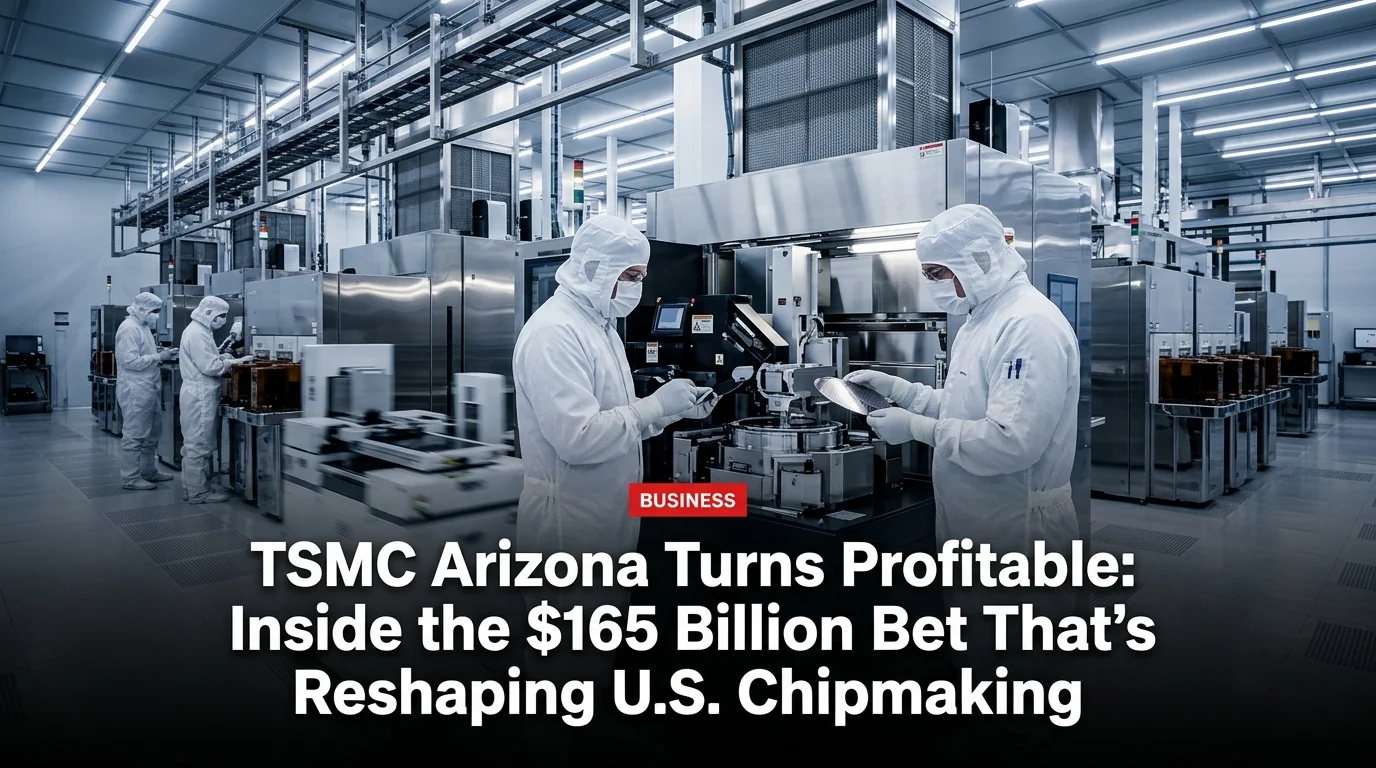
TSMC's Arizona subsidiary has done what skeptics said couldn't happen: it turned a profit manufacturing advanced chips on American soil. The milestone, confirmed in early 2026, validates the largest foreign direct investment in U.S. history and silences years of doubt about whether top-tier semiconductor fabrication could work outside East Asia.
Why This Matters Right Now
For the first time, the world's most advanced commercially produced chips — 4-nanometer processors powering iPhones and AI servers — are rolling off production lines in Phoenix, Arizona, at yields that match TSMC's legendary Taiwan facilities. That's not a talking point. It's a verified manufacturing achievement that shifts the global chip supply chain.
TSMC Arizona (officially TSMC Arizona Corporation) reported its first-ever profit in the first half of 2025 and sustained it through Q4, proving the U.S. site isn't just a political showpiece — it's a viable business.
- Total investment: $165 billion across six planned fabs
- CHIPS Act support: $6.6 billion in grants + $5 billion in loans
- Fab 1 status: High-volume 4nm production, yields matching Taiwan
- Jobs created: 12,000+ direct high-tech positions
- Fab 2 timeline: Equipment install Q3 2026, mass production H2 2027
- Fab 4 target: 2nm and A16 (1.6nm) chips by ~2030
The $165 Billion Roadmap
What started as a $12 billion single-fab announcement in May 2020 has ballooned into the most ambitious semiconductor project ever attempted outside Asia. Here's how TSMC's Arizona campus has evolved:
Who's Building What — and for Whom
TSMC isn't building this alone. The Arizona expansion involves a constellation of tech giants, government agencies, and contractors.
The customers driving demand:
- Apple (Tim Cook) — anchor customer, iPhone and Mac processors
- NVIDIA (Jensen Huang) — Blackwell AI processors for data centers
- AMD (Lisa Su) — high-performance computing chips
The government backing:
- U.S. Department of Commerce (Gina Raimondo) — administering $6.6B in CHIPS Act grants
- Arizona Governor Katie Hobbs — coordinating local infrastructure and workforce programs
The TSMC leadership:
- Dr. C.C. Wei, Chairman and CEO — led the $100B expansion negotiations
- Dr. Morris Chang, Founder — symbolic presence at major milestones
What Each Fab Will Produce
The Profitability Question — Answered
For years, the biggest criticism of TSMC Arizona was cost. Building chips in the U.S. was estimated to be 30-50% more expensive than in Taiwan, thanks to higher labor costs, construction delays, and cultural friction between Taiwanese engineers and American construction crews.
The early days were rough. Labor disputes in 2023-2024 over the use of Taiwanese workers versus local tradespeople created headlines and delays. Some industry analysts at Digitimes openly questioned whether the site would ever turn a profit.
Then the numbers came in.
What's Working
- Fab 1 yields match Taiwan (~90%+)
- First profit achieved H1 2025, sustained through Q4
- Workforce training agreements stabilized labor relations
- CHIPS Act grants offset higher construction costs
- AI chip demand provides guaranteed high-margin orders
What's Still Challenging
- Fab 2 ramp-up will temporarily increase depreciation costs
- U.S. operations still more expensive per wafer than Taiwan
- CHIPS Act profit-sharing requirements if returns exceed projections
- Government demands for detailed operational data concern TSMC
- Scaling from one fab to six requires massive workforce expansion ::/proscons
The key insight: TSMC didn't just match Taiwan on yield — it did so while charging premium prices to customers who value geographic diversification. Apple, NVIDIA, and AMD are willing to pay more for chips made outside the Taiwan Strait danger zone.
The Geopolitical Calculus
This isn't just a business story. It's a national security pivot.
Before TSMC Arizona, 100% of the world's most advanced chips (sub-5nm) were manufactured in East Asia — primarily Taiwan, an island that China considers a breakaway province. A single natural disaster, military conflict, or trade disruption could have crippled the global tech supply chain.
Now, the U.S. has a domestic source. And it's expanding fast.
Secretary of Commerce Gina Raimondo has framed it bluntly: "For the first time ever in our country's history, we are making leading-edge chips on American soil with yields comparable to Taiwan."
What Comes Next
The immediate focus is Fab 2. Equipment installation begins in Q3 2026 — months ahead of the original schedule — with mass production of 3nm chips expected in the second half of 2027. That acceleration signals confidence in the Arizona workforce and supply chain.
Beyond that, TSMC projects roughly 30% revenue growth company-wide in 2026, driven overwhelmingly by AI chip demand. Arizona will capture an increasing share of that growth as more fabs come online.