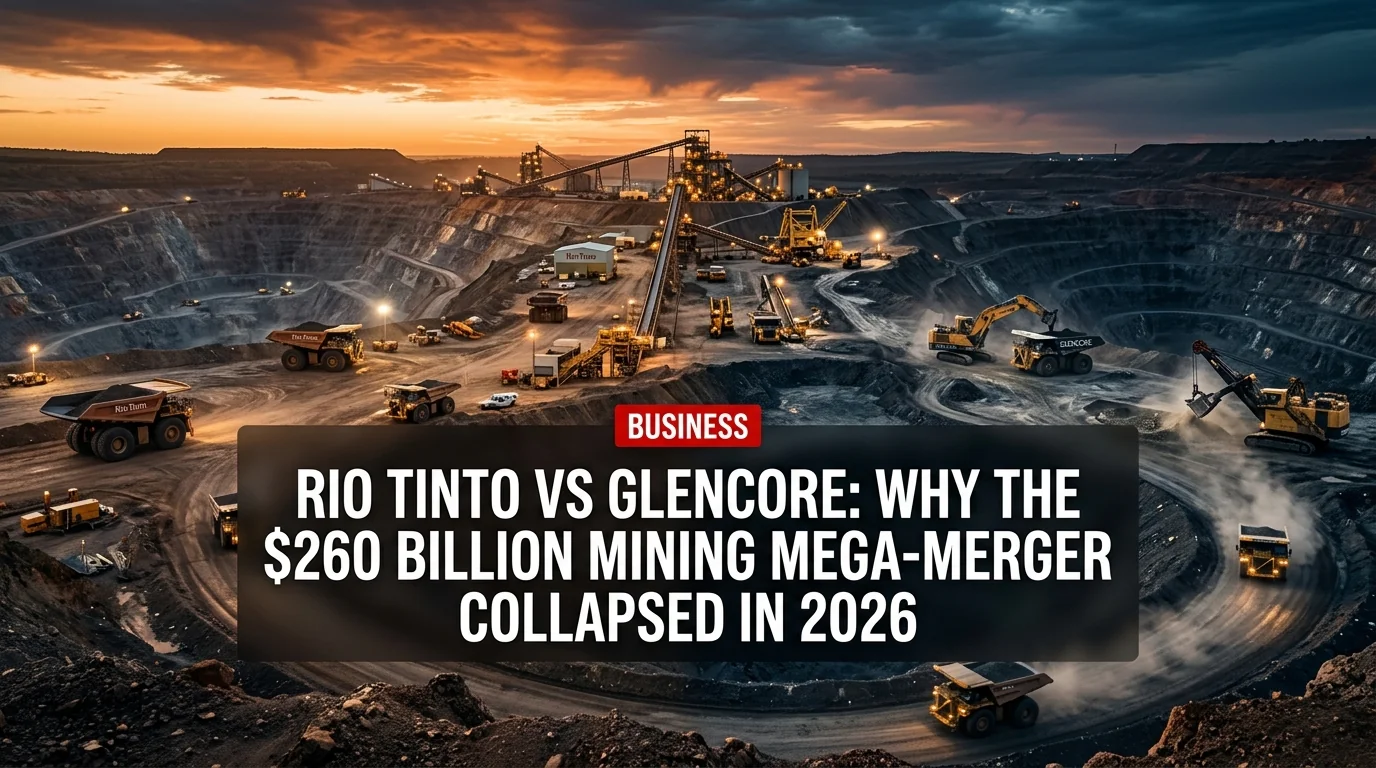
The proposed merger between Rio Tinto and Glencore would have created a $260 billion mining colossus — the largest the industry has ever seen. Instead, on February 5, 2026, Rio Tinto walked away from the negotiating table for the third time in twelve years. Now, with both companies locked in a six-month cooling-off period under UK takeover rules, the mining world is asking one question: will they try again in August?
What Happened: A Timeline of the Failed Deal
The collapse didn't come out of nowhere. It was the culmination of years of on-again, off-again courtship between two mining giants with complementary assets but incompatible egos.
Why the Deal Collapsed
Two irreconcilable differences killed the merger.
Valuation Gap. Glencore's board believed Rio Tinto's proposed all-share structure significantly undervalued Glencore's contribution — particularly its copper assets and growth pipeline. Glencore CEO Gary Nagle originally sought a 40% ownership stake for Glencore shareholders in the combined entity, which Rio Tinto refused.
Governance Control. Rio Tinto insisted on retaining both the chairman and chief executive roles in the merged company. For Glencore, a firm built on its swashbuckling trading culture, ceding total leadership was a non-starter.
- Combined market cap: ~$260 billion
- Would have controlled 7-15% of global copper supply
- Third failed merger attempt (2014, 2024, 2026)
- Rio Tinto barred from new approach until August 2026
- Glencore shares dropped ~8% after collapse
The Numbers That Made This Deal So Tempting
The strategic logic was undeniable. Together, Rio Tinto and Glencore would have dominated the metals powering the energy transition.
Rio Tinto | Glencore Market cap: ~$142B | Market cap: ~$65B Copper output: 883,000 tons | Copper output: 852,000 tons Iron ore: 327.3M tons | Iron ore: N/A Pure miner, disciplined culture | Miner + commodity trader, aggressive culture Exited coal in 2018 | Major thermal coal producer HQ: London/Melbourne | HQ: Baar, Switzerland ::/versus
Combined copper production of 1.73 million tons would have made the merged entity the world's undisputed copper king at a time when demand for the red metal is surging. Electric vehicles require 2.5 times more copper than combustion engines, and AI data centers are consuming copper at unprecedented rates.
What Both Companies Do Now
Rio Tinto: Doubling Down on Copper Alone
Without Glencore's assets, Rio Tinto must pursue its copper ambitions through smaller acquisitions and organic growth. The company has already signaled its priorities:
- Record 2025 copper production of 883,000 tons shows its existing operations are firing
- CEO Simon Trott was hired specifically to pursue consolidation — this won't be his last attempt
- Rio Tinto's 55% cash flow dependence on iron ore remains a strategic vulnerability it must address
Glencore: Playing the Field
Glencore isn't sitting idle during the cooling-off period:
- The company is advancing a copper joint venture with Vale in Canada's Sudbury Basin, with first production expected by 2028
- It recently agreed to sell a stake in its Democratic Republic of Congo copper and cobalt assets, potentially reshaping its portfolio
- If a third party makes a firm offer for Glencore, the cooling-off restrictions on Rio Tinto could be lifted early
The Bigger Picture: Mining's M&A Frenzy
This failed merger doesn't exist in isolation. The mining industry is undergoing its most aggressive consolidation wave since the commodities supercycle of the 2000s.
The driving force is copper. Global copper demand is projected to double by 2035, driven by:
- Electric vehicles — each EV uses 53-83 kg of copper
- AI infrastructure — data center construction is consuming record amounts of wiring and components
- Renewable energy — wind turbines and solar farms are copper-intensive installations
- Grid modernization — aging power grids worldwide need copper-heavy upgrades
Will They Try Again?
History says yes. This was the third attempt, and the strategic rationale only grows stronger with each passing year. The cooling-off period expires in early August 2026, and several factors could reignite talks:
Copper prices. If copper breaks above $12,000 per ton — as many analysts predict by mid-2026 — the economics of combining both copper portfolios become even more compelling.
Glencore's coal problem. ESG-conscious investors continue pressuring Glencore to shed its coal assets. A merger with Rio Tinto (which exited coal in 2018) could provide the political cover for a managed coal wind-down.
Competitive pressure. If BHP makes a move on Freeport-McMoRan, Rio Tinto would face enormous pressure to respond with its own mega-deal.
The Bottom Line
The Rio Tinto-Glencore merger collapse isn't the end of this story — it's a halftime break. Both companies need what the other has. Rio Tinto needs copper scale. Glencore needs an exit strategy for coal and a premium valuation. The energy transition is accelerating, and the mining industry that emerges from this consolidation wave will look nothing like it does today.
The August deadline is circled on every mining analyst's calendar. The only question is whether pride or pragmatism wins the fourth round.