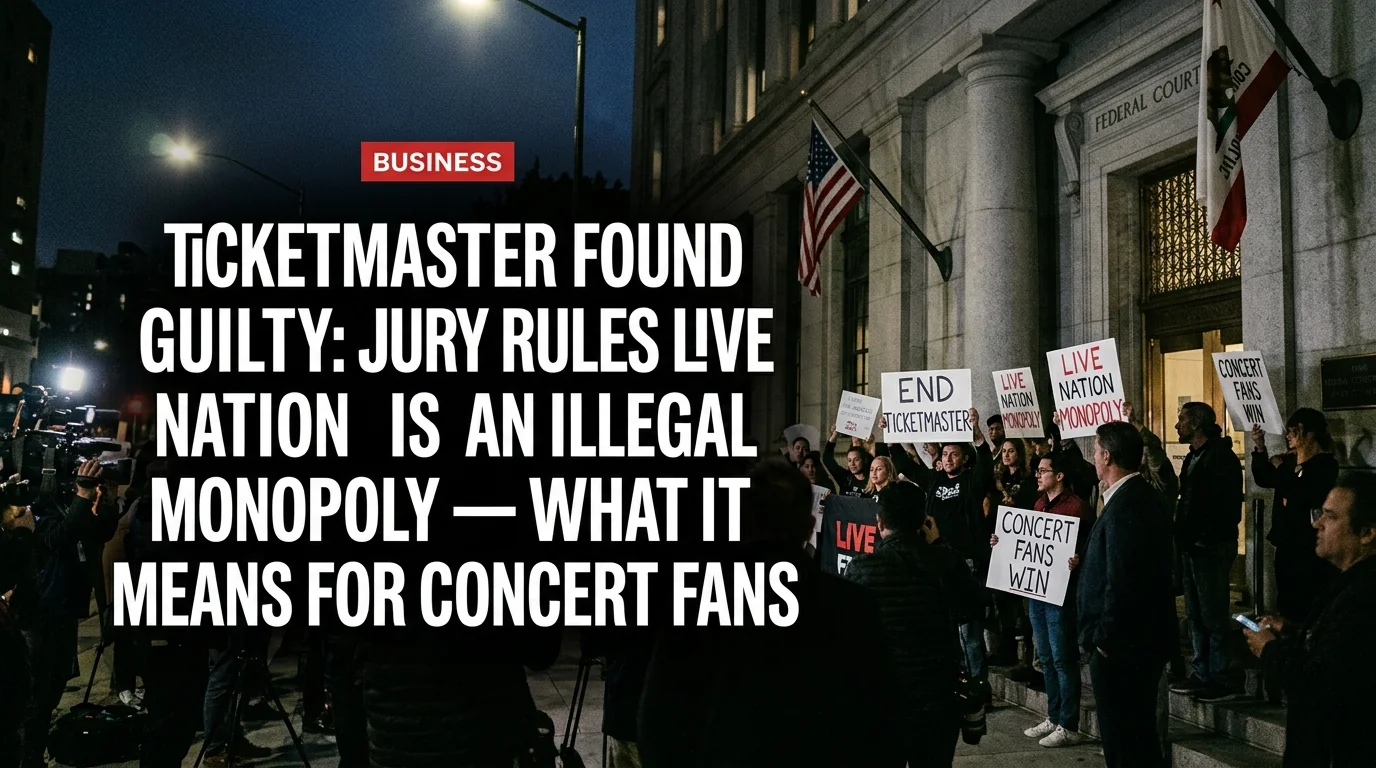
A federal jury delivered a landmark verdict Wednesday, finding that Live Nation Entertainment and its subsidiary Ticketmaster operated an illegal monopoly over the live concert ticketing market — overcharging millions of fans and squeezing out competition across 22 U.S. states.
The verdict, returned after roughly five weeks of trial in a Manhattan federal court, marks one of the most significant antitrust rulings against a entertainment company in decades. Jurors found the companies liable on all monopolization counts, sending shockwaves through the $30 billion live events industry.
What the Jury Found
The core finding: Ticketmaster used its dominant position to pressure major concert venues into exclusive ticketing contracts, effectively freezing out rival platforms like SeatGeek, AXS, and others. Venues that refused risk losing access to Live Nation's roster of A-list touring artists — a coercive arrangement the jury determined violated federal antitrust law.
On damages, the jury found Ticketmaster overcharged consumers by $1.72 per ticket. That may sound small, but scaled across hundreds of millions of tickets sold annually across 22 plaintiff states, the exposure runs into the hundreds of millions of dollars — before penalties and any court-imposed structural remedies.
A Long Time Coming
The trial is the culmination of a years-long fight. The U.S. Department of Justice, joined by a coalition of state attorneys general, filed the landmark antitrust lawsuit in May 2024 — just months after the Swift Effect exposed Ticketmaster's failures at mass scale during the Eras Tour presale, when millions of fans were locked out of the queue and thousands reported paying inflated resale prices on the company's own platform.
The trial brought internal Live Nation communications into the public record that attorneys argued showed executives knew their market position was anticompetitive — and exploited it anyway. Live Nation attorneys countered that the company's dominance reflected superior service and investment in the live entertainment ecosystem.
The jury disagreed.
What Happens Next
Wednesday's verdict is not the end — it's the beginning of the remedies phase, where the real stakes will be decided.
U.S. District Judge Arun Subramanian, who presided over the trial, instructed attorneys on both sides to submit a joint letter proposing a remedies schedule by late next week. Possible outcomes include:
- Monetary damages — The $1.72/ticket finding across 22 states alone could exceed $500 million. The judge will set final figures.
- Structural remedies — The most consequential outcome would require Live Nation to divest assets, potentially including its owned amphitheaters and concert venues — breaking the vertical integration that gives it leverage over artists, venues, and ticketing simultaneously.
- Behavioral remedies — Courts could prohibit specific anti-competitive practices, such as tying venue access to Ticketmaster contracts, without requiring a breakup.
- Appeal — Live Nation has vowed to fight. "The jury's verdict is not the last word on this matter," the company said in a statement. "Pending motions will determine whether the liability and damages rulings stand."
- Lower service fees if Ticketmaster loses market power
- More competition could mean better platforms and user experience
- Artists may gain more flexibility in touring partnerships
- Small venues could opt for alternative ticketing without fear of losing bookings
- Appeals could delay any relief for years
- A breakup of Live Nation could disrupt major tours and artist deals mid-cycle
- Behavioral-only remedies may not meaningfully change fees
- Ticketmaster's infrastructure is deeply embedded and won't disappear overnight
What It Means for You
For casual fans, the most visible change — if courts order structural remedies — would be the ability to choose a ticketing platform when buying tickets to major concerts. Today, if a show is at a Live Nation venue, Ticketmaster is your only option. Period.
Competitors like SeatGeek, AXS, and Dice have argued for years that they offer lower fees and better user experiences but can't get a foothold because venues are locked in. A forced divestiture of Live Nation's amphitheater portfolio would let venue operators choose any ticketing partner — theoretically driving fees down through competition.
For artists, the implications are different. Live Nation's vertically integrated model — owning venues, promoting tours, and handling ticketing — gives it unmatched leverage. Artists who want to tour stadiums and amphitheaters effectively have no alternative. A structural remedy could open the touring market to competing promoters and venue operators.
Live Nation's Response
The company pushed back hard. "We disagree with the jury's verdict and believe the evidence does not support these findings," Live Nation said in a statement. "We plan to appeal any unfavorable rulings on pending motions."
Legal observers note that antitrust cases of this complexity routinely face years of appeals, and structural remedies — if ordered — could be stayed pending appeal. The DOJ's landmark 1998 case against big tech antitrust cases took until 2001 to reach a final settlement, and even then, the initially ordered breakup was overturned on appeal.
For fans hoping for cheaper tickets next summer, managing expectations is probably wise. Real change — if it comes — is likely measured in years, not months.
The Bigger Picture
The verdict lands at a moment of heightened antitrust scrutiny across Big Tech and major industries. The Biden administration's aggressive posture toward monopolies was largely continued by the Trump DOJ in this case, reflecting bipartisan frustration with Ticketmaster's grip on concert culture.
State attorneys general from across the political spectrum joined the suit — from California and New York to Texas and Florida — a rare show of unity that signals just how broadly the frustration with Live Nation has spread.
"Today's verdict sends a message to every dominant company in America: antitrust laws will be enforced," Pennsylvania AG Dave Sunday said after the verdict.
For Live Nation, the fight is far from over. But for the first time in decades, the company faces a real legal reckoning — and concert fans, for once, have reason to think the system may actually work in their favor.