
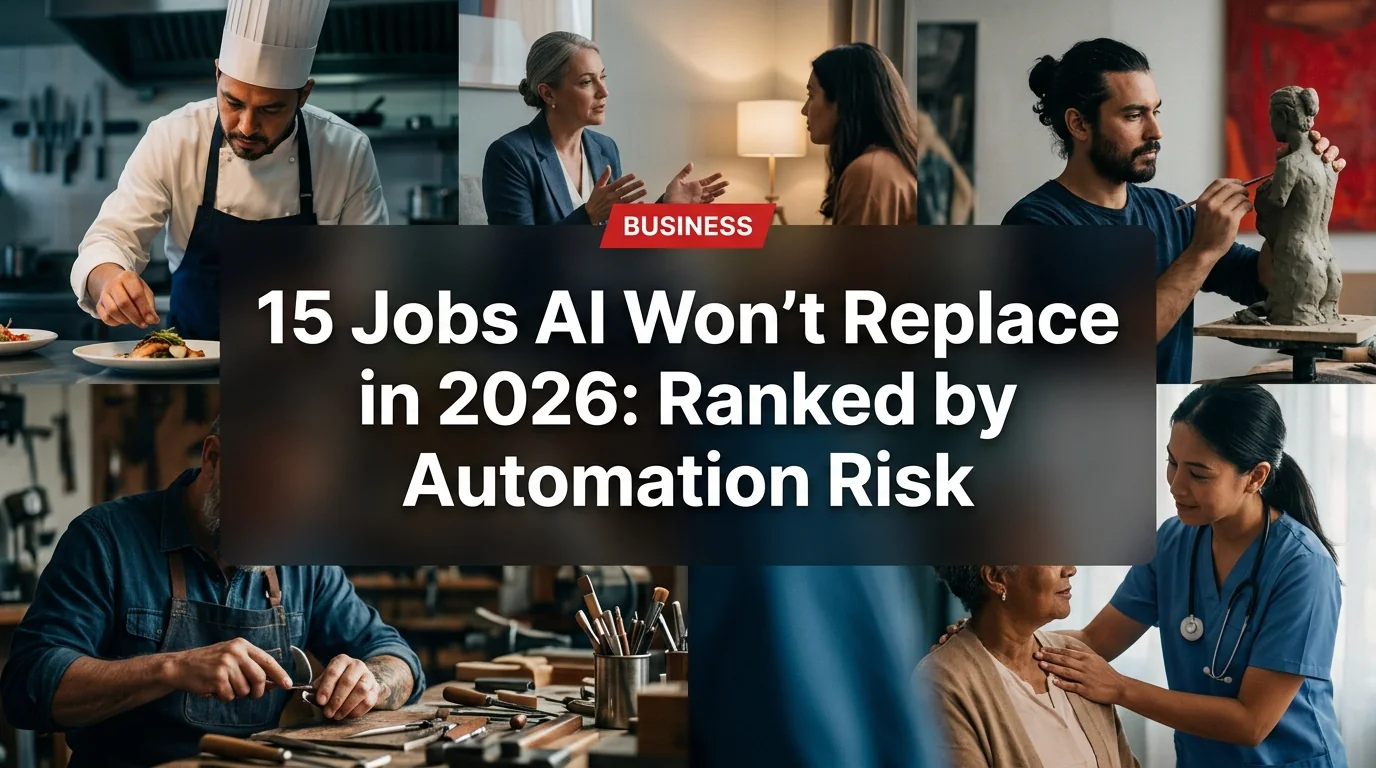
A recent World Economic Forum report found that 37% of companies plan to replace at least some employees with AI by the end of 2026. That's not a future threat — it's happening now. But automation doesn't affect all jobs equally, and many careers are not just surviving AI but growing because of it.
Here's a data-driven look at 15 roles where human judgment, physical presence, emotional intelligence, or ethical accountability make AI replacement either impossible or deeply impractical — ranked by how safe they actually are.
Why Some Jobs Are AI-Proof
AI excels at pattern recognition, language generation, and repetitive tasks with clear rules. It struggles with:
- Unpredictable physical environments — Every plumbing job, medical emergency, or crime scene is different
- Emotional attunement — Genuine empathy, reading unspoken cues, building trust over time
- Novel ethical decisions — Situations where the right answer isn't in any training data
- Legal and moral accountability — Society needs a human who can be held responsible
- Creative originality — Work that requires cultural context, lived experience, and aesthetic judgment
The 15 Most AI-Proof Jobs in 2026
1. Registered Nurse (RN) / Nurse Practitioner
Why it's safe: Patient care requires physical assessment, emotional support, and real-time judgment in unpredictable conditions. AI can analyze test results, but it cannot insert an IV, comfort a frightened patient, or read the subtle signs a family member is struggling. Nursing is already experiencing a shortage — demand is growing, not shrinking.
Median US salary: $81,000–$120,000 Job growth (2024–2034): +6% projected
2. Mental Health Therapist / Psychologist
Why it's safe: Therapy is fundamentally about human connection. Patients share trauma, grief, and crisis with a person they trust. AI chatbots can provide scripted CBT exercises, but they cannot hold space, read micro-expressions, or make the real-time clinical judgments required for crisis intervention. Regulatory bodies also require human therapists for licensed treatment.
Median US salary: $58,000–$95,000 Job growth: +19% (much faster than average)
3. Electrician / Master Electrician
Why it's safe: Electrical work demands fine motor skills in unstructured environments — old buildings, unusual layouts, unexpected hazards. Every job is different. Licensing requirements and safety liability mean a human must be on site and accountable. AI cannot physically run conduit, diagnose an intermittent fault by touch, or respond to sparks.
Median US salary: $62,000–$100,000+ Job growth: +11% through 2032
4. Plumber
Why it's safe: Same physical-world logic as electricians. No two crawl spaces are alike. Plumbers diagnose through sound, smell, and tactile feedback. The licensed accountability requirement protects the role. Plumbing shortages across the US and Europe mean wages are rising, not falling.
Median US salary: $60,000–$95,000 Job growth: +6%
5. Social Worker
Why it's safe: Child welfare, elder care, substance abuse counseling, housing crisis navigation — these roles require deep situational judgment, advocacy, and the legal authority to intervene in people's lives. Social workers operate within legal frameworks that require human decision-making and human accountability. AI cannot appear in family court.
Median US salary: $50,000–$75,000 Job growth: +9%
6. Emergency Medical Technician (EMT) / Paramedic
Why it's safe: Pre-hospital emergency care is inherently chaotic. EMTs and paramedics work in car crashes, domestic disputes, collapsed buildings, and rural roads at 3am. Physical intervention, improvisation, and medical judgment under pressure in uncontrolled environments are beyond current AI capabilities — and will be for the foreseeable future.
Median US salary: $38,000–$68,000 Job growth: +7%
7. Surgeon
Why it's safe: Robotic surgery tools like Da Vinci are AI-assisted, not AI-operated. The surgeon controls every cut and makes real-time decisions based on what they see, feel, and know about the patient. Full surgical autonomy by AI is blocked by medical licensing, liability, and the complexity of human anatomy's infinite variations.
Median US salary: $300,000–$500,000+ Job growth: +3%
8. Teacher (K-12 / Special Education)
Why it's safe: AI can personalize content delivery, but it cannot manage a classroom of 30 kids, notice which student is struggling emotionally, build the mentorship relationships that shape development, or handle the behavioral and social complexity of childhood. Special education teachers work with students who require individualized human presence that AI cannot provide.
Median US salary: $55,000–$75,000 Job growth: Steady
9. Construction Manager / Site Supervisor
Why it's safe: Project management software and AI scheduling tools help, but managing a construction site requires reading the room — dealing with subcontractors, solving problems that weren't in the blueprint, making safety calls under time pressure, and coordinating dozens of humans. On-site judgment and leadership cannot be delegated to software.
Median US salary: $98,000–$135,000 Job growth: +8%
10. Lawyer (Especially Litigation / Criminal Defense)
Why it's safe: AI is transforming legal research and document review — but arguing before a judge, reading a jury, negotiating face-to-face, and making real-time strategic calls in court requires a human. Bar licensing requires human accountability. Clients demand human counsel. AI will assist lawyers; it won't replace them.
Median US salary: $130,000–$200,000+ Job growth: +8%
11. Physical Therapist
Why it's safe: PT involves hands-on treatment, real-time assessment of movement quality, motivation of patients through pain, and adapting exercises based on subtle physical feedback. These require licensed human professionals. AI can suggest exercise programs, but it cannot perform manual therapy or respond dynamically to a patient wincing on the table.
Median US salary: $90,000–$110,000 Job growth: +17%
12. Firefighter
Why it's safe: Firefighting requires split-second decisions in burning, smoke-filled, structurally unstable environments. It demands carrying people, navigating by feel and sound, and making ethical triage decisions under extreme conditions. No robot or AI system is close to replacing this role. The job also includes community education, inspections, and emergency medical response.
Median US salary: $52,000–$85,000 Job growth: +4%
13. Dentist
Why it's safe: Dental care is another licensed, physical-contact profession where AI assists (digital X-ray analysis, treatment planning) but cannot perform fillings, extractions, or implant surgery. Patient anxiety, communication, and manual dexterity make this a deeply human role. The dental assistant shortage is already raising salaries.
Median US salary: $165,000–$220,000 Job growth: +4%
14. Human Resources (Strategic / Senior Level)
Why it's safe: AI is already replacing entry-level HR screening. But senior HR leadership — navigating workplace conflict, leading DEI initiatives, managing executive compensation, conducting sensitive investigations — requires human judgment, political awareness, and emotional intelligence that AI cannot replicate. Junior HR roles are at risk; senior HR is not.
Median US salary: $80,000–$130,000 (senior) Job growth: +5%
15. AI Trainer / Prompt Engineer / AI Oversight Specialist
Why it's safe: The fastest-growing AI-proof job category is working on AI itself. Training AI systems, red-teaming models for safety, writing the prompts that make AI useful, and overseeing AI deployments all require humans — and demand is soaring. These roles didn't exist five years ago and are proliferating rapidly.
Median US salary: $90,000–$180,000 Job growth: +40%+ (nascent field)
- Long-term job security as automation accelerates
- Many offer above-average wages in skilled trades
- Strong demand growth in healthcare and infrastructure
- Licensing creates barriers that protect incumbents
- Many require years of schooling or apprenticeship
- Physical roles can be demanding on the body
- Healthcare roles carry emotional weight and burnout risk
- AI will still change how these jobs are performed
What About Jobs That ARE at Risk?
For context, here are the categories where AI displacement is already significant:
- Data entry and processing — highly automated
- Customer service (Tier 1) — chatbots handling most routine inquiries
- Paralegal / legal research — AI now handles much of the research load
- Routine accounting and bookkeeping — software like QuickBooks AI
- Radiological image reading — AI is matching specialist accuracy
- Content writing (SEO/commodity) — AI generation is mainstream
How to Future-Proof Your Career
Bottom Line
AI is transforming the workforce faster than any technology since the internet — but it's not eliminating human work. It's redistributing it. Jobs requiring physical presence in unstructured environments, genuine emotional connection, licensed accountability, and creative originality are not just surviving — many are understaffed and raising wages.