
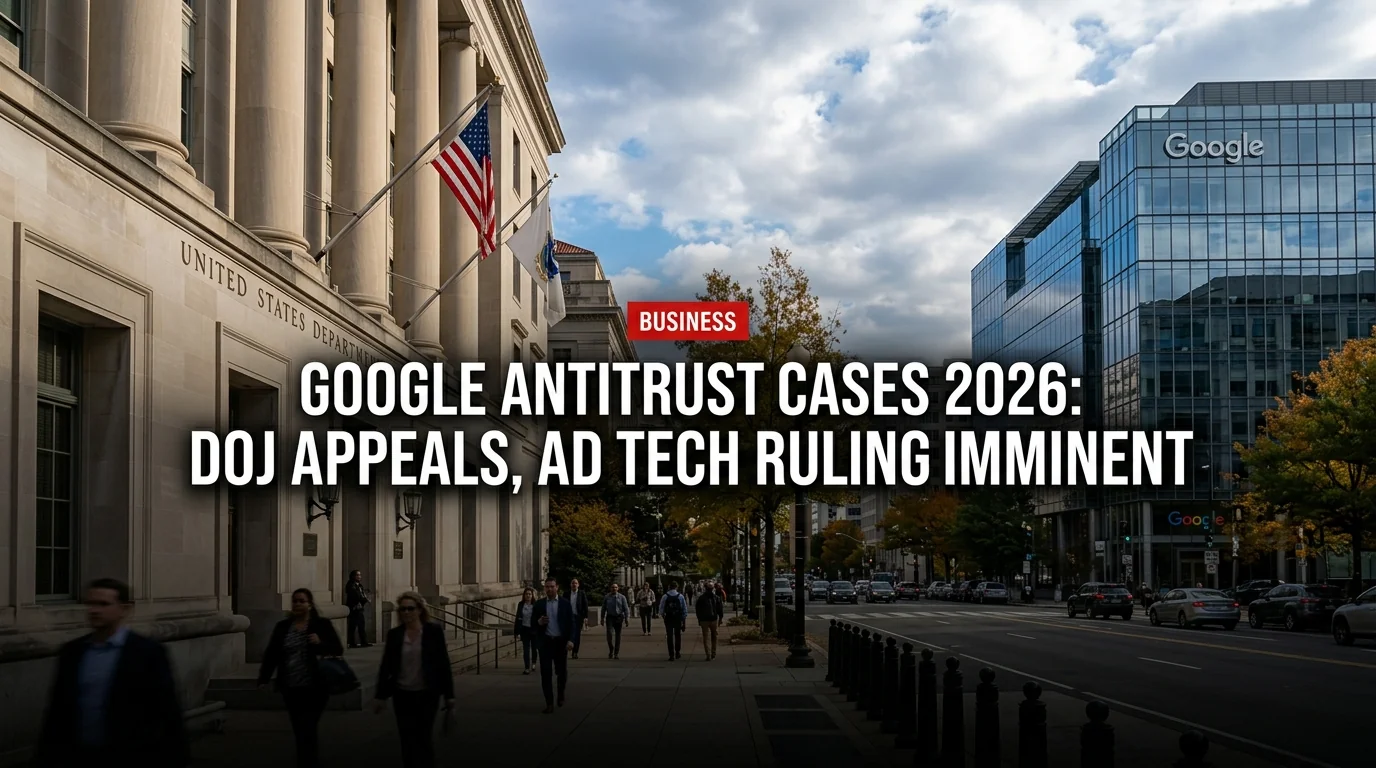
Google kept intact — but the fight is far from over. After two landmark antitrust losses, the courts rejected structural breakup in favor of behavioral remedies. Now the ad tech remedies ruling is imminent, and a cross-appeal is pushing for Chrome and Android divestitures anyway.
What Actually Happened — The Two Cases Explained
Google lost two separate federal antitrust cases. They're often confused — here's the distinction:
Case 1: US v. Google (D.C. District Court — Search Monopoly)
Judge Amit Mehta ruled in 2024 that Google illegally maintained its search monopoly through exclusive distribution deals — paying Apple billions to be the default search engine on iPhones, blocking competitors from the most valuable access points.
The remedies order came April 14, 2026. Judge Mehta's decision: no forced breakup. Instead:
- Google is banned from exclusive search distribution contracts
- Google must share its search index and user-interaction data with rivals
- A technical oversight committee will monitor compliance
- Chrome and Android divestitures: rejected
Case 2: US v. Google (Eastern District of Virginia — Ad Tech)
Judge Leonie Brinkema ruled in April 2025 that Google illegally monopolized publisher ad servers (DFP/DoubleClick for Publishers) and the ad exchange market (AdX), and illegally tied them together.
The remedies phase in this case is still ongoing. The DOJ demanded Google sell AdX and DFP outright. Google pushed back, arguing behavioral remedies suffice. Judge Brinkema set a March 31, 2026 self-imposed deadline for the ruling — that deadline passed. As of April 20, 2026, the ruling is overdue and expected imminently.
- No Chrome or Android breakup
- No Google divestiture of any product
- Banned: exclusive search distribution contracts
- Required: share search index data with competitors
- Required: technical committee oversight
Why Google's Stock Rose 65% Despite Losing
This seems paradoxical until you understand what Wall Street was actually worried about. For years, the nightmare scenario for Alphabet investors was forced structural breakup — spinning off Chrome, Android, or Google Search as separate companies.
When behavioral remedies were chosen over structural ones, the market re-rated Alphabet sharply upward. The actual remedies — sharing search data, prohibiting exclusivity deals — are operationally manageable. They don't threaten Google's core revenue engine.
The market was essentially saying: losing the legal case but keeping the business intact is the best-case outcome. And that's what happened.
- No breakup of Chrome, Android, or Search
- Behavioral remedies vs. structural ones
- Alphabet stock at multi-year highs
- Appeals process buys years before implementation
- Must share search index data with rivals
- Exclusive deals with Apple, Mozilla, others are now banned
- DOJ cross-appeal could reinstall Chrome/Android breakup demands
- Ad tech case ruling still pending — could require selling AdX
The Appeal: DOJ Is Still Pushing for More
Google filed a Notice of Appeal on January 16, 2026, challenging the data-sharing requirements and the technical oversight committee. The DOJ countered with a cross-appeal on February 3, 2026 — demanding the remedies order be strengthened to include Chrome and Android divestitures after all.
Both appeals are now before the D.C. Circuit Court of Appeals. Timeline:
- Briefing schedules expected mid-2026
- Oral arguments likely late 2026 or early 2027
- Final D.C. Circuit decision: 2027 at earliest
- Supreme Court involvement: possible but not certain
This means the status quo could persist for years while litigation grinds forward.
The Ad Tech Case: The One Still in Play
The ad tech remedies ruling is the most consequential decision still pending. This isn't about search market share — it's about Google's control of the digital advertising infrastructure itself.
Google operates on both sides of the ad marketplace:
- Supply side: DFP (DoubleClick for Publishers) — the tool publishers use to manage their ad inventory
- Demand side: Google Ads (formerly Google Ads) — the platform advertisers use to buy ads
- The exchange: AdX — the marketplace connecting buyers and sellers
Judge Brinkema found Google illegally tied these together, squeezing publishers and blocking rival ad exchanges from competing. The DOJ's remedy: force Google to sell AdX and DFP.
The DOJ argued this is the only structural fix that would restore competition. Google countered that it would destroy value, that no qualified buyer exists, and that any acquirer would face their own antitrust review.
Judge Brinkema acknowledged the practical challenges during closing arguments. No structural outcome is guaranteed — a behavioral remedy (like mandatory interoperability or third-party access requirements) remains possible.
What This Means for Different Stakeholders
For advertisers: In the short term, nothing changes. Google's ad products continue operating normally. If behavioral remedies are ordered (interoperability requirements), you may eventually have more choice about which ad exchange handles your spend.
For publishers: If structural remedies are ordered (sell AdX/DFP), the ad tech market could restructure meaningfully over 2–5 years. More competition could mean better publisher revenue splits. But it could also create transition costs and uncertainty.
For Google users: The search remedies — banning exclusive distribution deals — theoretically give rivals like DuckDuckGo and Bing a fairer shot at becoming device defaults. In practice, Google will still dominate because users actively prefer it, not just because of exclusivity deals.
For Alphabet investors: The behavioral-only outcome in the search case was priced in positively. The ad tech ruling is the remaining unknown. A sell-AdX order could shave 10–15% off Alphabet's display advertising revenue — significant but not existential.
The Bigger Picture: Does Antitrust Still Work?
The Google cases raise uncomfortable questions about whether antitrust law, written in a pre-internet era, is equipped to address 21st century platform monopolies.
Google found guilty of monopolization — twice — and the result is:
- Don't make exclusivity deals (you can still be the default if users choose you)
- Share your search index data with rivals
- Maybe sell your ad exchange (ruling pending)
Critics argue behavioral remedies are insufficient because they don't change the structural advantage Google has accumulated over 25 years: the search index itself, the user data, the brand, the distribution infrastructure.
Supporters counter that breaking up companies creates its own market distortions and that behavioral oversight, if rigorously enforced, can work.
The D.C. Circuit appeal will revisit these questions. Whatever it decides will set the precedent for how America handles Big Tech antitrust for the next decade.