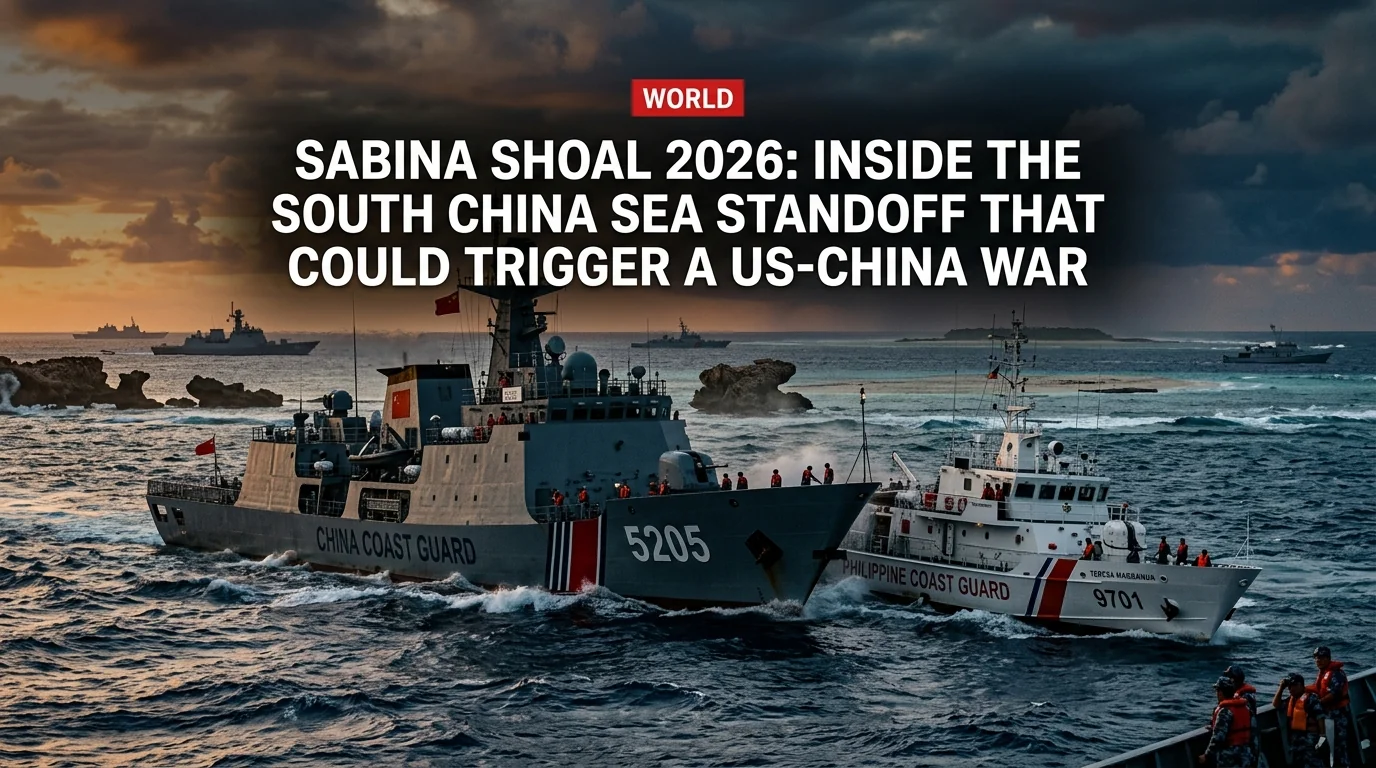
A 115-square-kilometer coral reef in the South China Sea has become the most dangerous flashpoint between the world's two largest militaries. Sabina Shoal — known as Escoda Shoal in Manila and Xianbin Jiao in Beijing — sits just 75 nautical miles from the Philippine island of Palawan but over 600 nautical miles from mainland China. And in March 2026, it remains under a near-permanent blockade by up to 70 Chinese vessels.
Here's everything you need to know about the standoff, why it's escalating, and what happens if someone blinks.
Why Sabina Shoal Matters
Sabina Shoal isn't just another disputed reef. It's the rendezvous point for Philippine resupply missions to Second Thomas Shoal, where the rusting BRP Sierra Madre — deliberately grounded in 1999 — serves as Manila's physical claim to the area. Control Sabina Shoal, and you control access to the Sierra Madre. Lose access, and the Philippines risks a repeat of the 2012 Scarborough Shoal disaster, when Manila withdrew its ships under a diplomatic deal only to watch China seize permanent control.
::keyfacts
- Location: 75 nautical miles west of Palawan, Philippines
- Area: 115 square kilometers of coral reef
- Distance from China: Over 600 nautical miles from the mainland
- Legal status: Within the Philippines' 200-nautical-mile Exclusive Economic Zone
- Trade at stake: $3 trillion in annual ship-borne trade passes through the South China Sea ::/keyfacts
The Timeline: From Deployment to Blockade
The current crisis began in April 2024 when the Philippine Coast Guard discovered crushed corals at Sabina Shoal — evidence of what Manila suspects was "surreptitious reclamation" by China. The Philippines responded by deploying its 97-meter multi-role vessel, the BRP Teresa Magbanua, to establish a presence.
::timeline
- April 15, 2024 — Philippines deploys BRP Teresa Magbanua to Sabina Shoal after discovering crushed corals
- July 3, 2024 — China sends its "Monster Ship" CCG 5901 (12,000 tons, the world's largest coast guard vessel) to intimidate the crew
- August 19, 2024 — First major collision between Philippine and Chinese coast guard vessels
- August 31, 2024 — CCG 5205 rams the Magbanua three times, damaging its bridge wing
- September 15, 2024 — After 150 days, the Magbanua withdraws to Palawan for repairs and medical evacuations
- October 12, 2025 — Major escalation near Thitu Island involving water cannons and rammings
- March 2026 — Philippines maintains "permanent-rotational" presence, challenged by up to 70 Chinese vessels ::/timeline
The Numbers Tell the Story
::stats
- 207 — Peak Chinese vessels monitored in the West Philippine Sea in late 2024
- 71 — Chinese ships clustered specifically around Sabina Shoal
- 150 — Days the BRP Teresa Magbanua held position before structural damage forced withdrawal
- 12,000 tons — Weight of China's "Monster Ship" CCG 5901, deployed to intimidate
- $400 billion — Size of the Philippine economy threatened by South China Sea instability ::/stats
What Each Side Says
The rhetoric gap between Manila and Beijing is widening.
::versus
| Philippines | China | |
|---|---|---|
| Claim basis | 200-nautical-mile EEZ under UNCLOS | "Nine-dash line" historical claim |
| Legal backing | 2016 Hague Tribunal ruling in Philippines' favor | Rejects the ruling as "null and void" |
| Strategy | Transparency policy — publicize every Chinese aggression | "Rights protection actions" — blockades, water cannons, ramming |
| Key quote | "We will not be intimidated... we have a right to be in Escoda Shoal" — Commodore Jay Tarriela | "The root cause is that the Philippines sent ships to permanently occupy it" — Spokeswoman Mao Ning |
| Ally support | US Mutual Defense Treaty covers coast guard vessels | Russia, Cambodia provide diplomatic backing |
| ::/versus |
Philippine President Ferdinand Marcos Jr. has shifted to a "transparency policy" — essentially live-streaming Chinese aggression to the world. It's a bet that global attention will deter Beijing more than quiet diplomacy ever did.
China, meanwhile, has consistently framed the Philippines as the provocateur. Spokeswoman Mao Ning has called Philippine deployments an attempt to "permanently occupy" the shoal, while the China Coast Guard issues operational warnings through spokesperson Liu Dejun.
The US Factor: Could This Trigger Article IV?
This is the question that keeps defense analysts awake at night.
Article IV of the 1951 US-Philippines Mutual Defense Treaty states that an armed attack on Philippine public vessels — including coast guard ships — anywhere in the South China Sea would trigger mutual defense obligations. The US State Department has repeatedly reaffirmed this, with Ambassador MaryKay Carlson being vocal about Washington's commitment.
::alert warning Experts fear a "collision-induced sinking" or the death of a Filipino sailor could force invocation of the Mutual Defense Treaty, dragging the United States into a direct confrontation with China over a coral reef most Americans have never heard of. ::/alert
Stanford University's SeaLight maritime transparency project, led by Ray Powell, describes the situation as a "gray zone" conflict — China using non-military hulls to achieve military objectives without crossing the threshold that would trigger a full-scale war. It's a strategy designed to slowly change facts on the ground (or water) while staying just below the line.
The Environmental Toll
The geopolitical standoff has an ecological cost that rarely makes headlines. University of the Philippines marine scientists report that coral health in parts of Sabina Shoal is "almost 100% dead" following the dumping of crushed coral materials. The reef destruction isn't collateral damage — it appears deliberate, likely preparation for potential island-building similar to China's artificial islands elsewhere in the Spratlys.
What Happens Next
Three developments to watch:
1. A new legal case. The Philippines is expected to file before the Permanent Court of Arbitration regarding environmental destruction at Sabina Shoal. While China ignored the 2016 ruling, a new case would further isolate Beijing diplomatically.
2. A shift in tactics. The PCG is moving away from "single-ship long-term" deployments — which left the Magbanua vulnerable — toward more frequent, high-speed rotational patrols designed to outmaneuver blockades.
3. The red line. The math is simple: with 70+ Chinese vessels conducting aggressive maneuvers against Philippine coast guard ships, the probability of a fatal incident grows with every patrol. And a fatal incident changes the calculus entirely.
The South China Sea has always been a slow-burning crisis. Sabina Shoal in 2026 is where the temperature is highest — and where the consequences of miscalculation could reshape the entire Indo-Pacific order.