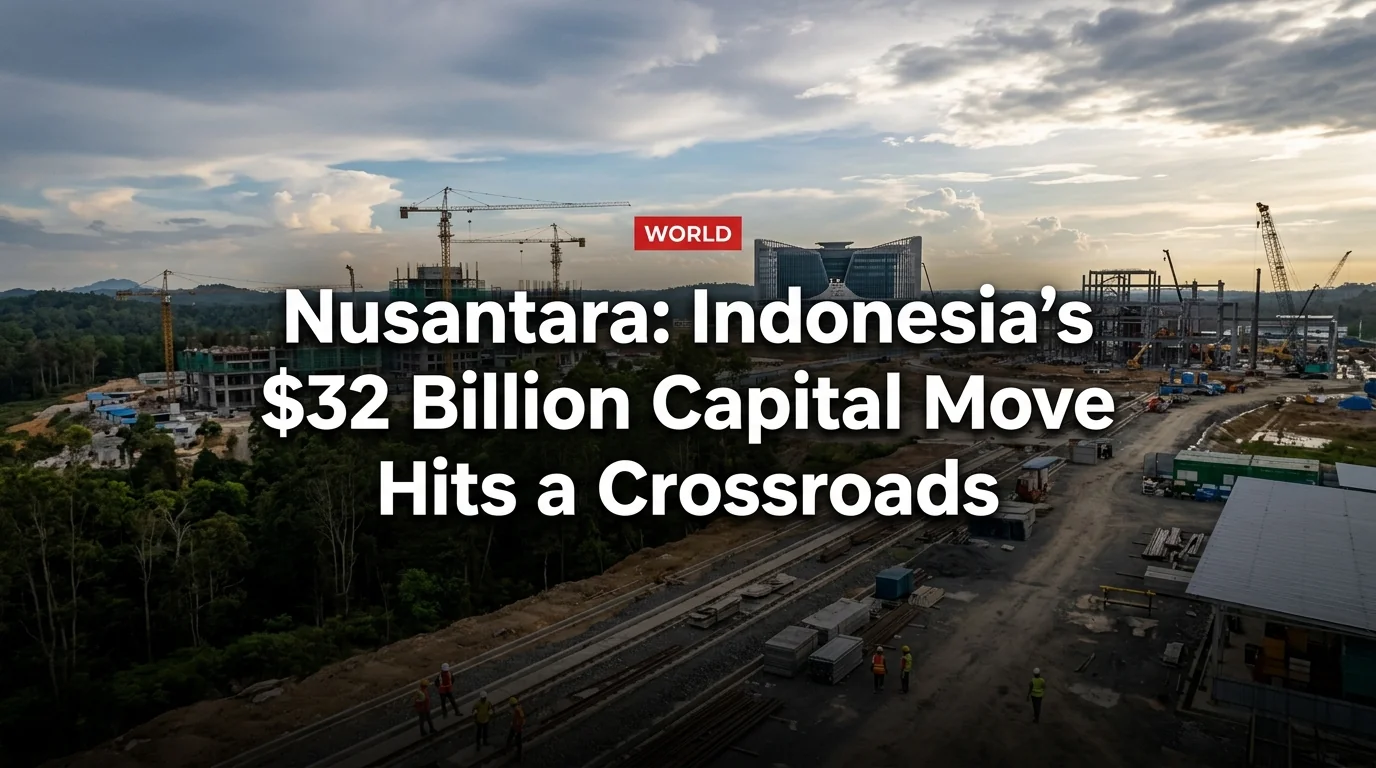
Indonesia is building one of the most ambitious cities in modern history — and in March 2026, the project stands at a critical inflection point. Nusantara, the $32 billion replacement capital carved from Borneo's rainforest, is simultaneously taking physical shape and losing financial momentum.
Four thousand civil servants are scheduled to relocate this year. The Garuda Palace stands complete. Legislative buildings are under construction. But state funding has collapsed from $2 billion in 2024 to just $300 million allocated for 2026 — a 85% cut that has critics warning of a ghost city in the jungle.
Why Indonesia Is Moving Its Capital
Jakarta is sinking. Literally.
The megacity of 11 million people drops up to 25 centimeters per year in its worst-hit northern districts, making it the fastest-sinking major city on Earth. Chronic flooding, gridlocked traffic costing $4.5 billion annually, and extreme overcrowding on the island of Java — home to 56% of Indonesia's 280 million people — drove former President Joko Widodo to announce the relocation in August 2019.
- Location: East Kalimantan, Borneo — spanning Penajam Paser Utara and Kutai Kartanegara regencies
- Total area: 256,142 hectares (990 square miles) — roughly four times the size of Singapore
- Target population: 1.9 million residents by 2045
- Project cost: $32–45 billion over five development phases
- Funding model: 20% state budget, 80% private and foreign investment
The name "Nusantara" — an Old Javanese term meaning "archipelago" — was adopted when Parliament passed the IKN Law on January 18, 2022. Construction broke ground six months later.
Where Things Stand in 2026
Phase 1 is over 80% complete. The centerpiece Garuda Palace — a presidential office designed by sculptor Nyoman Nuarta in the shape of Indonesia's mythical eagle — is finished. Ministry buildings, civil servant apartments, a hotel, and a bank are operational. An international airport is under construction at a cost of $261 million.
But the timeline has already slipped. The original plan called for a full inauguration in 2024. That was quietly abandoned when infrastructure fell behind schedule. Under President Prabowo, who took office in October 2024, the project was formally reclassified — Nusantara is no longer planned as a full replacement capital but as a "political capital," with Jakarta retaining its economic dominance.
The Money Problem
This is where the project faces its sharpest challenge. The numbers tell a stark story.
Relative state funding index (2022–2024 period = 100). The 2025–2029 allocation of Rp 48.8 trillion ($2.9B) represents roughly 60% of what was spent in the previous three-year period alone.
The funding model always relied on private investment covering 80% of costs. On paper, the Nusantara Capital City Authority (OIKN) reports Rp 225 trillion ($13.8 billion) in total investment commitments from 42 companies. In practice, only about $4 billion has actually been realized.
Major players include China's CITIC Construction (residential towers), Malaysia's IJM Corporation (infrastructure), and domestic giants like Ciputra Group. Tech partnerships with Microsoft, Cisco, and Autodesk aim to build Nusantara as a "smart city" from the ground up. Stanford University's Doerr School of Sustainability is exploring a research center on-site.
But the gap between commitments and cash flow is real. "The private sector is watching the government's commitment level before making large deployments," noted analysts at ASEAN Briefing.
Ghost City or Future Metropolis?
The debate has sharpened in recent months. Vice President Gibran Rakabuming Raka — Jokowi's eldest son and an obvious political bridge between the project's founder and its current steward — has instructed his office to begin operating from Nusantara. His secretariat facilities are nearly complete.
- Reduces catastrophic risk of governing from a sinking city
- Decentralizes wealth from Java to outer islands
- Phase 1 physically over 80% complete
- Smart city infrastructure being built from scratch with global tech partners
- 42 companies committed with $13.8B in pledges
- State funding cut 85% from peak levels
- Only $4B of $13.8B in commitments actually deployed
- Downgraded from full capital to "political capital" only
- Indigenous Balik communities report land displacement
- Greenpeace cites deforestation and ecological damage
- Civil servants reportedly unenthusiastic about jungle relocation
Critics haven't held back. Greenpeace Indonesia's Arie Rompas has called it a "haphazard and reckless project that violates the rights of indigenous communities." The Balik people, indigenous to the area, face displacement as construction expands.
Environmental concerns extend beyond land rights. Clearing tropical rainforest for a city contradicts Nusantara's stated goal of becoming carbon-neutral by 2045. President Prabowo has responded by revising the development plan to include more reservoirs and forest fire prevention measures — an implicit acknowledgment that the original environmental planning was inadequate.
What Comes Next
The 2026–2028 window is decisive. Legislative and judicial buildings broke ground in December 2025 with a December 2027 completion target. If those buildings are finished and Parliament actually convenes in Nusantara by 2028, the political capital becomes real. If funding continues to shrink and construction stalls, the ghost city narrative wins.
President Prabowo's January 2026 overnight stay was widely interpreted as a symbolic recommitment. "My presence here demonstrates the government's commitment to ensuring development proceeds according to plan," he told reporters.
But symbolism won't pour concrete. Indonesia's new capital needs the private sector to convert pledges into bulldozers — and the private sector needs the government to show that Nusantara is more than a political trophy project.
The world's fourth-most-populous nation is betting that it can build a capital city from scratch in the middle of Borneo. Twenty-six months into construction, the question is no longer whether Nusantara will exist. It's whether it will matter.