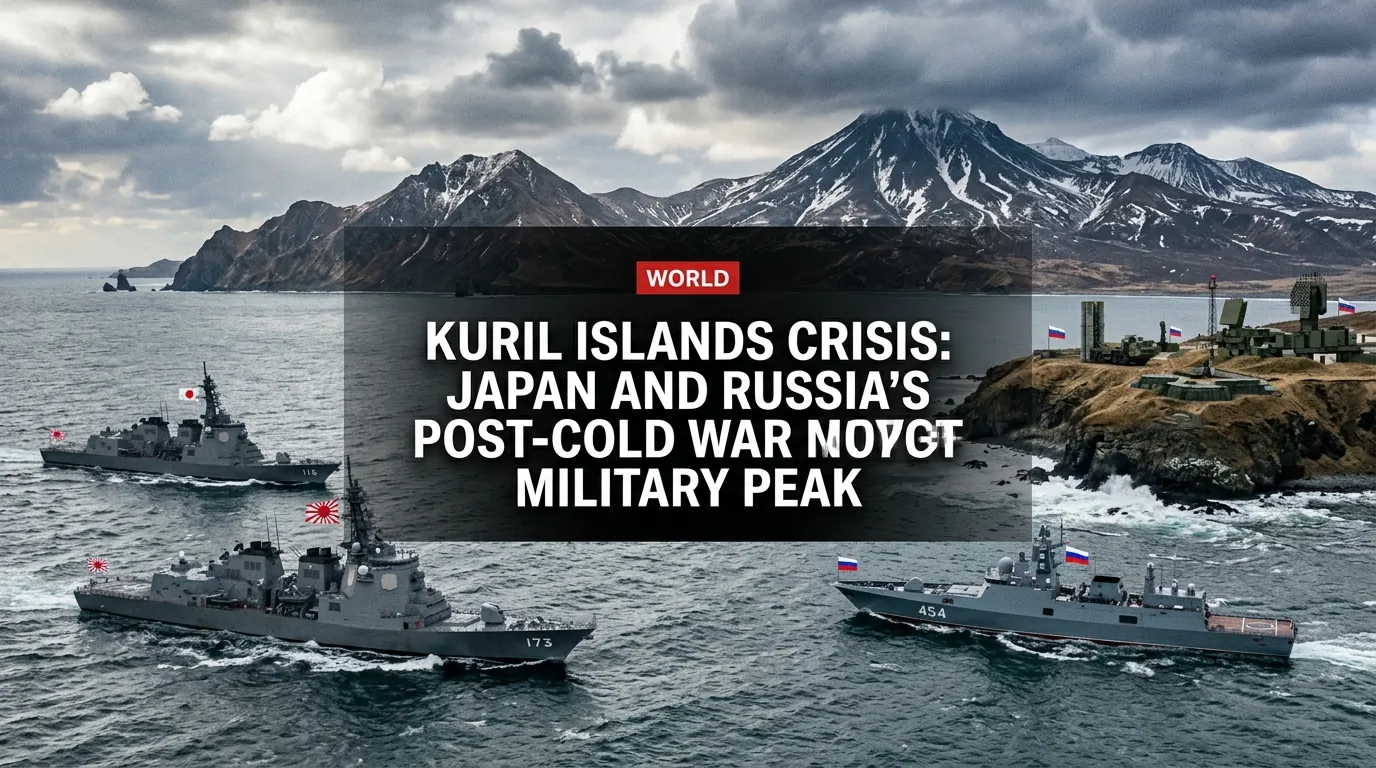
Japan and Russia are locked in their most dangerous military standoff since the Cold War over four windswept islands in the Pacific — and both sides are digging in.
The Kuril Islands dispute, an 80-year-old territorial conflict that has prevented a formal peace treaty since World War II, reached a new inflection point in early 2026 when the Kremlin declared bilateral relations had been "reduced to zero."
- **Dispute duration:** 80+ years with no peace treaty signed
- **Russian troops deployed:** ~3,500 on southern Kurils
- **Japan's FY2026 defense budget:** ¥9.04 trillion ($58 billion) — record high
- **Military infrastructure:** 51 Russian objects built on the islands since 2021
- **Contested territory:** 4 islands — Etorofu, Kunashiri, Shikotan, and the Habomai islets
The Military Buildup in Numbers
Both nations have been quietly transforming the region into one of the most heavily armed flashpoints in the Pacific.
- 3,500 troops (18th Machine Gun-Artillery Division)
- Bastion anti-ship missiles (300–500 km range)
- Bal coastal missiles (120–260 km range)
- S-300V4 air defense systems
- 51 military infrastructure projects since 2021
- Yasen-M submarine with Zircon hypersonic missiles (deploying late 2026)
- Type 12 upgraded missiles (1,000 km range)
- $640 million "Shield" coastal defense system
- MQ-9B Sea Guardian surveillance drones
- High-speed gliding missiles at Camp Kamifurano
- Record ¥9.04 trillion ($58B) defense budget
- US Typhoon missile deployment on Hokkaido
The missile math tells the story. Russia's Bastion systems on Iturup can strike ships 500 kilometers out — far enough to cover the waters around Hokkaido. Japan's upgraded Type 12 missiles, now with a 1,000-kilometer range, can reach deep into Russia's Far East from bases in Hokkaido and Kumamoto.
How We Got Here
The crisis didn't appear overnight. It's the product of a slow-motion escalation that accelerated sharply after Russia's 2022 invasion of Ukraine.
The Key Players
The standoff is shaped by leaders on both sides who have little incentive to back down.
Prime Minister Sanae Takaichi, Japan's first female PM and a noted security hawk, has accelerated Japan's shift from pacifist self-defense to what her government calls "proactive deterrence." She has repeatedly called the Kuril Islands "illegally occupied" — language her predecessors largely avoided.
On the Russian side, Vladimir Putin has signaled he intends to visit the disputed islands personally — a move that would be seen as a deliberate provocation in Tokyo. Russia's 2020 constitutional amendments now explicitly ban ceding sovereign territory, making any future territorial compromise legally impossible under Russian law.
Defense Minister Shinjiro Koizumi has described the current security environment as "the severest and most complex in the postwar era" — a statement validated by the numbers.
The Ukraine Factor
Russia's war in Ukraine has had a paradoxical effect on the Kuril standoff. Satellite imagery from Maxar Technologies confirmed in late 2025 that some S-300V4 air defense units were quietly moved from Iturup to Ukraine to replace battlefield losses — temporarily thinning Russia's northern defenses.
This redeployment reveals the strain Russia's military faces in maintaining two confrontation zones simultaneously. But it also means Moscow is compensating with naval power — the nuclear submarine Perm, armed with Zircon hypersonic missiles capable of Mach 9, is scheduled to join the Pacific Fleet before year's end.
The Human Cost
Behind the missile ranges and defense budgets, the dispute carries a deeply personal dimension. In Nemuro, the Hokkaido city closest to the disputed islands, former residents — now averaging 90 years old — fear they will never visit their ancestral graves again.
The visa-free humanitarian visits that once allowed elderly Japanese to cross the strait were terminated by Moscow in March 2022. Three years later, there is no indication they will resume.
What Comes Next
Japan's "Shield" program — a $640 million multi-layered coastal defense network using uncrewed air, sea, and underwater assets — will begin testing long-endurance MQ-9B Sea Guardian drones over the northern approaches in 2026. High-speed gliding missiles designed for island defense are scheduled to complete deployment at Camp Kamifurano in Hokkaido by the end of the fiscal year.
Russia shows no signs of de-escalating. Admiral Alexander Moiseev is overseeing a modernization of the Pacific Fleet that includes not just the Perm submarine but expanded anti-submarine warfare capabilities in the Kuril straits.
- Neither side wants actual conflict — deterrence is the stated goal
- International trade ties create economic incentive for stability
- US alliance provides Japan extended deterrence umbrella
- Russia's constitution now bans ceding territory — no legal path to compromise
- Both nations deploying offensive-capable systems, not just defensive
- China-Russia joint naval patrols around Japan add a third dimension of risk
- Former residents dying without resolution — humanitarian clock is running out
As Temple University professor James D.J. Brown puts it, the standoff is a "race of patience." But with Russia's constitution banning territorial concessions and Japan's military transformation accelerating under Takaichi, patience may be the one resource in shortest supply.
The four small islands between Hokkaido and Kamchatka have never been more heavily armed — and the two nations that claim them have never been further from agreement.