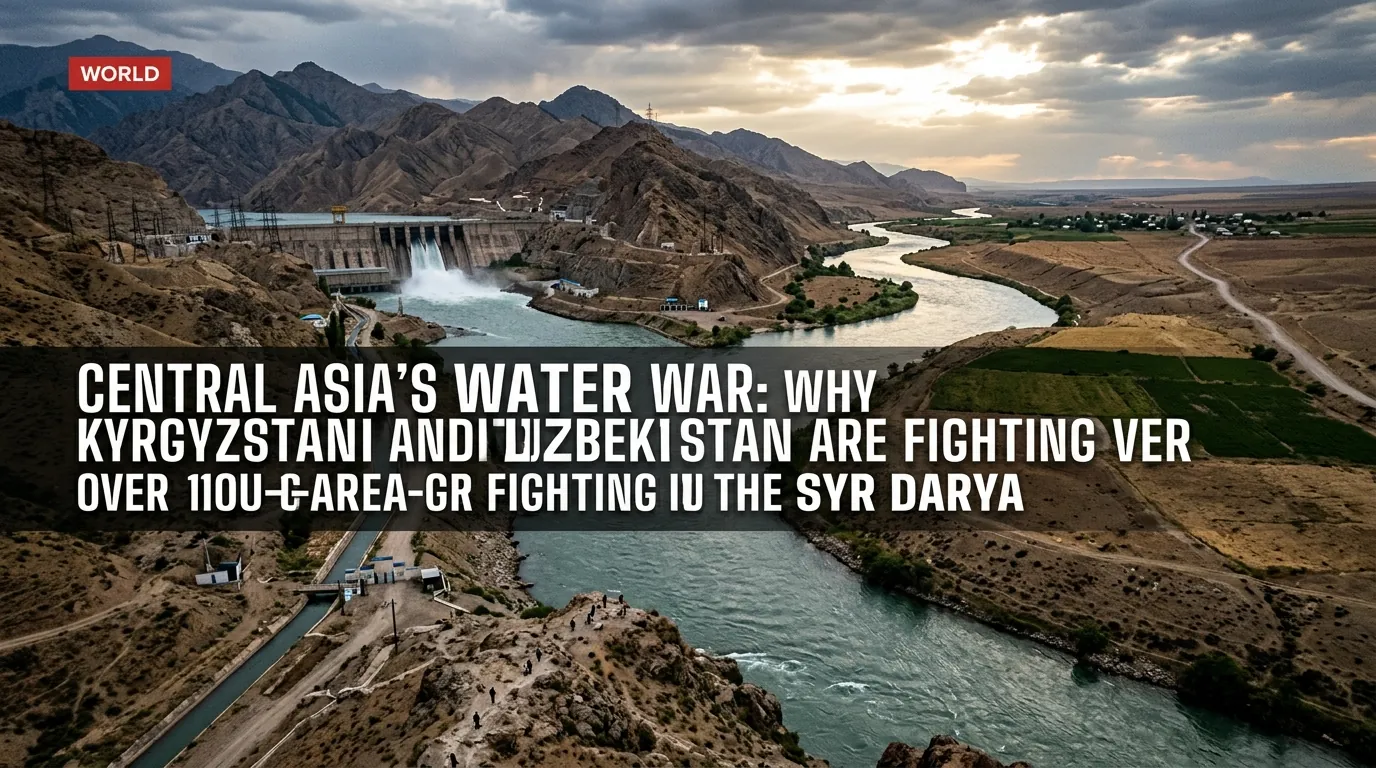
A diplomatic crisis is unfolding across Central Asia as Kyrgyzstan and Uzbekistan clash over control of the Syr Darya river — a 2,200-kilometer lifeline that irrigates the Fergana Valley and powers hydroelectric dams feeding millions of people.
The dispute escalated in March 2026 after Kyrgyzstan restricted water flow from the Toktogul Reservoir, its primary hydropower source, triggering emergency meetings in Tashkent and angry parliamentary debates in Bishkek.
What's Actually Happening
The immediate trigger: Kyrgyzstan's decision to hold back water at the Toktogul Reservoir for winter hydropower generation left downstream Uzbekistan facing irrigation shortfalls in the Fergana Valley — Central Asia's most densely populated and agriculturally vital region.
On February 9, Kyrgyz MP Umbetaly Kydyraliev publicly demanded that Uzbekistan and Kazakhstan start paying for water, stating: "80% of the water in our reservoirs goes to Kazakhstan and Uzbekistan... how are we resolving this?"
The remark triggered a diplomatic firestorm. Uzbek Ambassador Saidikram Niyazhodjaev responded by highlighting Uzbekistan's investment in water-saving technology, noting the country has expanded water-efficient irrigation from 4% to 60% coverage across 2.6 million hectares.
Who Gets What: The 2026 Water Allocation
The Interstate Coordination Water Commission (ICWC) set strict limits for the 2025–2026 season, allocating 4.219 billion cubic meters from the Syr Darya. The split reveals the power imbalance at the heart of the dispute:
| Country | 2026 Allocation | Share of Total | Role |
|---|---|---|---|
| Uzbekistan | 3.347 bcm | 79.3% | Largest consumer — cotton irrigation |
| Kazakhstan | 0.460 bcm | 10.9% | Downstream agriculture |
| Tajikistan | 0.365 bcm | 8.6% | Upstream tributary access |
| Kyrgyzstan | 0.047 bcm | 1.1% | Controls the taps, gets the least |
Kyrgyzstan controls the Toktogul Reservoir — the region's master valve — yet receives just 1.1% of the water it releases. This asymmetry drives the political anger in Bishkek.
The $3.6 Billion Dam That Could Change Everything
At the center of the long-term dispute sits the Kambar-Ata-1 Hydroelectric Project, a proposed trilateral joint venture between Kyrgyzstan, Uzbekistan, and Kazakhstan. The $3.6 billion dam on the Naryn River (a major Syr Darya tributary) would regulate seasonal water flow and generate massive hydropower.
- Regulates water flow for year-round agricultural irrigation
- Generates clean hydropower for energy-starved Kyrgyzstan
- Trilateral ownership could align national interests
- Reduces Kyrgyzstan's winter energy imports
- Gives Kyrgyzstan strategic leverage over downstream water supply
- Construction timeline stretches past 2030
- Uzbekistan fears operational control disputes
- Environmental impact on the Naryn River ecosystem unknown
Meanwhile, Uzbekistan isn't waiting. State power company Uzbekhydroenergo is building six new hydropower plants on the Naryn River, a move that has alarmed Kyrgyz officials who view it as encroachment on their upstream sovereignty.
A Crisis Decades in the Making
The roots trace back to the Soviet Union's collapse in 1991. Under Moscow, a simple barter existed: upstream Kyrgyzstan stored water in summer for downstream irrigation, and downstream Uzbekistan sent coal and gas upstream in winter for heating.
Post-independence, that deal died. Kyrgyzstan began releasing water in winter for hydropower revenue. Uzbekistan started charging market prices for gas. Trust evaporated.
The Numbers That Should Terrify the Region
The trajectory is stark. Per capita water availability has dropped by 70% in a single generation, and the region's population continues to grow. The New Lines Institute warned in February 2026 that Central Asia faces a "chronic deficit" by 2030 if current patterns hold.
The Afghanistan Wild Card
Complicating everything: Afghanistan's Qosh Tepa Canal, under construction on the Amu Darya and expected to become operational by 2028. The canal could divert up to 30% of the Amu Darya's flow for Afghan agriculture.
If that happens, Uzbekistan — which depends on both the Amu Darya and Syr Darya — will be forced to draw even more from the Syr Darya, further starving downstream Kazakhstan and intensifying the upstream fight with Kyrgyzstan.
*2026 Syr Darya water allocation by country (% of total flow)*What Happens Next
The Kempir-Abad flashpoint remains unresolved. Kyrgyzstan transferred control of the Kempir-Abad (Andijan) Reservoir to Uzbekistan under a controversial 2022 deal, and over 20 Kyrgyz activists were arrested for protesting the "secretive" handover. The issue continues to fuel nationalist sentiment in Bishkek.
Uzbekistan is racing to modernize, planning to concrete-line 80% of its canals by 2028 to stop the 40% seepage losses. Kyrgyzstan wants the Kambar-Ata-1 dam built. Kazakhstan is mediating through its IFAS chairmanship.
But the glaciers don't negotiate. With 80% of Tian Shan glaciers already shrinking and temperatures rising at twice the global average, the math is simple: there will be less water every year and more people who need it.
The question isn't whether Central Asia's water war will get worse. It's whether diplomacy can move faster than the ice melts.
Sources: ICWC 91st Meeting Report, Times of Central Asia, Astana Times, New Lines Institute, 24.kg, Asia-Plus