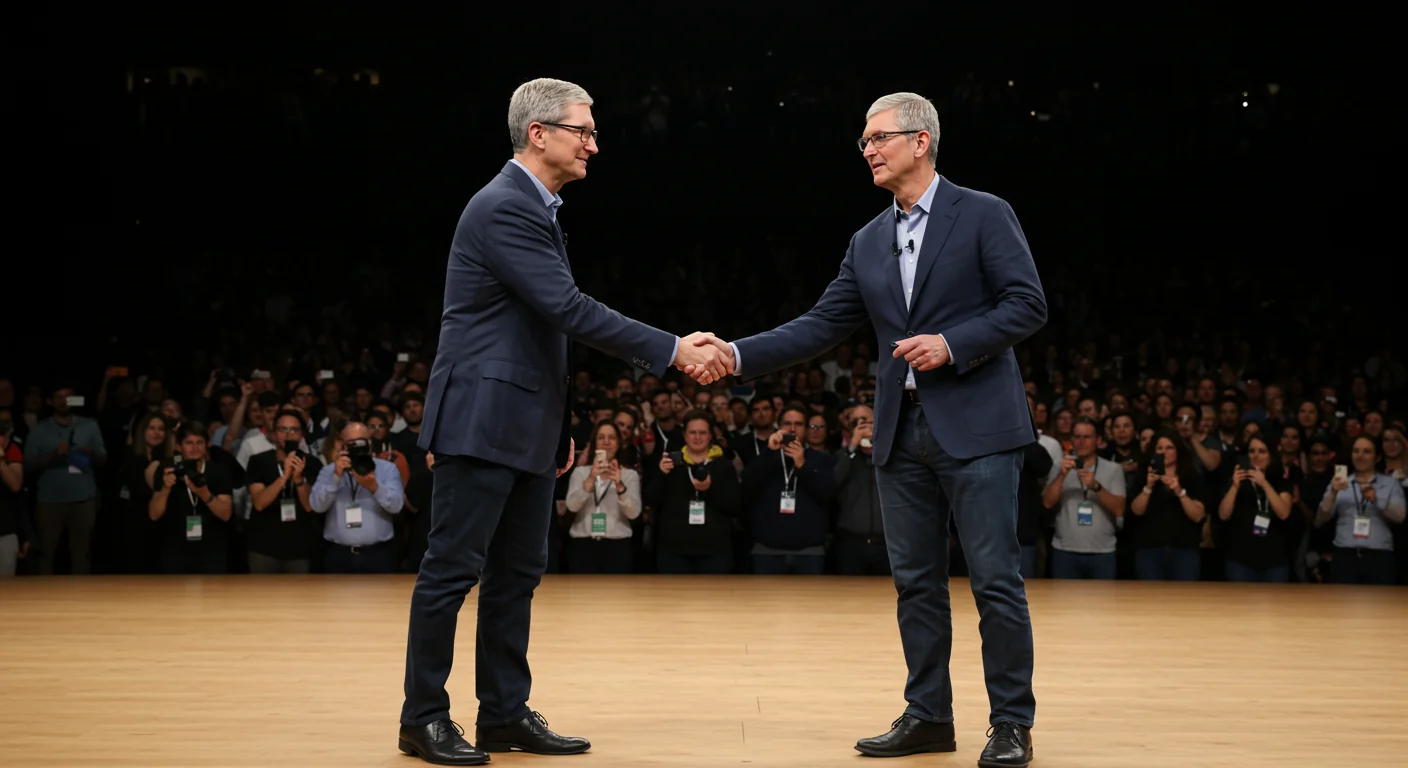
Apple made one of the biggest leadership announcements in corporate history on April 20, 2026: Tim Cook, who has run the company for 15 years and turned it into a $4 trillion giant, will step down as CEO on September 1, 2026. His successor is John Ternus, currently Apple's Senior Vice President of Hardware Engineering and a 25-year company veteran.
Cook will not disappear entirely — he transitions to the role of Executive Chairman, remaining involved at the board level while Ternus takes operational control.
Who Is John Ternus?
If you follow Apple product launches closely, you already know John Ternus — he's been the face of Apple's hardware presentations for years, taking the stage to introduce new iPhone 18s, M-series Macs, and AirPods generations.
Born in 1975, Ternus earned a mechanical engineering degree from the University of Pennsylvania in 1997, where he also competed on the swim team. He started his career designing virtual reality headsets at Virtual Research Systems before joining Apple in 2001 as part of the product design team — his first project was the Apple Cinema Display.
Over 25 years, he worked his way up through every major hardware category:
- 2013 — Named VP of Hardware Engineering under Dan Riccio, overseeing AirPods, Mac, and iPad
- 2020 — Added iPhone hardware to his portfolio
- 2021 — Promoted to SVP of Hardware Engineering, replacing Riccio
- 2022 — Took charge of Apple Watch hardware
Ternus was instrumental in the M-series Apple Silicon transition — the chip family that transformed Mac performance and margins — and oversaw the modern AirPods lineup from concept to market dominance.
- Ternus joined Apple in 2001 — 25 years ago
- He's a mechanical engineer by training
- He will be Apple's 8th CEO
- Effective date: September 1, 2026
- Cook becomes Executive Chairman (stays on board)
Tim Cook's 15-Year Legacy by the Numbers
When Steve Jobs handed Cook the CEO role in August 2011, Apple was already a success story. What Cook did next was almost incomprehensible in scale.
Cook's signature moves were less about flashy product invention and more about ruthless operational excellence and strategic expansion:
Apple Watch and AirPods. Both launched under Cook's watch. Both became category-defining products that now generate tens of billions per year. AirPods alone consistently outsell every other headphone brand combined.
Services. Cook transformed Apple from a hardware company into a services juggernaut. Apple Music, iCloud, Apple TV+, Apple Arcade, and the App Store ecosystem now produce $109 billion in annual revenue — a business that barely existed when Cook took over.
Apple Silicon. The M1 through M4 chip transitions shifted Mac from Intel dependency to Apple-designed silicon with dramatically better performance-per-watt. This was Ternus's hardware project executed under Cook's strategic direction.
Supply chain. Before becoming CEO, Cook was Apple's supply chain wizard. He applied that same discipline globally, building a manufacturing network that let Apple ship hundreds of millions of devices per year with remarkable consistency.
What Does a Hardware-First CEO Mean for Apple?
The obvious question: does Ternus's hardware background signal a strategic shift?
Analysts are divided. The bull case: Apple's next growth chapter — spatial computing (Vision Pro line), AI-integrated hardware, smart glasses, health sensors — is fundamentally a hardware problem. Having a CEO who built the M-series chips and AirPods understands this territory at a molecular level.
The bear case: Services has been Apple's most reliable growth engine. A CEO whose instinct is hardware could underinvest in software and subscription ecosystem development at exactly the wrong moment.
- Deep expertise in Apple Silicon, iPhone, Mac, wearables
- Understands hardware-AI integration at the chip level
- 25-year institutional knowledge — not an outsider disruption
- Trusted internally; avoids leadership vacuum risk
- Vision Pro and future spatial computing is a hardware bet
- Less experience managing services, software, or finance
- Cook staying as Chairman may create tension over strategy
- No track record running a $4 trillion public company
- Investors may react cautiously to uncertainty
Apple Stock Reaction
Apple stock slipped modestly on the news before stabilizing, reflecting the market's mixed read. Investors largely expected a leadership change — Cook is 65 and had been publicly discussing succession planning. The choice of Ternus, an insider with deep product credibility, was seen as less disruptive than an external hire would have been.
Apple's board clearly prioritized continuity. Cook as Executive Chairman provides a safety net, and Ternus has worked alongside Cook long enough that the strategic playbook is unlikely to reverse overnight.
The Transition Timeline
What Stays the Same
For consumers, the immediate answer is: almost everything.
Apple's product roadmap is set years in advance. The iPhone 18 lineup, next-generation Macs, and whatever Apple has planned for Vision Pro are already deep in development. Ternus has been the engineering lead on those products. Switching from engineering chief to CEO doesn't change what ships — it changes who sets the five-year vision.
The bigger question is how Ternus handles the macro challenges Cook navigated: tariffs, China manufacturing dependencies, antitrust pressure from the EU and US, and the AI arms race where Apple has been perceived as playing catch-up to OpenAI and Google.
Cook was a diplomat-CEO — patient, process-driven, politically careful. Ternus is an engineer. That difference in temperament will likely become visible in Apple's public positioning within the first year.
A Historic Handoff
Apple has had only seven CEOs in its history. Steve Jobs defined the company's creative soul. Cook industrialized it into the most valuable company on Earth. Ternus inherits a near-impossible brief: maintain $4 trillion in market value, keep the iPhone franchise healthy, build the next hardware category, and not make Tim Cook look bad.
For a company that has pulled off that kind of transition before — from Jobs to Cook, arguably the most scrutinized CEO succession in tech history — there is at least precedent for it working.
The clock starts September 1.