
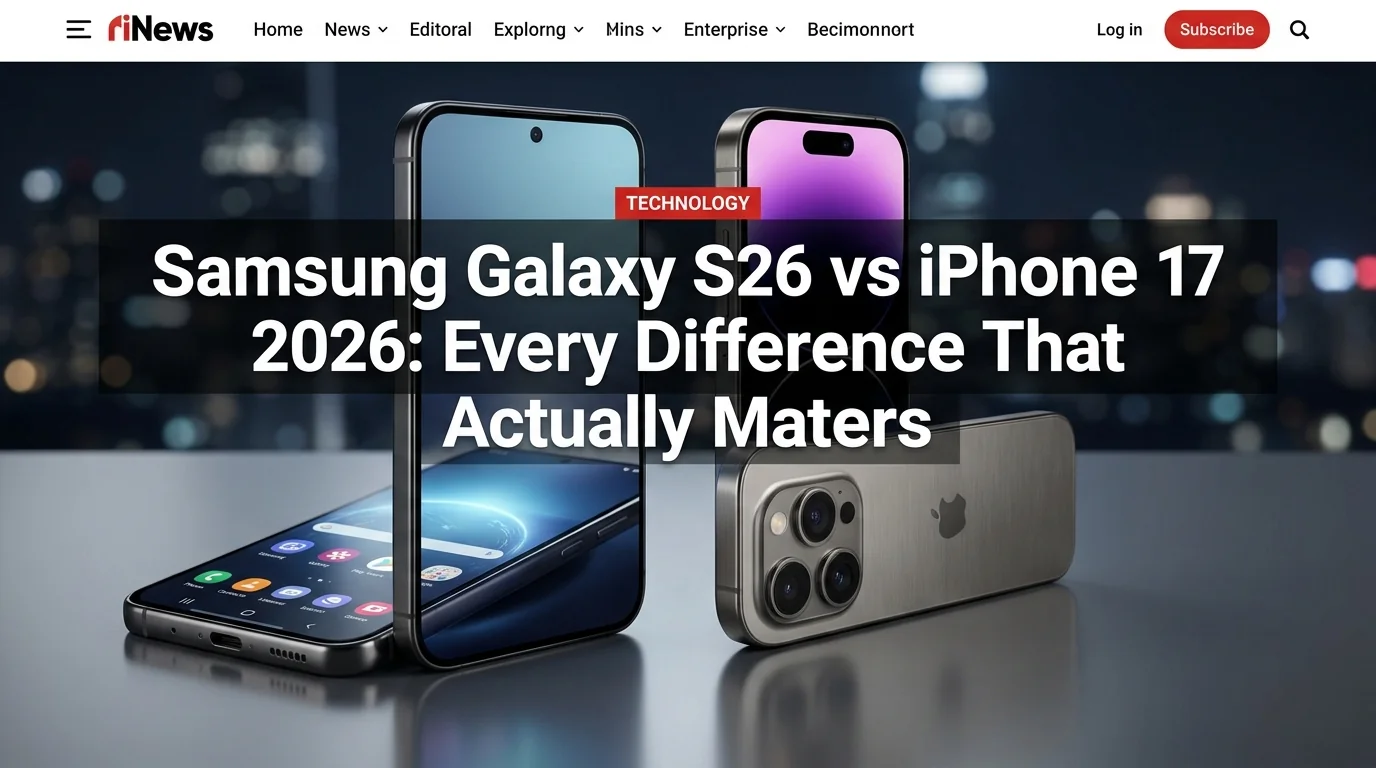
The two biggest flagship phones of 2026 are finally head-to-head: Samsung's Galaxy S26 at $900 versus Apple's iPhone 17 at $800. On paper, the iPhone 17 costs $100 less. In practice, the choice is more complicated than price. Here's every difference that actually matters.
- Starts at $900
- 6.3-inch, 2340x1080, 2650 nits
- Snapdragon 8 Elite Gen 5
- 50MP + 12MP + 10MP 3x telephoto
- 4300mAh, 25W wired
- Galaxy AI (Gemini + Bixby + Perplexity)
- 7.2mm thin, 167g
- Starts at $800
- 6.3-inch, 2622x1206, 2160 nits
- Apple A19 chip
- 48MP main + 12MP ultrawide
- All-day battery, 30W wired
- Apple Intelligence + Siri 2.0
- Titanium frame option on Pro
Price: iPhone 17 Wins on Value (But Not by Much)
The iPhone 17 starts at $800, the Galaxy S26 at $900. A $100 gap sounds significant — but both phones are priced for the same buyer: someone who wants the best mid-size flagship without going Ultra or Pro Max.
The full lineup breakdown:
- iPhone 17: $800 | Galaxy S26: $900
- iPhone 17 Pro: $1,100 | Galaxy S26+: $1,100
- iPhone 17 Pro Max: $1,200 | Galaxy S26 Ultra: $1,300
At the top end, the iPhone 17 Pro Max actually undercuts the Galaxy S26 Ultra by $100. For the base model, Apple has the price advantage — and in 2026, with tariff uncertainty still affecting electronics, that $100 gap has held steady because Apple shifted significant assembly to India.
Display: Different Priorities
Both phones sport a 6.3-inch screen — same size, different character.
The Galaxy S26 hits 2,650 nits peak brightness, making it one of the brightest phones available. Outdoor visibility in direct sunlight is excellent. The resolution is 2340 x 1080 (411 PPI).
The iPhone 17 counters with 2,622 x 1,206 resolution at 460 PPI — noticeably sharper pixel density — but tops out around 2,160 nits. In most conditions you won't spot the brightness difference, but you will notice the iPhone's crisper text rendering, especially at smaller font sizes.
Winner: Galaxy S26 for outdoor use; iPhone 17 for crisp detail and content consumption.
Performance: Both Are Overkill (In Different Ways)
The Galaxy S26 runs Qualcomm's Snapdragon 8 Elite Gen 5 in the US — a generational leap in AI processing that Samsung built its new Galaxy AI features around. The Exynos 2600 (used elsewhere) closes the gap considerably compared to previous years.
Apple's A19 chip maintains Apple's traditional lead in single-core performance and efficiency. The A19 Pro in the Pro models adds a more capable Neural Engine for Apple Intelligence tasks.
Real-world verdict: both phones handle everything you'll throw at them — games, 4K video, multitasking. The S26 has a slight edge in multitasking via split-screen and pop-up windows that iOS still doesn't match. The iPhone 17 is more efficient, with fewer thermal throttling episodes under sustained load.
Camera: Two Very Different Philosophies
Camera is where this comparison gets interesting — and where your priorities determine the winner.
Galaxy S26 camera system:
- 50MP main (f/1.8)
- 12MP ultrawide
- 10MP 3x telephoto
- Galaxy AI Photo Assist (prompt-based editing)
- Audio Eraser for video noise removal
- Night photography: class-leading dynamic range
iPhone 17 camera system:
- 48MP main with larger sensor
- 12MP ultrawide with autofocus
- No telephoto on base model (Pro models only)
- Apple Intelligence photo cleanup
- Best-in-class video: LOG format, Action mode
The Galaxy S26 has a telephoto on the base model — iPhone 17 doesn't. That alone makes the S26 better for general photography if you zoom often. Samsung's computational photography has caught up significantly; the 50MP main produces excellent shots with strong dynamic range.
But for video, iPhone 17 remains the benchmark. LOG format recording, better audio processing, and consistency across lighting conditions keep Apple ahead for creators. If you shoot video more than photos, the iPhone is still the pick.
Battery: Galaxy S26 Lasts Longer
Samsung boosted the S26's battery to 4300mAh, up from 4000mAh on the S25. In testing, the Galaxy S26 routinely reaches nearly three days of moderate use before needing a charge. That's exceptional for a slim flagship.
The iPhone 17 delivers solid all-day battery (18-22 hours typical use) but rarely stretches to a second full day without a charge.
The catch: charging speeds favor iPhone 17. Apple improved wired charging to 30W on the iPhone 17, while Samsung stays at 25W wired and 15W wireless — unchanged from the S25. The Galaxy S26 battery is bigger, but it charges slower.
AI Features: Galaxy AI vs Apple Intelligence
This is the defining battleground for 2026 flagships.
Samsung Galaxy AI bets big on third-party partnerships. The S26 ships with:
- Gemini (Google's AI, deeply integrated)
- Bixby (Samsung's assistant, improved)
- Perplexity integration (AI search built into the home screen)
- Nudge: AI that reads your screen and proactively suggests actions
- Now Brief: personalized daily insights, reminders from booking confirmations and contacts' birthdays
- Audio Eraser: removes background noise from videos in post
Apple Intelligence + Siri 2.0 on the iPhone 17 takes the opposite approach — Apple does it all in-house, with heavy emphasis on privacy (on-device processing first):
- Siri 2.0 with full app context awareness
- Writing tools across every app
- Smart photo cleanup and memory generation
- ChatGPT integration for Siri overflow queries
- Priority Notifications with AI summarization
Galaxy AI has more features and more partners. Apple Intelligence works more consistently and privately. Neither is definitively better — it depends on whether you want a broad AI ecosystem or a tightly integrated one.
Design: Galaxy S26 Is Thinner and Lighter
The Galaxy S26 is remarkably thin at 7.2mm and weighs just 167 grams. It's one of the slimmest flagship phones from a major manufacturer in 2026.
The iPhone 17 is slightly heavier and thicker — though Apple's industrial design with the titanium frame on Pro models feels more premium in-hand. The base iPhone 17 uses an aluminum frame.
Both have Gorilla Glass Victus 2 (S26) and Ceramic Shield (iPhone 17) on the front. Both are rated IP68 for water resistance.
Who Should Buy Which?
- Telephoto lens on the base model
- Significantly better battery life (nearly 3 days)
- Brighter display for outdoor use
- More AI features and third-party integrations
- Thinner and lighter design
- $100 more expensive than iPhone 17
- Slower charging (25W vs 30W)
- Android app ecosystem still trails iOS for some categories
- Exynos variant in most non-US markets
Buy the Galaxy S26 if:
- You're on Android and want the best mid-size Samsung flagship
- Battery longevity matters more than charging speed
- You shoot photos more than video and want optical zoom
- You want the thinnest possible phone
- You value having multiple AI systems (Gemini + Perplexity + Bixby)
Buy the iPhone 17 if:
- You're in the Apple ecosystem (Mac, iPad, AirPods, Apple Watch)
- Video quality is your priority
- You want to save $100 without sacrificing performance
- Privacy-first AI appeals to you
- You prefer Apple's tighter software experience
The Verdict
There's no bad choice here. Both are genuinely excellent phones that will last you three or four years.
The Galaxy S26 edges ahead on hardware specs: better battery, brighter display, telephoto camera, and thinner build. The $100 premium is real but justified if those features matter to you.
The iPhone 17 wins on ecosystem cohesion, video quality, price, and the fact that if you're already in Apple's world, switching costs are high. For most iPhone upgraders, there's no compelling reason to cross the aisle.
If you're buying new with no loyalty to either platform: the Galaxy S26's battery life and camera versatility make it the better hardware value. But hardware is only half the story — and for many people, software and ecosystem make the iPhone 17 the right call regardless.