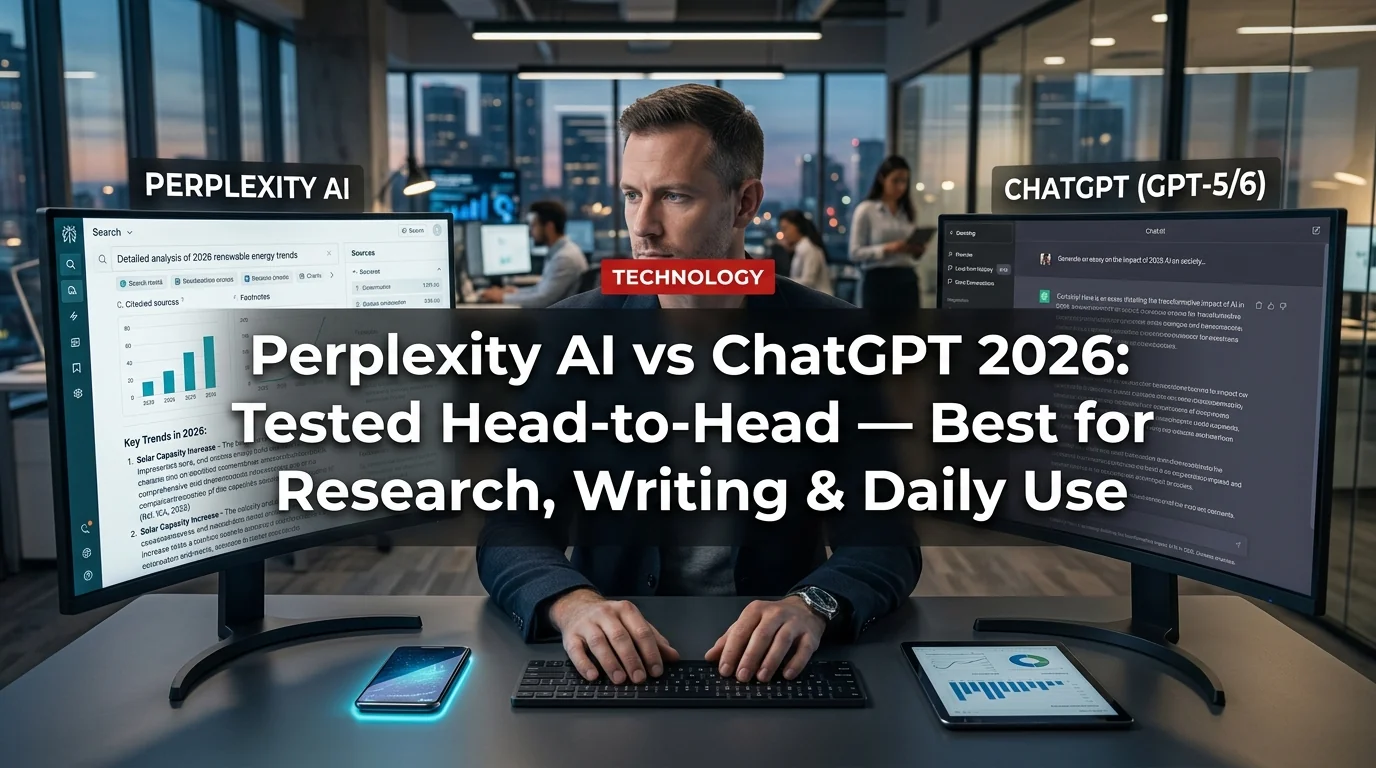
Perplexity AI and ChatGPT look similar on the surface — you type a question and get an answer. But they're built for fundamentally different jobs, and choosing the wrong one for the wrong task will cost you time and accuracy. We tested both in April 2026 across five real-world scenarios. Here's what we found.
What They Actually Are
Perplexity AI is an AI-powered search engine first. It answers questions by actively searching the web, citing its sources, and synthesizing results from authoritative pages in real time. Think of it as Google + an AI analyst that explains what it found.
ChatGPT (GPT-5.2, as of April 2026) is a general-purpose AI assistant. It can search the web when needed, but its core strength is reasoning, writing, coding, and conversation — not live information retrieval. For a broader look at all major AI tools, see our best AI chatbots 2026 ranked list. It's also gained significant new tools: Canvas for document editing, custom GPTs, and the ChatGPT Agent for autonomous task completion.
They overlap, but they're not the same product.
Head-to-Head: 5 Real Test Scenarios
Test 1: Research Accuracy
We asked both tools to answer ten factual questions requiring up-to-date information — market data, recent news, product specifications, and scientific findings.
Result: Perplexity wins clearly.
Independent benchmarks from LMSYS (April 2026) show Perplexity achieving 92% factual accuracy on real-time queries versus ChatGPT's 87%. More striking: Perplexity's citation error rate is 37% versus ChatGPT's 67% — meaning ChatGPT is nearly twice as likely to attribute a claim to the wrong source.
Perplexity's sources are also higher quality on average. Its results lean heavily toward academic journals, government sites, and established publications. ChatGPT's web search pulls from a wider range, including lower-credibility sources.
Winner: Perplexity AI
Test 2: Long-Form Writing
We gave both tools the same prompt: write a 600-word analysis of remote work trends in 2026, suitable for publication.
Result: ChatGPT wins.
ChatGPT produced a piece with smooth narrative flow, varied sentence structure, and a clear editorial voice. It felt like something a human journalist might write.
Perplexity's output was accurate and well-cited — but structured like a research briefing. It leaned heavily on bullet points, subheadings, and factual chunks rather than narrative prose. Perfectly functional for internal reports; less suitable for readers.
Winner: ChatGPT
Test 3: Coding Help
We asked both to debug a Python script with three intentional errors, then write a new function for processing JSON data.
Result: ChatGPT wins convincingly. For a deeper coding and task comparison with another major rival, check our ChatGPT vs Gemini 2026 test.
ChatGPT found all three bugs, explained why each was wrong, and wrote clean, commented code for the new function. It also caught a potential edge case we hadn't mentioned.
Perplexity identified two of three bugs and provided working code — but without explanations or edge case handling. It's not designed as a coding assistant, and it shows.
Winner: ChatGPT
Test 4: Daily Information Queries
We tested quick everyday queries: "What's the latest on [current news topic]?", "What's the best way to [do a specific task]?", and "How does [current tech product] compare to [competitor]?"
Result: Perplexity wins.
For anything requiring current information, Perplexity is consistently faster and more accurate. It cites what it found, so you can click through to verify. ChatGPT is improving its live search, but it still occasionally confuses recent information or adds caveats that slow you down.
Winner: Perplexity AI
Test 5: Creative and Generative Tasks
We tested both on creative prompts: write a product description, generate email copy, brainstorm 10 angles for a marketing campaign, and write a short story opening.
Result: ChatGPT wins.
ChatGPT's creative range is broader and more expressive. Its Canvas feature (available in the Plus plan) lets you edit documents collaboratively, which is genuinely useful for writing workflows. Custom GPTs let you configure a persona and consistent style. Perplexity has no equivalent.
Winner: ChatGPT
Pricing Comparison
The free tiers are both usable. Perplexity Free gives 5 Pro Searches every 4 hours (standard searches are unlimited). ChatGPT Free gives GPT-5.2 with usage caps — enough for light daily use.
Verdict by Use Case
- Researching a topic and need cited, verifiable sources
- Checking facts or current events
- Comparing products with up-to-date specs
- You need to share sources with colleagues
- Writing long-form content (articles, emails, reports)
- Coding, debugging, or building tools
- Creative projects requiring narrative voice
- Automating multi-step tasks with ChatGPT Agent
The Smartest Workflow: Use Both
The most efficient setup in 2026 isn't choosing one over the other — it's using them in sequence.
Phase 1 (Perplexity): Research your topic. Collect facts, identify key stats, verify claims, note sources.
Phase 2 (ChatGPT): Take what you found and create something with it. Write the article, build the presentation, draft the email, or write the code.
This approach leverages each tool's strength: Perplexity's accuracy for input, ChatGPT's generative ability for output.
- Perplexity leads on factual accuracy and real-time information (92% vs 87%)
- ChatGPT leads on writing quality, coding, and creative tasks
- Both cost $20/month for Pro — ChatGPT Go at $8/month is a budget option
- Best workflow: research in Perplexity, create in ChatGPT
- Free tiers of both are genuinely usable for moderate daily use
Which Should You Pay For?
If you're picking one paid plan, the decision is simple:
- Information worker, researcher, student: Perplexity Pro at $20/month. The source quality and accuracy payoff is real.
- Writer, developer, marketer: ChatGPT Plus at $20/month. Canvas, custom GPTs, and the Agent justify the price.
- Budget-conscious: ChatGPT Go at $8/month covers most daily use cases at a price that's hard to argue with.
Both tools have improved substantially in the past year. If you want to add a third powerful option, our Gemini 3.1 Pro vs Claude Opus 4.6 vs GPT-5 benchmark breakdown covers all three head-to-head. The honest answer is that they serve different jobs — which means the real question isn't "Perplexity or ChatGPT?" but "what am I actually trying to do?"