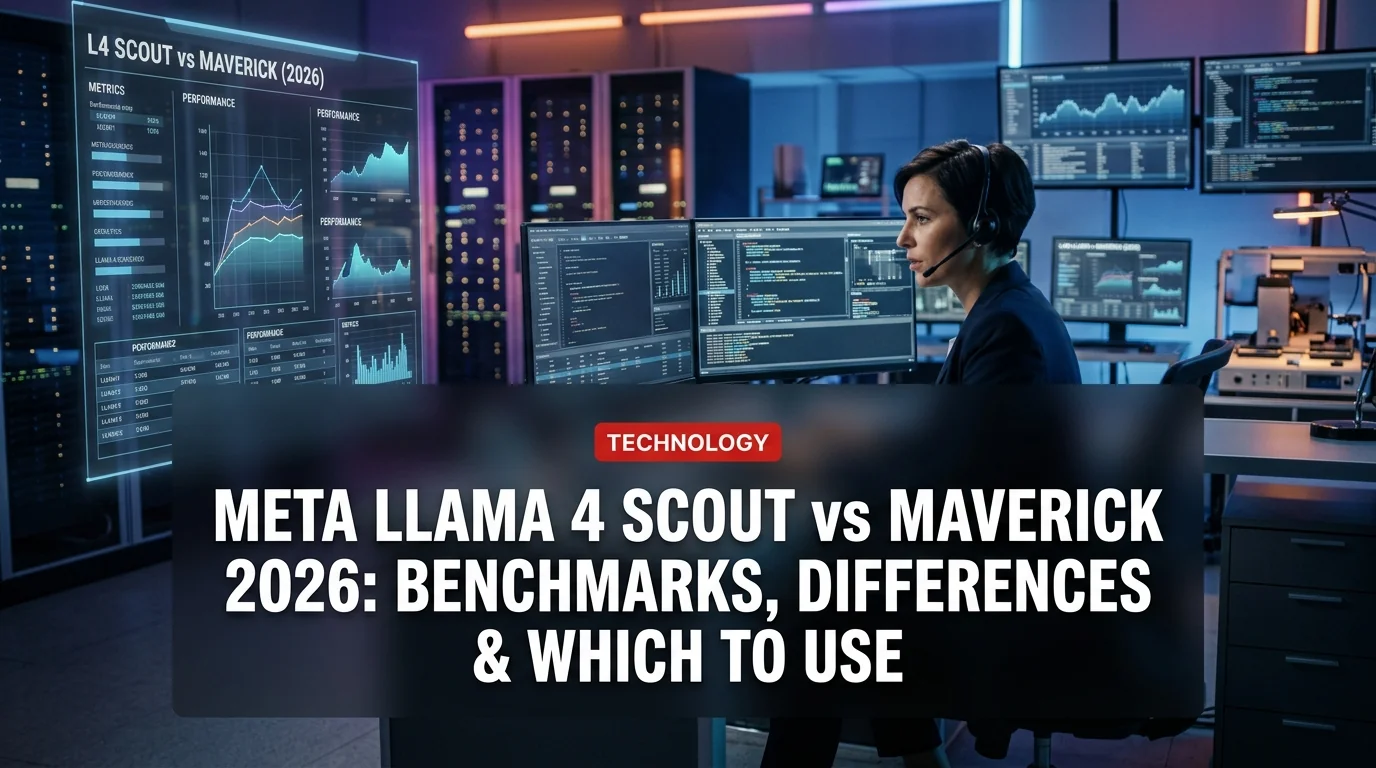
When Meta released Llama 4, it didn't launch one model — it launched a family. Llama 4 Scout and Llama 4 Maverick share the same 17 billion active parameters and MoE (Mixture-of-Experts) architecture, but they're built for radically different jobs. Scout has a 10 million token context window. Maverick has 128 experts and beats GPT-4o on benchmarks. Knowing which to use can mean the difference between the right tool and an expensive mistake.
The Core Difference in One Sentence
Scout is built for long-context, high-volume, cost-efficient workloads. Maverick is built for maximum reasoning, coding, and multimodal performance.
They're both Mixture-of-Experts (MoE) models, meaning only a fraction of their total parameters activate per token. But the number of experts — and the total parameter count — diverges significantly.
Architecture: Where They Split
Both models activate the same 17B parameters per forward pass — which is why inference costs are similar. But Maverick's pool of 128 experts (vs Scout's 16) gives the routing layer far more specialization to draw from, resulting in better performance on diverse, multi-domain tasks.
Scout makes a different bet: fewer experts, more context. Its 10 million token window is the largest of any open-weight model available in 2026 — 10x Maverick's 1M limit, and roughly 80x the 128K window from Llama 3.
Benchmark Comparison
Where Maverick wins: Meta benchmarked Maverick against the leading models of 2026 — GPT-4o and Gemini 2.0 Flash — and Maverick wins outright across 11 benchmarks including ChartQA, GPQA, LiveCodeBench, MATH, MathVista, MBPP, MGSM, MMLU, MMLU-Pro, MMMU, and TydiQA. On pure reasoning tasks, Scout trails Maverick by 8–12 percentage points.
Where Scout wins: Long-context retrieval is Scout's domain. When tasks require finding specific information across massive documents — entire codebases, multi-year financial reports, legal libraries — Scout's 10M token window is the deciding advantage. Maverick simply can't hold that much context in one pass.
Scout also outperforms Gemma 3, Gemini 2.0 Flash-Lite, and Mistral 3.1 on its own benchmark suite — it's not a weak model, just purpose-built differently.
Hardware Requirements
Here's where the real-world difference becomes stark:
- Scout: Fits on a single NVIDIA H100 GPU. That's deployable for most ML teams and feasible for local inference on high-end consumer hardware.
- Maverick: Requires a full H100 host (typically 8× H100s). It's a data center workload — not something you run on one machine.
For teams self-hosting, Scout is the practical choice. Maverick is better accessed via API from providers like Groq, Together AI, Fireworks, or Meta.ai.
Cost Comparison
At scale, the cost difference compounds quickly. Processing 10 billion tokens monthly costs roughly $800 with Scout vs $1,700 with Maverick — over 2x the cost for Maverick at high volume.
Which Model to Use: Decision Guide
Choose Llama 4 Scout when:
- You're processing long documents, legal filings, codebases, or financial reports
- Cost per token matters — high-volume API calls, batch processing
- You need 1M+ tokens in a single context window
- You're self-hosting and working with one H100
- The task is retrieval-heavy rather than reasoning-heavy
- Speed and throughput are critical (Scout is faster due to fewer experts)
Choose Llama 4 Maverick when:
- You need the best possible reasoning and coding performance
- The task involves complex math, science, or multi-step logic
- You're building multimodal applications (images + text)
- Benchmark accuracy matters more than cost
- You're accessing via API and don't need to self-host
- You want to compete with or replace GPT-4o in a pipeline
- 10M token context window
- 16 experts, 109B total params
- $0.08/$0.30 per 1M tokens
- Single H100 deployment
- Best for: long documents, batch, retrieval
- 1M token context window
- 128 experts, 400B total params
- $0.17/$0.60 per 1M tokens
- Multi-GPU deployment
- Best for: reasoning, coding, multimodal
How to Access Both Models for Free
Both Llama 4 Scout and Maverick are available at no cost through several channels:
Hugging Face (weights download):
- Search
meta-llama/Llama-4-Scout-17B-16Eormeta-llama/Llama-4-Maverick-17B-128Eon Hugging Face - Request access (approved quickly for most users)
- Download weights and run with vLLM, llama.cpp, or Ollama
Meta.ai: Meta's consumer AI product (meta.ai) runs Maverick in the background for free chat use — no setup required.
Free API providers:
- Groq offers free-tier access to both Scout and Maverick
- Together AI has free credits for new signups
- Fireworks AI offers pay-as-you-go with no minimums
IBM watsonx.ai: Both models are available on IBM's enterprise platform — useful for regulated industries.
- Both models released April 2026 under the Llama 4 Community License
- Free for commercial use unless you have 700M+ MAU
- Both are natively multimodal (text + images)
- MoE architecture means inference cost scales with active params, not total params
- Scout's 10M context window can hold ~7.5 million words in a single call
- Maverick outperforms GPT-4o on 11 of 11 tested benchmarks
Real-World Use Case Examples
Use Scout for:
- Ingesting and analyzing an entire GitHub repository in one call
- Processing a 500-page SEC filing without chunking
- Summarizing multi-year email threads or support ticket histories
- High-volume RAG pipelines where cost efficiency matters
- Legal discovery across thousands of documents
Use Maverick for:
- Competitive coding challenges and technical interviews
- Complex mathematical proofs and STEM problem solving
- Multimodal tasks: chart analysis, image captioning, document parsing
- Building chatbots that compete with GPT-4o quality
- Scientific research assistance requiring strong reasoning
The Bottom Line
Llama 4 Scout and Maverick aren't competing models — they're complementary tools. Meta built them for different jobs, and the naming reflects that philosophy: Scout explores wide territory efficiently; Maverick pushes hard on difficult targets.
For most developers getting started: use Maverick via API for quality-critical tasks, and switch to Scout when you hit cost or context-length constraints. For self-hosters: Scout is the only practical option on a single GPU.
Both are genuinely impressive in 2026 — and both are free to use.