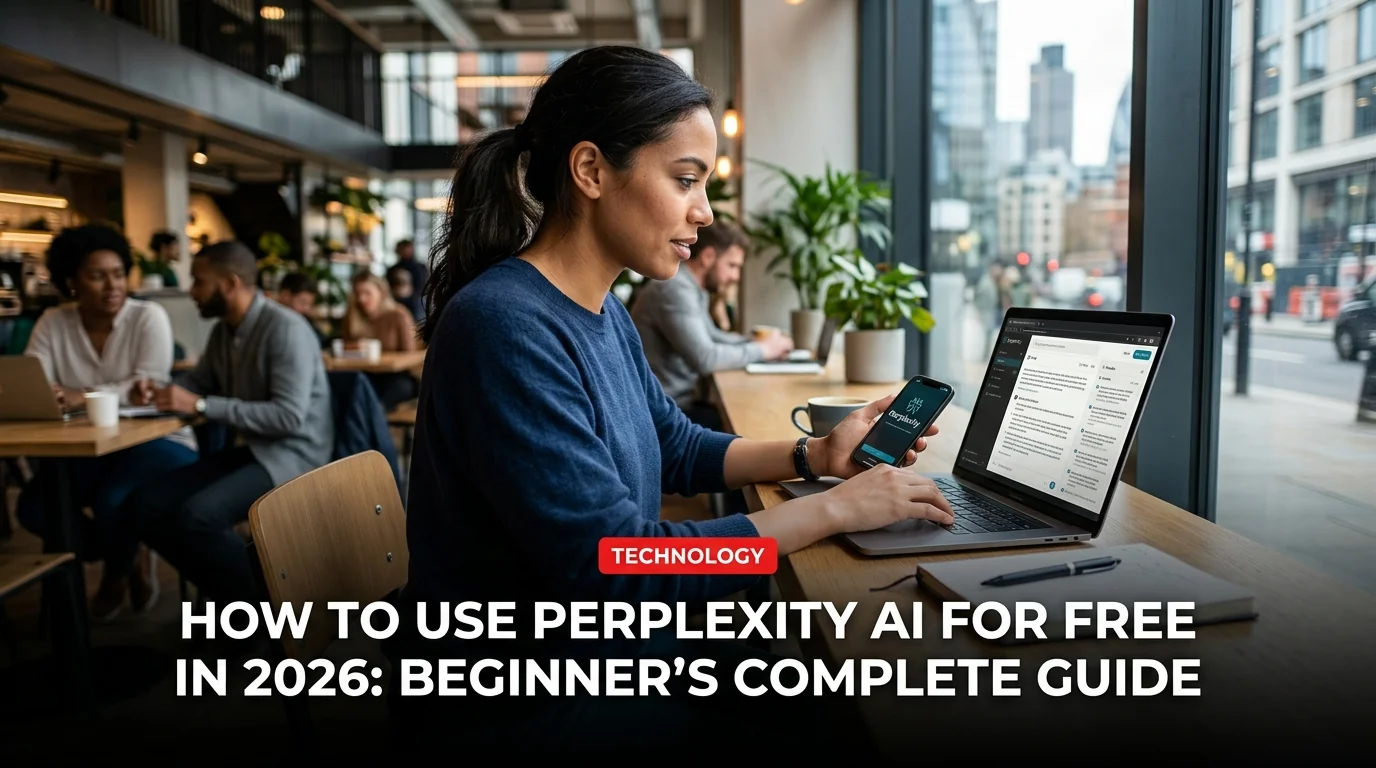
If you've tried ChatGPT but want answers that cite their sources and search the live web, Perplexity AI is worth 10 minutes of your time. It's not just another AI chatbot — it's a research engine that reads multiple websites in real time and delivers one coherent answer with numbered citations you can actually verify. Here's how to use it from scratch in 2026.
What Is Perplexity AI — and How Is It Different?
Perplexity AI is an AI answer engine. You ask a question; it searches the live web, reads the top sources, and synthesizes a direct answer — with numbered citations linking to every source it used.
- Searches the live web in real time
- Cites every source with clickable links
- Answers are current (minutes old)
- Better for: research, fact-checking, current events
- Knowledge cutoff — no live web access by default
- No citations on most answers
- May confidently state outdated information
- Better for: creative writing, coding, long-form content
The key distinction: Perplexity trades some conversational fluency for verifiability. You always know where the answer came from.
Step 1: Get Started (No Account Needed)
- Go to perplexity.ai in any browser
- Type your question in the search bar — be specific, like you're asking a smart colleague
- Hit Enter or click the arrow button
- Read the answer, then click the numbered citations to verify the sources
That's it. No signup, no API key, no credit card.
For the best experience, create a free account (top-right corner → Sign up). This unlocks:
- Search history saved across sessions
- Collections (organized research folders)
- 5 free Pro Searches per day
- Spaces for collaborative research
Step 2: Use Focus Modes for Better Results
Perplexity's biggest hidden feature is Focus — different search modes that prioritize specific source types. Click the "Focus" button (or the grid icon) before or after your query to switch modes.
- All — Default. Searches the broad web across all source types
- Academic — Prioritizes peer-reviewed papers, journals, and research databases
- Writing — Pulls writing guides, style examples, and structured explanations
- Wolfram — Routes math and computational questions to Wolfram Alpha for precise answers
- YouTube — Searches video transcripts — great for finding what someone said in a video
- Reddit — Searches Reddit threads for real user opinions and personal experiences
Example: Ask "best budget mechanical keyboard" on All focus vs Reddit focus — Reddit gives you unfiltered community recommendations, while All gives you review articles. Both are useful for different intents.
Step 3: Write Better Queries
Perplexity works best when you're specific. Unlike Google, you don't need to keyword-optimize — ask in plain language.
Weak query: protein powder
Better query: What's the best protein powder for someone who is lactose intolerant and trains 4 days a week?
Weak query: Python list comprehension
Better query: Explain Python list comprehensions with examples, including when NOT to use them
You can also ask follow-up questions in the same thread — Perplexity maintains context across the conversation, so each follow-up narrows or expands on the original answer.
Step 4: Organize Research with Collections
Collections are Perplexity's answer to bookmarks — folders where you save related searches and build a searchable research archive over time.
How to create a Collection:
- After getting an answer, click the bookmark icon (top-right of the answer)
- Click New Collection or add to an existing one
- Name your collection (e.g., "Mortgage research 2026" or "Competitor analysis")
- Every answer in that collection is searchable and timestamped
Collections are especially useful for ongoing projects where you're researching the same topic across multiple sessions.
Free vs Pro: What You Actually Get
- Unlimited basic searches, no cap
- 5 Pro Searches per day (uses advanced models)
- Access to all Focus modes
- Collections, history, and Spaces
- Works without an account
- Pro Searches limited to 5/day
- No access to Claude Opus, GPT-5, or Gemini Pro
- File uploads capped (limited pages)
- No AI image generation
- Slower during peak hours
Perplexity Pro is $20/month (or ~$200/year). It unlocks:
- Unlimited Pro Searches
- Choose your AI model: Claude Opus 4.6, GPT-5.4, Gemini 3 Pro, or Mistral
- Upload PDFs, documents, and spreadsheets for analysis
- AI image generation via DALL-E and SDXL
- Advanced Research mode for multi-step deep dives
For casual use — current events, quick research, fact-checking — the free tier handles 90% of use cases. Upgrade to Pro if you do daily in-depth research, work with documents, or need specific AI models.
How to Get Perplexity Pro Free
Two legitimate ways to get Pro without paying:
- Student email: Sign up with a .edu address for a full year free (worth $240). Available through the Perplexity Education program at perplexity.ai/education.
- Xfinity subscribers: Eligible Comcast/Xfinity customers get 12 months of Pro free as a subscriber benefit. Check xfinity.com for eligibility.
Pro Search vs Basic Search: When to Use Each
Not every question needs Pro Search. Knowing when to spend your daily Pro credits saves them for what matters.
Use Basic Search for:
- Simple factual questions (who won the Masters 2026?)
- Quick definitions or explanations
- News lookups and current events
- Anything you'd normally Google
Use Pro Search for:
- Complex research requiring multiple source types
- Nuanced comparisons (best mortgage rate today)
- Technical questions with conflicting information
- Anything where source quality matters
Perplexity Spaces: Collaborative Research
Spaces are shared workspaces where teams or individuals can save queries, share findings, and build collective research hubs. Think of them as collaborative Collections.
You can create a Space around a topic (e.g., "2026 home buying research") and invite others — or keep it private. Each Space has its own search history and saved answers.
Spaces are available on both free and Pro accounts.
Perplexity vs Google vs ChatGPT: Which to Use When
- Perplexity — Best for: cited research, current events, source-verified facts, academic questions
- Google — Best for: local search, maps, shopping, image search, finding specific websites
- ChatGPT — Best for: writing, coding, brainstorming, creative tasks, long-form output
- Perplexity Pro — Best for: deep research with document uploads and model switching
The practical workflow most people land on: use Perplexity for research and fact-finding, ChatGPT for creating and writing, and Google when you need a specific website or local result.
FAQ
Is Perplexity AI actually free? Yes. Unlimited basic searches with no account required. Creating a free account adds history, Collections, and 5 daily Pro Searches.
Does Perplexity always give accurate answers? Better than most AI tools, because every claim is cited. But it can still synthesize sources incorrectly — always click the numbered citations to verify important facts before acting on them.
Can I use Perplexity on mobile? Yes. Perplexity has iOS and Android apps that are free to download and include the same features as the web version.
Is Perplexity better than Google for research? For synthesized answers and academic research, yes. For local search, maps, images, and navigating to specific sites, Google is still better. They serve different intents.
What data does Perplexity collect? Perplexity collects search queries and usage data. You can delete your search history from your account settings. Pro subscribers can also opt out of having their queries used for model training.
Perplexity won't replace every tool in your stack, but for research tasks where you need sourced, current answers — it's the fastest free option available in 2026.