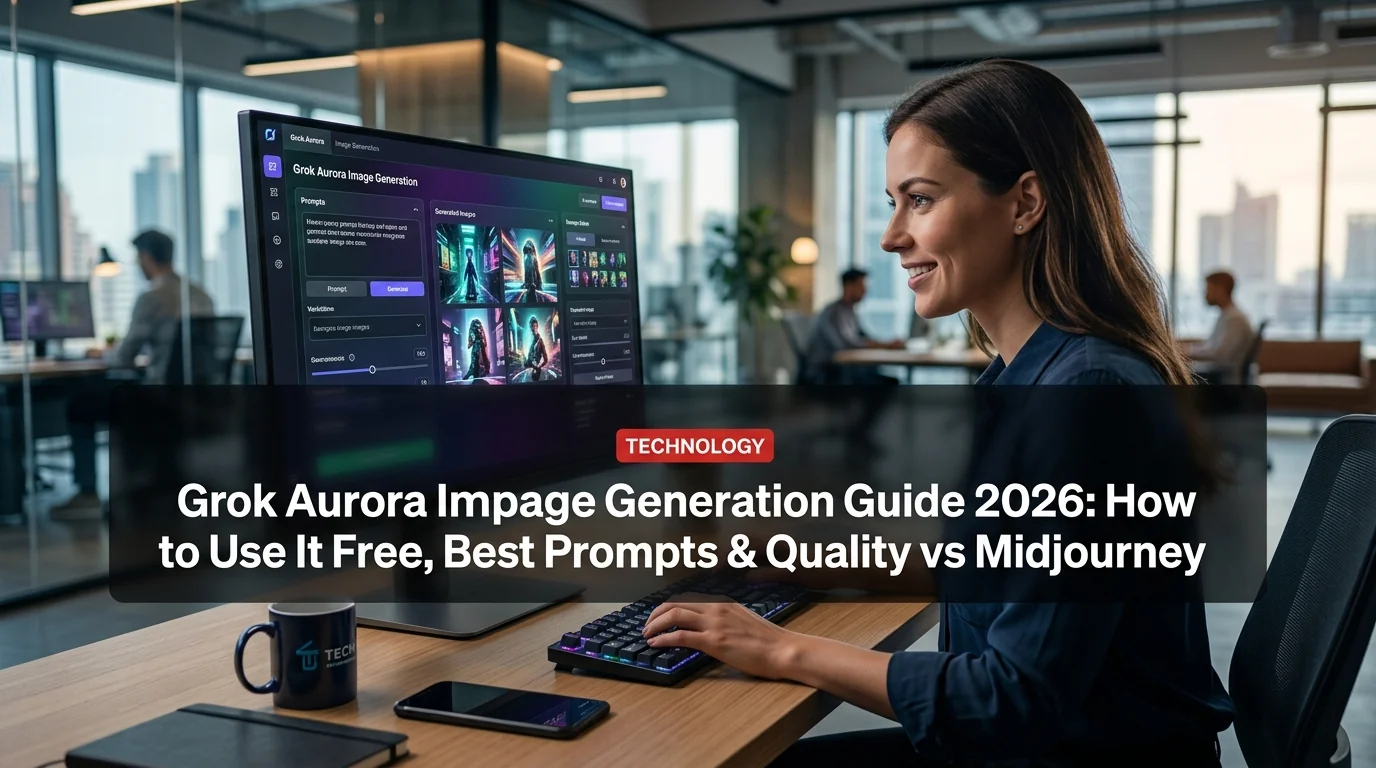
xAI's Aurora image model has been hiding in plain sight inside Grok since late 2024 — and most people still don't know it exists. In 2026, it's quietly become one of the best free AI tools image generators available, with photorealistic output that competes with Midjourney at a fraction of the cost.
Here's the complete guide: how to access Aurora, what you actually get for free, prompt techniques that work, and an honest comparison to the competition.
What Is Aurora?
Aurora is xAI's proprietary text-to-image model, built directly into Grok. Unlike the image features bolted onto ChatGPT-5 or Gemini, Aurora was designed from scratch by the same team building Grok's reasoning models.
Technically, it's an autoregressive mixture-of-experts network — meaning it predicts image tokens in sequence, similar to how language models predict words. Trained on billions of images from the web, it has two standout strengths: photorealistic rendering and unusually accurate text placement within images.
That second point matters. Getting AI image generators to reliably render readable text inside images — logos, signs, labels — has been a long-standing weakness of diffusion models like Midjourney. Aurora handles it cleanly.
How to Access Grok Aurora for Free
Via X (formerly Twitter)
- Go to x.com or open the X mobile app
- Tap Grok in the left sidebar
- Type your image prompt in the chat input
- Add "generate an image" or just describe what you want — Grok will detect image intent automatically
Free X accounts get a limited daily quota of Aurora generations. Images typically render in 5–15 seconds.
Via grok.com
You can also access Grok directly at grok.com without needing an X account. The image generation works the same way — type your prompt, Grok handles the rest.
The Free Tier Limits
Free vs Paid: What You Actually Get
- 10 daily images — sufficient for casual use
- Full Aurora model quality, not a downgraded version
- Works directly in Grok chat — no separate app needed
- Can reference and edit uploaded images
- No watermarks on free generations
- 10 image daily cap — runs out fast in creative sessions
- Slower queue during peak hours (paid users prioritized)
- Cannot batch-generate multiple variations simultaneously
- No API access without paid plan
Prompt Techniques That Work With Aurora
Aurora responds well to structured, descriptive prompts. Here's a reliable framework:
[Subject] + [Setting/Context] + [Style/Mood] + [Technical Details]
For example:
- Weak:
a dog on a beach - Strong:
A golden retriever mid-leap catching a frisbee on a sunset beach, cinematic lighting, shallow depth of field, photorealistic 4K
Prompts Aurora Excels At
Photorealistic portraits and scenes: Aurora's strongest category. Specify lighting (golden hour, studio, overcast), lens type (wide angle, 85mm portrait), and texture details.
Product mockups and marketing visuals: Aurora handles clean product-on-surface shots well. Try: iPhone 17 on a minimalist white desk with soft natural light and slight shadow, commercial photography style
Text and logos in images: Unique Aurora strength. Be specific: A rustic wooden sign reading 'WELCOME TO THE LAKE', hand-painted letters, forest background, natural lighting
Architectural and interior design: Modern Scandinavian living room, floor-to-ceiling windows, neutral palette, late afternoon light, architectural digest style
What Aurora Struggles With
- Complex multi-figure compositions with precise spatial relationships
- Highly stylized or painterly illustration styles (Midjourney still wins here)
- Consistent character generation across multiple images (no character reference system yet)
- Aurora can read and edit images you upload — paste a photo and ask it to modify elements
- Adding "photorealistic" or "cinematic" to prompts consistently improves output quality
- Text rendering in images is Aurora's biggest advantage over Midjourney and DALL-E 3
- Free tier quality is identical to paid — only speed and daily limits differ
- Grok interprets natural language image requests automatically (no special command needed)
Aurora vs the Competition in 2026
- Photorealistic output with accurate text rendering
- 10 free images/day, no watermarks
- Integrated directly into Grok chat
- No separate account or subscription needed
- Weak on stylized/artistic illustration styles
- No consistent character reference system
- Industry-leading artistic and stylized output
- Stronger for painterly, cinematic, and fantasy aesthetics
- $10+/month minimum, no meaningful free tier
- Requires Discord or web interface
- Excellent community and prompt reference resources
- More control over style consistency across images
For photorealistic, commercial-style images — product shots, portraits, architectural renders, marketing visuals — Aurora is genuinely competitive with Midjourney at no cost. For stylized or artistic output — fantasy art, painterly aesthetics, anime-adjacent styles — Midjourney still has the edge.
Against DALL-E 3 (built into ChatGPT), Aurora wins on photorealism and text accuracy. DALL-E 3 edges it on whimsical illustration and creative concept interpretation.
Real-World Use Cases
Social media content: Generate header images, post visuals, or thumbnail art directly in Grok without switching tools. The no-watermark free tier makes this practical.
Blog and article headers: Describe your article topic and ask for a cinematic header image. Fast enough (5–15 seconds) to integrate into a writing workflow.
Rapid prototyping: Need a quick mockup of a product concept, app UI, or logo idea? Aurora's text-handling makes it better than most tools for visualizing brand concepts.
Image editing via chat: Upload an existing image and ask Aurora to modify it: "remove the background and replace it with a mountain scene" or "change the jacket color to navy blue."
Getting More From Your 10 Free Daily Images
Describe before generating. Spend 30 seconds writing a detailed prompt before hitting send. A well-crafted prompt generates a usable image in 1-2 tries. Vague prompts burn through your quota on re-generations.
Use aspect ratio hints. Say "wide 16:9 landscape" or "square 1:1 composition" in your prompt — Aurora follows aspect ratio cues in natural language.
Iterate by uploading your result. Take a generated image you 80% like, upload it back to Grok, and ask for specific changes. This uses fewer generations than starting fresh each time.
Use Aurora for the frame, edit elsewhere. Generate your base image in Aurora, then use a free tool like Canva or Adobe Express to add text, logos, and design elements. Saves quota for the creative generation, not the layout work.
Is SuperGrok Worth It for Image Generation?
At $30/month, SuperGrok is competing with Midjourney Pro. The case for it:
- You're generating more than 10 images daily and hitting the free cap regularly
- You want priority queue access during peak hours
- You use Grok's full AI suite (reasoning, code, research) and image generation is one of several features you'd use
For image generation alone, Midjourney at $10/month produces more stylized output. SuperGrok makes more sense as an all-in-one Grok subscription than as a standalone image tool.
The bottom line: Aurora's free tier is genuinely good for photorealistic content. Start there, and upgrade only if you hit the cap consistently.