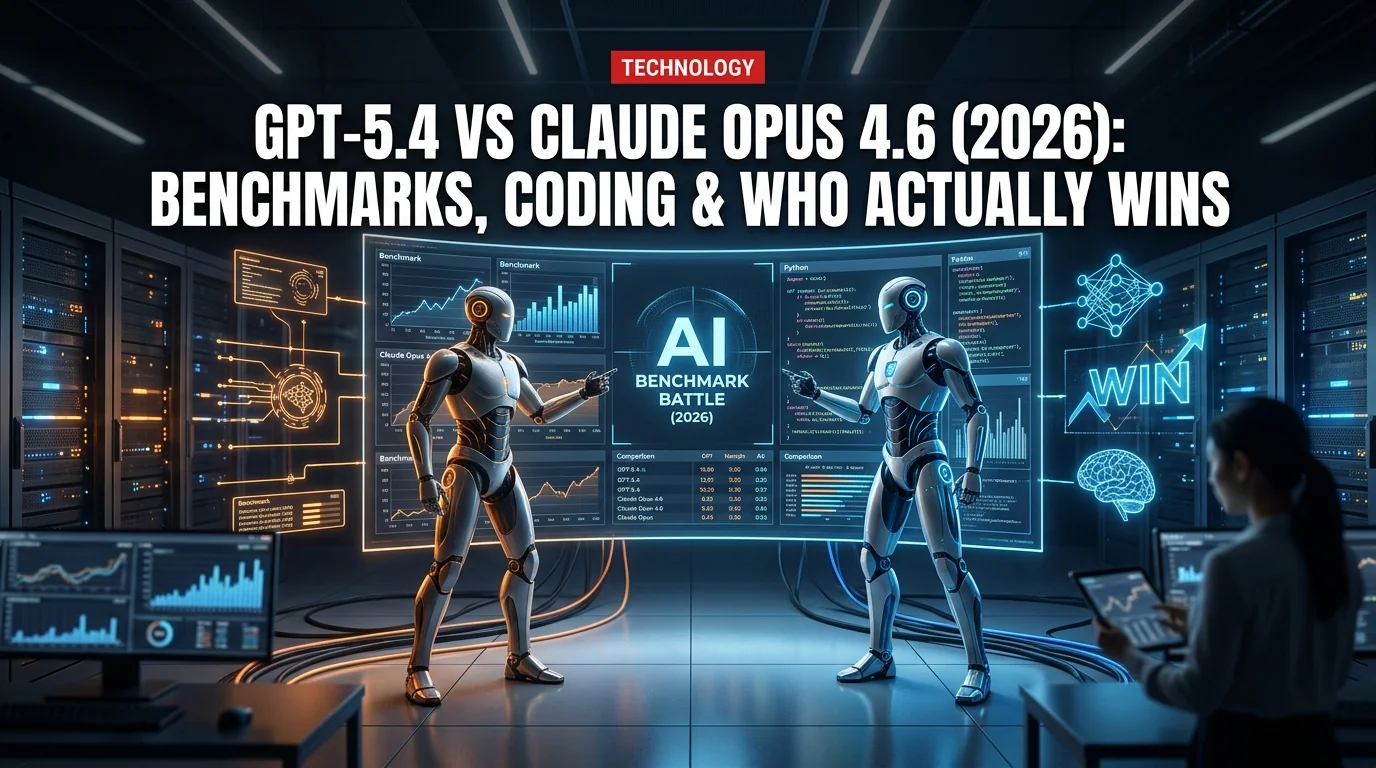
The two most powerful AI models on the planet right now are OpenAI's GPT-5.4 and Anthropic's Claude Opus 4.6. Both cost $20/month for consumer subscriptions. Both can write code, analyze documents, and run multi-step agent workflows. So which one should you actually use?
We broke down every major benchmark published as of April 2026, plus real-world developer sentiment data, to give you a definitive answer — by use case, not just by number.
What Each Model Is Built For
GPT-5.4 is OpenAI's current flagship, optimized for speed, broad task coverage, and computer-use automation. It excels at quick turnaround tasks, prototyping, and GUI-based automation workflows. It also leads on HumanEval standard coding benchmarks (93.1% vs Claude's 90.4%).
Claude Opus 4.6 is Anthropic's top model, built with a deliberate emphasis on deep reasoning, safety, and long-context accuracy. It leads on SWE-bench (real engineering tasks), GPQA Diamond (graduate-level science reasoning), and user preference in writing quality.
The difference isn't which model is "smarter" in a general sense — it's which model is smarter for your specific work.
Coding: Claude Wins on What Actually Matters
GPT-5.4 scores higher on HumanEval (93.1% vs 90.4%), a standard benchmark for algorithmic coding problems. But HumanEval has a known limitation: it tests isolated functions, not real software.
SWE-bench Verified is the harder, more realistic test — it requires models to navigate multi-file codebases, understand context across hundreds of lines, and produce working patches for real GitHub issues. Here, Claude Opus 4.6 leads at 80.8% versus GPT-5.4's approximately 80%.
- Leads SWE-bench Verified (real engineering tasks)
- Superior multi-file codebase analysis
- Fewer hallucinated API calls in independent testing
- 95% functional coding accuracy vs GPT's ~85% in developer tests
- Higher HumanEval score (93.1%)
- Faster for quick snippets and prototyping
- Better computer-use automation (75% OSWorld)
- Stronger at GUI scripting and browser automation
- Slightly slower response times on simple tasks
- HumanEval score trails GPT-5.4 by ~3 points
- Slightly behind Claude on real-world multi-file tasks
- More prone to confident hallucinations in complex refactors
Verdict: For production code, multi-file refactoring, and agentic coding pipelines, Claude Opus 4.6 wins. For quick prototypes and computer-use automation, GPT-5.4 is faster and better-suited.
Reasoning: Claude Has a Clear Lead
This is the starkest difference between the two models. On high-difficulty multi-step reasoning tasks, Claude Opus 4.6 scores 78.7% versus GPT-5.4's 76.9%. That 1.8-point gap widens on GPQA Diamond — a graduate-level science reasoning benchmark — where Claude leads by 3.5 points.
GPQA Diamond tests the kind of reasoning that can't be solved by pattern-matching memorized information. It requires chaining inferences, holding contradictory evidence in context, and arriving at non-obvious conclusions. Claude's architecture shows a clear edge here.
Writing Quality: Claude Wins by a Wide Margin
In blind human preference tests, Claude Opus 4.6 is preferred for writing quality by 47% of evaluators versus 29% for GPT-5.4. That's not a marginal difference — it's nearly a 2-to-1 advantage.
Claude's writing tends to be more nuanced, less repetitive, and better calibrated to the requested tone. GPT-5.4 can produce high-quality prose too, but it defaults more frequently to generic structures and over-confident assertions.
For content creation, long-form analysis, or any task where writing style matters, Claude Opus 4.6 is the stronger choice.
Agentic Tasks: Depends on What "Agentic" Means
"Agentic AI" covers two different categories in 2026: computer-use automation (clicking, form-filling, browser control) and multi-step reasoning pipelines (research → analysis → output).
For computer-use automation, GPT-5.4 leads with 75% on OSWorld — the benchmark for GUI-based task completion. If you're building bots that interact with software interfaces, OpenAI has an edge.
For reasoning-heavy pipelines — where the agent needs to analyze a complex situation, make decisions, and produce high-quality outputs — Claude Opus 4.6's superior reasoning and lower hallucination rate make it the safer and more capable choice.
- Long-context analysis (200K token window)
- Multi-file code refactoring agents
- Research and reasoning pipelines
- Legal, medical, and scientific document work
- Writing-heavy workflows
- Computer-use and GUI automation
- Quick prototyping and fast responses
- Browser automation and web agents
- Tasks needing broad tool coverage
- Teams already embedded in OpenAI infrastructure
Pricing in 2026
Both models are available via subscription at comparable price points. Claude Opus 4.6 is accessible through Claude Pro ($20/month) and via Anthropic's API. GPT-5.4 is available through ChatGPT Plus ($20/month) and OpenAI's API.
On API pricing, Claude Opus 4.6 charges $15 per million input tokens and $75 per million output tokens. GPT-5.4 pricing is similar in the $15–80 range depending on the tier, with GPT-5.4 mini available at a fraction of the cost for lower-stakes tasks.
For teams running high-volume pipelines, GPT-5.4's mini tier offers real cost advantages. For quality-critical work, the flagship pricing is comparable enough that cost shouldn't be the deciding factor.
- Claude Opus 4.6 has a 200,000-token context window
- GPT-5.4 offers native computer-use (Operator) integration
- Both support multi-modal inputs (text, images, documents)
- Claude has native tool use and agent orchestration via Claude.ai
- GPT-5.4 integrates with OpenAI's broader tool ecosystem (DALL-E, Sora, Operator)
The Practical Answer: Use Both
Most professional developers and teams in 2026 don't choose one — they route tasks. The emerging pattern:
- GPT-5.4 for fast first drafts, prototyping, computer-use automation, and tasks embedded in OpenAI's product ecosystem
- Claude Opus 4.6 for deep work: complex refactoring, reasoning-heavy analysis, writing quality tasks, and agent workflows where accuracy matters more than speed
If you can only pick one, the benchmarks favor Claude Opus 4.6 for most professional use cases — particularly coding, reasoning, and writing. GPT-5.4's edge is speed and computer-use automation.
Final Verdict
Claude Opus 4.6 is the better model for depth. GPT-5.4 is the better model for breadth and speed. Neither is definitively "the best AI" — they're tools, and the right one depends entirely on what you're building.
For developers, researchers, writers, and analysts doing complex work: Claude Opus 4.6 is the 2026 pick. For teams that need fast automation, broad integrations, and computer-use workflows: GPT-5.4 earns its place.
The smartest move? Evaluate both on your actual tasks. Most subscriptions let you switch freely — and the performance gap in your specific domain may be different from any published benchmark.