
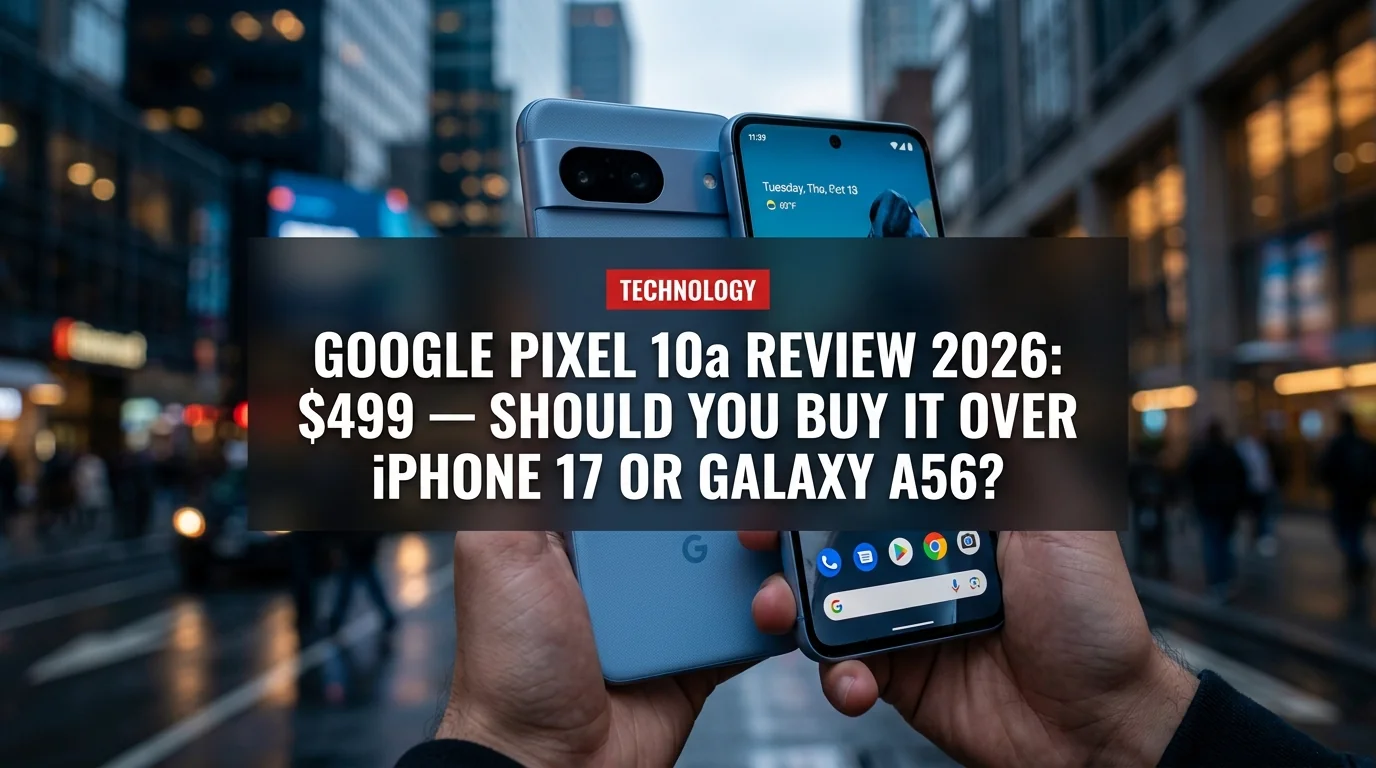
The Google Pixel 10a launched on March 5, 2026 at $499, and it might be the most straightforward phone recommendation of the year. You don't need to think hard about it. Here's why — and who should skip it.
The Short Verdict
The Google Pixel 10a is the best $499 phone you can buy in 2026 if you're in the Android ecosystem. Its camera system punches well above its price bracket, its 5,100mAh battery is genuinely all-day, and seven years of guaranteed software updates through 2033 make this phone a long-term investment, not a short-term compromise.
The Tensor G4 chip won't win benchmark wars against Snapdragon 8 Elite, but for everything you actually do on a phone — photos, AI features, streaming, messaging — it handles everything smoothly.
Design: Clean, But Bold Changes
The Pixel 10a makes one surprising design call: Google removed the camera visor bump. The rear cameras now sit flush in a horizontal bar across the top — a bumpless design that splits opinion but makes the phone significantly easier to set flat on a table.
The 6.3-inch screen means the 10a is noticeably smaller than most 2026 flagships pushing 6.7+ inches. For one-handed users, this is a feature, not a limitation.
Gorilla Glass 7i now protects the display — an upgrade from the Gorilla Glass 3 used on the 9a. The build feels solid for the price, though the plastic back (versus glass on the Pixel 10 Pro) is a cost-saving trade-off you'll notice.
Display: 120Hz pOLED at This Price
A 120Hz pOLED display at $499 is not standard — many competitors at this price still use 60Hz LCDs. Google's Actua display technology makes scrolling feel smooth and colors look punchy without being oversaturated.
Brightness is rated higher than the 9a, which matters outdoors. Under direct sunlight the screen remains readable. It's not at the level of the Pixel 10 Pro's LTPO panel, but it's genuinely excellent for the price.
Camera: Still the Killer Feature
The Pixel 10a uses a dual rear camera setup: a 48MP wide sensor and a 13MP ultrawide. No telephoto — that remains a Pro-tier exclusive.
What Google does with those sensors through computational photography is remarkable. Super Res Zoom pushes to 8x with optical-quality results at common zoom levels (0.5x, 1x, 2x). Night Sight still produces low-light photos that outclass most phones at 2–3x the price.
AI features carry over from the flagship line:
- Best Take — composite group photos from multiple shots so everyone looks their best
- Magic Eraser — remove photobombers and distractions
- Photo Unblur — sharpen old blurry photos
- Zoom Enhance — improve detail on zoomed crops
For most people who don't shoot with dedicated cameras, the Pixel 10a produces photos they'll actually be proud of. That matters more than spec-sheet megapixel counts.
Performance: Tensor G4 — Honest Assessment
Google's Tensor G4 chip is built for AI tasks, not raw speed. In benchmarks, it trails Snapdragon 8 Elite (Galaxy S25) and Apple A18 (iPhone 16). In real use, you won't notice.
Everyday tasks — launching apps, multitasking, video playback, web browsing — are handled without hesitation. Gaming is solid for casual titles; demanding 3D games like Genshin Impact or Call of Duty Mobile run fine at medium-high settings.
Where Tensor G4 shines is on-device AI processing: real-time translation, voice transcription, photo enhancement. These run locally without requiring a server connection, which is fast and private.
Battery: The Best Part Nobody Talks About
The 5,100mAh battery is the headline nobody's leading with, and they should be. Google claims 30 hours of mixed use. In practice, heavy users (constant email, social media, navigation) get a comfortable full day with battery to spare. Light to moderate users easily hit two days.
Extreme Battery Saver mode extends this to 120 hours — over five days. At that point the phone restricts to core functions, but it's there when you need it.
Charging specs finally improved: 30W wired (up from 23W on the 9a) and 10W wireless charging. Not class-leading — the Galaxy S25 hits 45W — but a meaningful real-world improvement.
- Best-in-class camera system at this price
- 120Hz pOLED display is exceptional for $499
- 5,100mAh battery with 30-hour real-world life
- 7 years of updates (Android 16 ready, through 2033)
- Satellite SOS emergency support
- Compact 6.3-inch size for one-handed use
- Tensor G4 trails in benchmark performance vs Snapdragon rivals
- No telephoto camera (Pro exclusive)
- Plastic back (not glass)
- 30W charging is slower than Samsung/OnePlus competitors
- No microSD expansion
Pixel 10a vs iPhone 18 vs Samsung Galaxy: How It Stacks Up
The Pixel 10a sits in a genuinely competitive price bracket in 2026. Here's the honest comparison:
vs iPhone 17 ($799): The iPhone 17 costs $300 more and delivers better sustained performance, a stronger ecosystem for Apple users, and a telephoto camera. If you're in the Apple ecosystem, the jump makes sense. If not, you're paying $300 for ecosystem lock-in.
vs Galaxy A56 ($449): Samsung's Galaxy A56 comes in $50 cheaper and offers a triple-camera setup with a dedicated telephoto. It runs One UI — more customizable than stock Android but heavier. The A56 wins on hardware value per dollar; the Pixel 10a wins on camera quality, guaranteed updates, and AI features.
Verdict: At $499, the Pixel 10a beats the A56 on camera and software longevity. It undercuts the iPhone 17 by $300 while handling 90% of the same daily tasks.
New: Satellite SOS (Finally)
Satellite SOS — the ability to send emergency messages when out of cell coverage — is now on the Pixel 10a. Previously this feature was limited to the Pixel 9 Pro and higher, and iPhone (via Apple's implementation).
This matters most for hikers, travelers, and anyone who regularly goes off-grid. It's a safety feature that didn't exist at this price last year.
Software: Android 16 + Gemini AI
The Pixel 10a ships with Android 16 and Gemini AI deeply integrated. Google Assistant effectively becomes Gemini on Pixel devices — more capable at complex tasks, better at multi-step reasoning, and more useful for summarization and document analysis.
Seven years of updates (through 2033) is the software story that matters most for buying decisions. A $499 phone you keep for 5–6 years is cheaper per year than a $999 phone you replace every 3. Pixel's update commitment makes it the clear long-term value choice in Android.
Who Should Buy the Pixel 10a
Buy it if:
- You want the best camera under $600
- You prefer compact Android phones
- You want guaranteed updates through 2033
- You're switching from an older Android phone
- You care about AI photography features
Skip it if:
- You're deep in the Apple ecosystem
- You need the best gaming performance
- You want a telephoto camera
- You want faster charging than 30W
Final Score
The Google Pixel 10a is the rare budget-tier phone that doesn't feel like a budget compromise. At $499 in 2026, it delivers a flagship camera experience, a great display, and software longevity no Android competitor at this price matches. It's the phone to recommend to anyone who asks what Android phone to buy without specifying a higher budget.
The Tensor G4 performance gap is real — but only on benchmarks. Real-world users won't notice it. The camera, battery, and update commitment will make them very happy they didn't spend more.