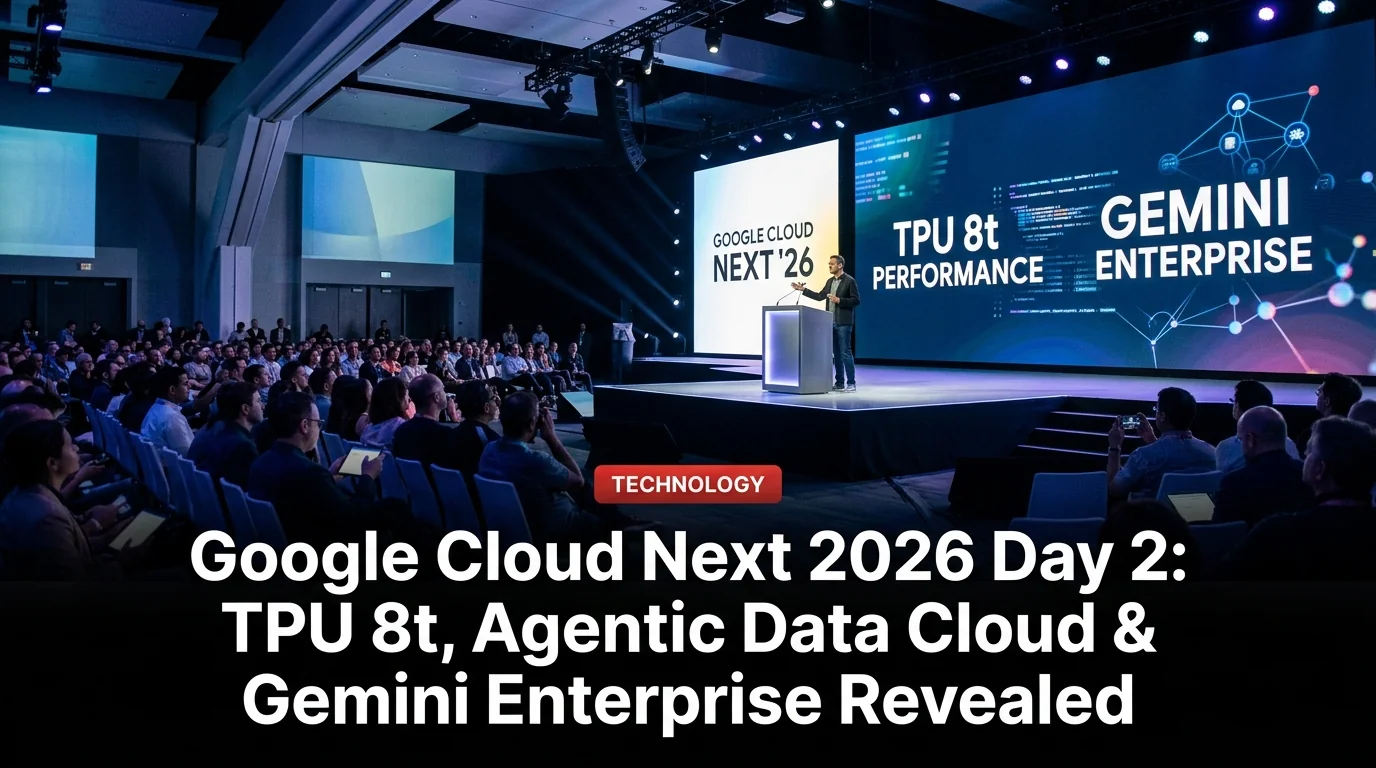
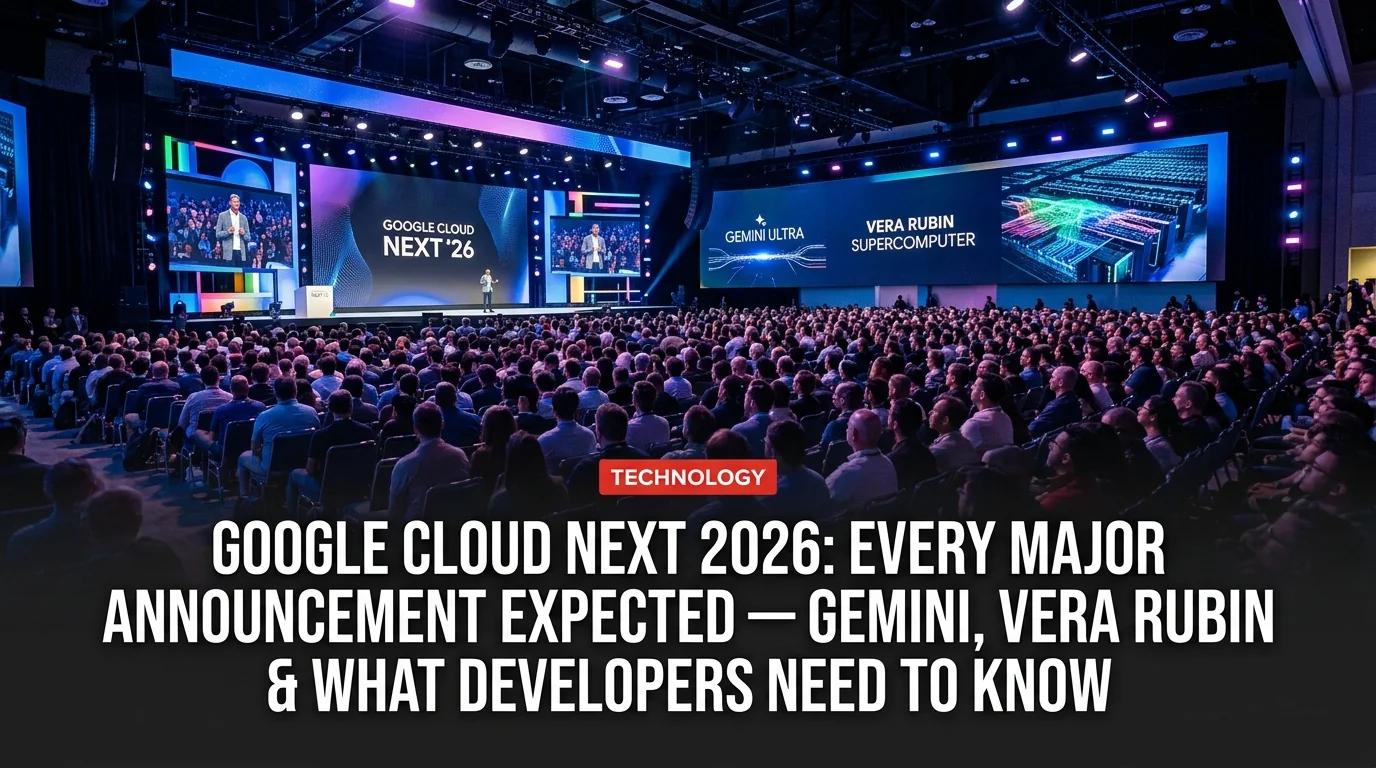
Google Cloud Next 2026 opens its doors in Las Vegas on April 22, and this year's conference isn't about chatbots or demos. It's about production-grade agentic AI — systems that actually take action rather than just answer questions.
The event runs April 22–24 at Mandalay Bay, and all eyes are on what Google's cloud division has built since last year. With Microsoft Copilot and AWS Bedrock both pushing hard on enterprise AI — and with Google Gemini facing legal scrutiny over its consumer chatbot, the enterprise pivot matters more than ever, Google needs to show it can compete at scale. Based on pre-event sessions, partner guides, and confirmed hardware plans, here's everything that's expected to land.
The Big Theme: Agentic AI Is the New Baseline
Google has spent the past year repositioning Gemini from a chatbot into an enterprise agent. At Next 2026, expect that transformation to hit full speed.
The opening keynote — scheduled for 90 minutes starting at 9:00 AM on April 22 — will cover the high-level roadmap for the Google Cloud ecosystem. Multiple session guides and partner previews confirm the central narrative: agentic systems, not AI assistants.
This means AI that books meetings, writes and executes code, manages pipelines, and interacts with external APIs — all with minimal human hand-holding. The shift is significant because most enterprises are still figuring out how to move from AI prototypes to autonomous systems that can be trusted in production.
Gemini Enterprise: What's New
Gemini has been Google's most visible AI product, but Next 2026 is expected to show what it can do in enterprise settings rather than consumer ones.
Confirmed session tracks include:
- Gemini agentic platform advancements — multi-step task execution, tool use, and memory across sessions
- New Workspace AI features — deeper integration with Gmail, Docs, Meet, and Drive, including agent-driven drafting and summarization
- Expanded partner ecosystem — third-party tools connecting to Gemini's agent framework via standardized APIs
- Enhanced security controls — zero-trust architecture applied to AI agents, treating every internal identity as a potential attack vector
The Workspace sessions are particularly notable. Google has been rolling out AI features to Google Workspace for months, but Next 2026 appears to mark the moment those become agent-class — meaning they can operate across multiple apps and take multi-step actions without a user confirming each step.
- Gemini Enterprise keynote track runs all three days
- New agentic Workspace features expected across Gmail, Docs, Drive, and Meet
- Zero-trust AI security is a dedicated session track
- Partner ecosystem integrations to be announced
- Vertex AI agent orchestration updates confirmed
Hardware: Vera Rubin and the Blackwell GPU Wave
This is where Google Cloud gets interesting. On the infrastructure side, two major hardware announcements are expected — one for bleeding-edge AI workloads and one for more accessible entry-level GPU work.
NVIDIA Vera Rubin NVL72
Google Cloud has confirmed it will be among the first cloud providers to offer NVIDIA Vera Rubin NVL72 rack-scale systems in the second half of 2026. These are the successor to the H100/H200 lineup — a full rack of interconnected GPUs designed for training and inference at a scale that individual chips can't achieve.
The Vera Rubin architecture was designed specifically for the kind of massive model inference that agentic AI requires. Running an autonomous agent at enterprise scale demands far more compute than a simple chat query — Vera Rubin NVL72 is built for exactly that workload.
Fractional G4 VMs (Now in Preview)
Not every company can afford a full Vera Rubin rack, and Google knows it. The newly announced fractional G4 VMs use NVIDIA vGPU technology — specifically the RTX PRO 6000 Blackwell Server Edition — to slice GPU resources into smaller, more affordable units.
According to Google, this makes G4 VMs the first cloud offering to support fractional NVIDIA RTX PRO 6000 Blackwell GPUs. The target audience is teams that need GPU acceleration for AI inference or 3D rendering but don't have the budget for full-GPU instances.
Vertex AI and Developer Tools
Vertex AI is Google's managed ML platform, and it's getting significant updates at Next 2026.
The big technical announcement on the developer side: integration of Dynamo (an open-source inference optimization layer) with GKE Inference Gateway. This creates a modular, open-source control plane that spans both the application layer and hardware — letting engineering teams customize their inference infrastructure instead of being locked into Google's defaults.
In practice, this matters because agentic AI systems require dynamic, high-throughput inference. Static, pre-configured setups break under the variable load patterns that agents generate. The Dynamo + GKE integration is designed to handle that variability efficiently.
Other Vertex AI updates expected at the conference:
- Improved model evaluation and monitoring tooling
- Agent Builder updates for no-code agent creation
- Expanded multi-modal capabilities (text, image, video, audio in a single agent)
- Better fine-tuning infrastructure for domain-specific enterprise models
Security: Zero-Trust for the AI Era
One theme running through every session preview is security — specifically, how to run autonomous AI agents without creating new attack surfaces.
Google's approach is zero-trust applied to AI: every agent identity is treated as potentially compromised until verified. This means agents operate with the minimum permissions needed, all actions are logged, and there are hard limits on what any single agent can do without escalating to a human.
This is a significant departure from how most enterprises have deployed AI so far, where agents often run with broad access to be maximally helpful. As agentic systems become more powerful, the security implications become real — and Google appears to be positioning Next 2026 as the moment it defines best practices for the industry.
Who Should Watch and How
If you can't make it to Las Vegas, Google will stream the opening keynote and select sessions. The keynote stream historically draws hundreds of thousands of viewers — it's the fastest way to see what Google actually announces versus what was previewed.
For developers specifically, the Google Developers Blog and Google Cloud Blog will be live-updating throughout the event. The most technically dense content — the infrastructure and API announcements — typically lands in written form the same day it's presented.
Bottom Line
Google Cloud Next 2026 is the most consequential cloud conference of the year for anyone building with AI at scale. The shift from generative to agentic AI is happening whether enterprises are ready or not, and Google's announcements — Vera Rubin hardware, fractional GPUs, Gemini agent updates, and the Dynamo/GKE integration — are designed to make that shift easier on Google's platform.
Mark April 22 at 9:00 AM Pacific for the keynote stream. The announcements will be worth watching in real time.