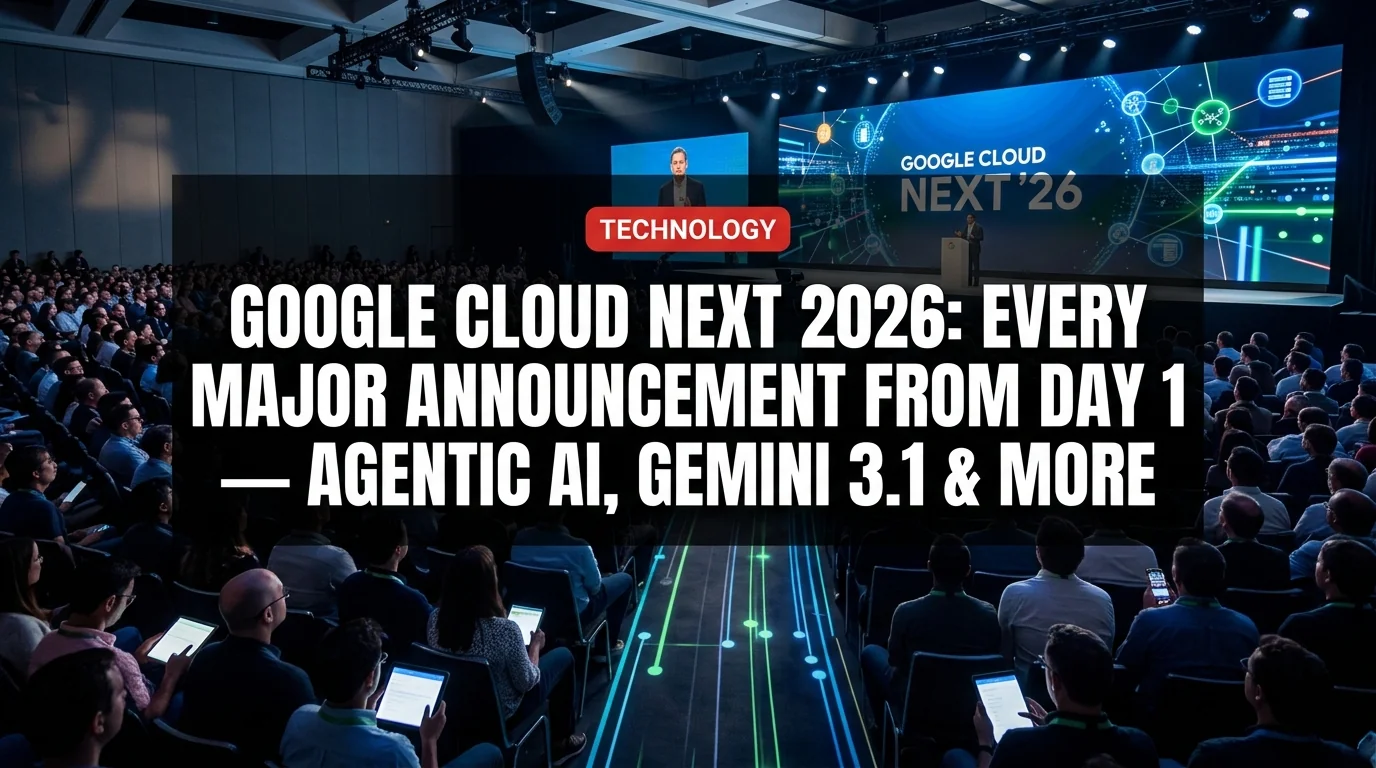
Google Cloud Next 2026 opened its doors Wednesday at Mandalay Bay in Las Vegas, and if there was any doubt about where enterprise AI is heading, Google's opening keynote wiped it clean. CEO Thomas Kurian took the stage with a single message: the era of copilots is over. What comes next is the agentic enterprise — and Google wants to own the control plane.
Here's everything announced on Day 1.
The Theme: "The Agentic Cloud"
Kurian opened with a simple thesis: AI assistants that answer questions are yesterday's story. The next chapter is AI agents that do things — autonomously, persistently, and across your entire enterprise stack.
Google Cloud exited Q4 2025 as the fastest-growing of the Big Three cloud providers (AWS, Azure, Google), and Kurian used that momentum as a launching pad. The goal now is to turn TPU hardware advantages and Gemini model dominance into something more durable: an end-to-end platform for running multi-agent workflows at enterprise scale.
"Start with the business problem," Kurian said. "Measure the result. And make sure the data feeding your AI agent is actually good." Simple advice — but it signals a shift away from hype and toward deployment.
Gemini 3.1 Updates
Google confirmed several Gemini model updates now available through Vertex AI:
Gemini 3.1 Pro (Preview): The flagship multimodal model is now in preview on Vertex AI and Gemini Enterprise. Designed for complex reasoning, long-context tasks, and enterprise integrations, it's Google's answer to GPT-4o and Claude Opus in the business market.
Gemini 3.1 Flash-Lite: Built specifically for high-volume developer workloads. Flash-Lite prioritizes speed and cost efficiency without sacrificing too much quality — Google's play for the inference-at-scale market where every millisecond and every token has a price.
Gemini Embedding 2: A natively multimodal embedding model that unifies text, images, video, audio, and documents into a single embedding space. For enterprises building RAG pipelines or semantic search, this is significant — one model to embed everything, rather than stitching together specialized models.
- Gemini 3.1 Pro now in preview on Vertex AI
- Gemini 3.1 Flash-Lite targets high-volume, cost-sensitive workloads
- Gemini Embedding 2 supports text, images, video, audio and documents in one model
- All models accessible via Vertex AI platform
The Agent Stack: From Kit to Marketplace
This is the biggest structural announcement of Day 1. Google isn't just releasing a new model — it's building an entire ecosystem for deploying and managing AI agents. Kurian laid out a full stack:
Agent Development Kit (ADK): An open-source framework for building AI agents. Google is betting that open-source will drive developer adoption the way Kubernetes did for containers — get developers building on your abstractions, and the cloud follows.
Agent Engine: The runtime layer for deploying and managing agents in production. Think of it as the execution environment — agents built with ADK run here, with Google handling orchestration, scaling, and reliability.
Agent Garden: A curated library of ready-to-use agent tools and integrations. Enterprises don't want to build every agent from scratch — Agent Garden provides pre-built connectors for common business workflows.
Agent Marketplace: A commercial hub where third-party developers and ISVs can publish agents. This is Google's move to create an ecosystem flywheel: more agents → more developers → more enterprise use cases.
Agent2Agent Protocol: Perhaps the most technically interesting piece. A standardized protocol so that agents from different vendors — or different internal systems — can communicate with each other. Kurian framed agent interoperability as critical: most enterprise workflows span multiple systems, and agents that can't talk to each other can't automate those workflows.
- Open-source ADK for building
- Agent Engine for running at scale
- Agent2Agent for cross-system communication
- Microsoft Copilot Studio (closed, Microsoft-only)
- AWS Bedrock Agents (AWS ecosystem)
- Anthropic Claude API (model-only, no runtime)
Sovereign AI Strategy
Kurian also addressed something that's been a growing concern among global enterprises: data sovereignty. Google outlined a "sovereign AI" strategy for organizations — particularly in regulated industries and government sectors — that need to run AI workloads with guarantees about where data lives and who can access it.
This isn't a new concept, but the formal strategy signals that Google is taking enterprise compliance seriously as it pushes into healthcare, finance, and public sector accounts.
What This Means for Enterprises
If you're evaluating cloud AI platforms in 2026, here's the honest read on Google's positioning:
Google's strengths are real — Gemini is genuinely competitive, TPU infrastructure is differentiated, and the Agent2Agent protocol is a smart interoperability bet. The open-source ADK play mirrors what made Kubernetes dominant and could repeat that pattern.
The risk: enterprises are notoriously slow to move, and the agent hype cycle still has a lot of proving-out to do. Kurian's emphasis on measuring business outcomes over AI features is the right framing — but it also acknowledges that most enterprise AI deployments aren't yet delivering the ROI that justifies the investment.
Day 2 and Day 3: What to Watch
The conference runs through Friday, April 24. Key sessions to follow:
- Deep-dives on Vertex AI agent orchestration
- Google Workspace + Gemini integration updates
- Infrastructure announcements (TPU roadmap, regional expansion)
- Partner ecosystem announcements from major ISVs
- Security and compliance updates for regulated industries
We'll be covering every major announcement as it drops. Bookmark this page for continuous updates throughout the week.
Google Cloud Next 2026 is less a product launch and more a declaration of direction: Google is building the enterprise AI operating system, one agent at a time.