
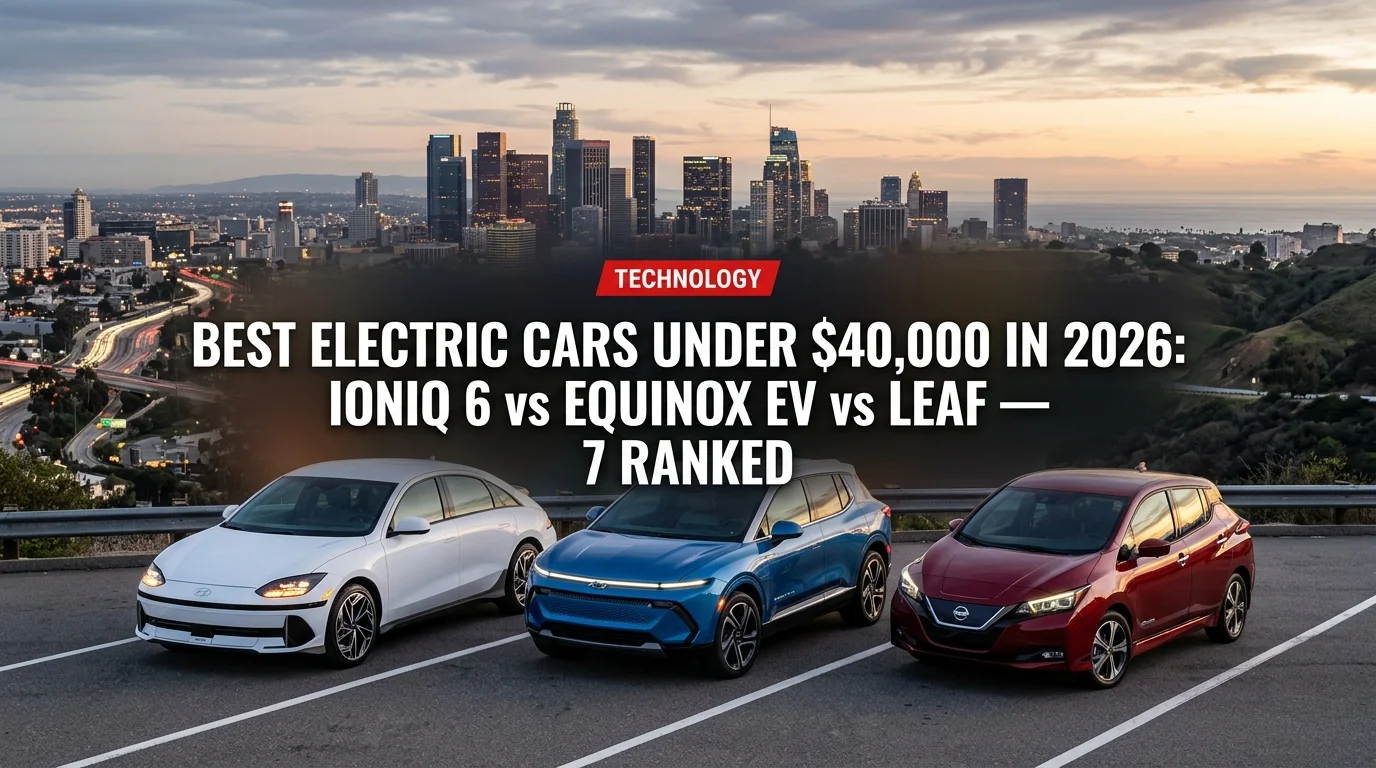
The federal EV tax credit expiration hit at the worst possible time — right when EV prices were finally getting reasonable. But here's the thing: affordable electric cars in 2026 are genuinely good. We're talking 250+ mile ranges, real fast charging, and prices that undercut gas cars when you factor in fuel savings. We ranked the seven best EVs under $40,000 by what actually matters: real-world range, total cost of ownership, and whether you'll regret buying one two years from now.
What Changed in 2026: The Tax Credit Situation
The $7,500 federal EV tax credit that made EVs affordable for millions of Americans expired at the end of 2025. That's the bad news. The good news: manufacturers responded by cutting prices, launching cheaper trim levels, and leaning into the value angle more aggressively than ever. Several state-level credits remain active — California, Colorado, and New York still offer $2,000–$5,000 rebates on qualifying EVs.
The under-$40,000 segment is also where automakers are most competitive right now. Every major manufacturer has at least one entry here, and the quality gap between budget and premium EVs has shrunk dramatically.
1. Hyundai Ioniq 6 — Best Overall Under $40K
Starting price: $38,615 (SE Standard Range RWD) Range: 240 miles (SE) | 361 miles (SE Long Range RWD) Charging: 350 kW DC fast charge — 10 to 80% in 18 minutes
The Ioniq 6 is the benchmark. Nothing else in this price range combines its range, charging speed, and build quality. The 800V architecture means it charges faster than almost any EV regardless of price — you'll add 100 miles in about 13 minutes on a fast charger. The interior is genuinely premium: flat floor, ambient lighting, a driver-focused layout that feels more like a $55,000 car than a $39,000 one.
The SE trim at just under $40K gives you 240 miles of range — respectable but not class-leading. Stretch to the Long Range RWD and you get 361 miles, though that pushes past $41K before options. For daily driving and occasional road trips with charging stops, the standard range is plenty.
Who it's for: Buyers who want the most car per dollar and do most driving within 200 miles.
2. Chevrolet Equinox EV — Best Value Pick
Starting price: $34,995 (1LT FWD) Range: 319 miles (1LT) Charging: 150 kW DC fast charge
The Equinox EV pulled off a rare trick: it launched at a price that's almost embarrassingly reasonable for what you get. Over 300 miles of range at under $35K was genuinely surprising when it launched, and the 2026 model year brought minor refinements without a price increase.
The interior won't impress EV snobs — it's clearly a rebadged Chevy with a big screen dropped in — but the fundamentals are right. The 319-mile range is real-world credible (not just EPA optimistic), the backseat is genuinely roomy for a mid-size crossover, and GM's dealer network means service is available everywhere.
The 150 kW charging speed is the main compromise vs the Ioniq 6. It's not slow, but it's not class-leading either.
Who it's for: Practical buyers, families, anyone who wants maximum range at minimum price.
3. Tesla Model 3 RWD — Best Software & Charging Network
Starting price: $38,990 Range: 333 miles Charging: 250 kW DC (Supercharger) — 15 to 80% in ~25 minutes
The updated Model 3 is still the EV that makes the most sense for road trippers — not because of the car itself, but because of the Supercharger network. Tesla's 50,000+ charging stations are faster, more reliable, and more widely available than any competitor's network. That matters on long drives.
The 2025-2026 Model 3 interior is genuinely improved: better materials, an actual rear screen, and quieter cabin. The single-motor RWD hits 333 miles on a charge — strong for this price point. Tesla's software updates mean the car you buy today will have more features in 12 months.
The downside: build quality remains inconsistent (panel gaps are real), customer service is phone/app-only, and some buyers have strong feelings about the brand in 2026.
Who it's for: Frequent road trippers, Tesla ecosystem converts, anyone who values software and charging convenience over everything else.
4. Volkswagen ID.4 — Best for European Car Buyers
Starting price: $38,995 (Standard RWD) Range: 260 miles (Standard) | 291 miles (Pro RWD) Charging: 135 kW DC fast charge
The ID.4 got a meaningful update for 2026 that addressed its two biggest weaknesses: charging speed and software responsiveness. It's now a properly polished mid-size EV crossover with a spacious interior, composed driving dynamics, and the refinement you expect from VW.
The range is honest — 260 miles in the standard trim, 291 in the Pro — and the crossover body gives it genuine cargo utility. Access to Tesla's Supercharger network (via CCS adapter now standard) means charging infrastructure is no longer a concern.
Still not the most exciting EV on this list, but it's the one you'll never regret buying — solid, sensible, and built to last.
Who it's for: Buyers who want European quality without Audi/BMW prices, families who prioritize cargo space.
- Spacious interior with best-in-class cargo room
- Refined, quiet highway ride
- Supercharger network access via adapter
- Strong resale value
- Software still lags Tesla and Hyundai
- 135 kW charging is slower than Ioniq 6 or Model 3
- No particularly exciting performance option under $40K
- Plain exterior design
5. Nissan Ariya — Best Design Under $40K
Starting price: $39,125 (Engage FWD) Range: 304 miles Charging: 130 kW DC fast charge
Nissan's second-generation EV is a major improvement over the Leaf and a genuine competitor in this segment. The Ariya's interior is the nicest-feeling of any EV under $40K — the design team clearly prioritized materials and aesthetics in a way others didn't. The 304-mile range is solid, and the flat floor (no transmission tunnel) creates surprisingly airy cabin space.
The main hesitation is Nissan's charging network situation. CHAdeMO fast charging is being phased out in favor of CCS, and while that transition is now complete on the Ariya, charging station availability varies more than Tesla or GM.
Who it's for: Design-conscious buyers who spend more time on aesthetics than spreadsheets.
6. Ford Mustang Mach-E — Best for Performance Fans
Starting price: $37,995 (Select RWD) Range: 250 miles (Select) Charging: 150 kW DC fast charge
The Mach-E polarized Mustang fans when it launched, but as an EV it stands on its own. The Select trim comes in just under $38K with 250 miles of range and rear-wheel drive that's genuinely fun in everyday driving. Ford's SYNC 4 interface is the most intuitive non-Tesla software in this class.
Ford BlueCruise (hands-free highway driving on mapped roads) is available as an add-on and is genuinely impressive when it works. The charging infrastructure, via Ford's BlueOval network and CCS compatibility, covers most of North America adequately.
The range is the main compromise at this price. 250 miles is workable but not confidence-inspiring for anxiety-prone EV buyers.
Who it's for: Ford loyalists, buyers who want driving personality with their practicality.
7. Nissan Leaf Plus — Best Budget EV With Proven Track Record
Starting price: $29,990 (S Plus) Range: 212 miles Charging: 100 kW DC fast charge (CHAdeMO)
The Leaf Plus is the oldest design on this list and it shows — but the $29,990 starting price is its superpower. In a segment where everything else costs $35K+, the Leaf gets you into EV ownership for under $30K with a drivetrain that has over a decade of real-world reliability data behind it.
The 212-mile range is the minimum we'd recommend for daily driving; longer commuters should look elsewhere. The CHAdeMO fast charging plug is an increasingly niche standard in North America. But if budget is the priority, nothing else comes close.
Who it's for: First-time EV buyers, urban commuters under 80 miles/day, buyers on strict budget.
Total Cost of Ownership: The Real Math
The sticker price tells half the story. At current electricity rates, the average EV costs $0.03–$0.05 per mile to fuel vs $0.12–$0.15 per mile for a comparable gas car. Over 12,000 miles per year, that's $1,080–$1,440 in annual fuel savings.
Maintenance is another win: no oil changes, fewer brake replacements (regenerative braking extends pad life dramatically), and simplified drivetrains with fewer failure points. Independent data suggests EVs average $900 less per year in maintenance costs vs comparable gas vehicles.
Factor those savings over 5 years and the effective cost of even the most expensive EV on this list comes down by $8,000–$12,000 against its sticker price.
- Fuel savings: $1,200–$1,800/year vs average gas car
- Maintenance savings: ~$900/year on average
- 5-year total savings: $8,000–$13,000 vs comparable gas vehicle
- Home charging installation (Level 2): $800–$1,500 one-time cost
- Check your state's EV incentive: California, Colorado, and New York still offer $2K–$5K
Our Verdict
Best overall: Hyundai Ioniq 6 — unmatched charging speed, strong range, premium feel. Best value: Chevrolet Equinox EV — 319 miles for $35K is genuinely hard to beat. Best for road trips: Tesla Model 3 — the Supercharger network makes long-distance driving stress-free. Best budget pick: Nissan Leaf Plus — the only serious option under $30K.
The sub-$40K EV segment in 2026 is the most competitive it's ever been. The federal credit loss stings, but the cars themselves are better than ever — real ranges, real charging speeds, real quality. If you've been waiting to make the switch, the wait is over.