
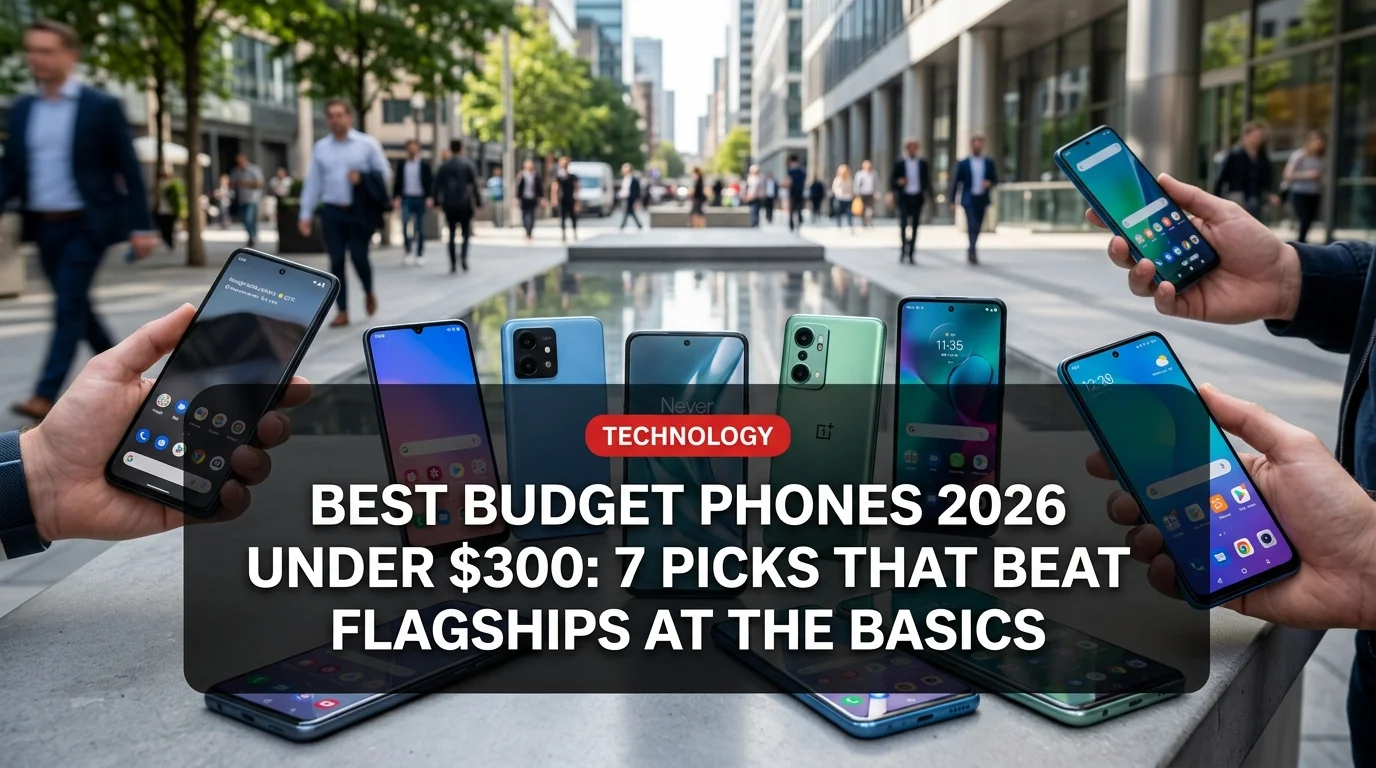
Best Budget Phones 2026 Under $300: 7 Picks That Beat Flagships at the Basics
Flagship phones in 2026 have crossed a line. The iPhone 17 Pro starts at $1,099 — and with tariff-driven price increases baked in, it'll likely go higher. Samsung's Galaxy S26 Ultra clears $1,300. For most people, those prices are impossible to justify.
If you're looking for a complete home setup on a budget, also check out our picks for best wireless earbuds 2026 and best TV 2026.
The good news: budget phones have never been better. At $200-$300, you can get a phone that handles everything most people actually do — social media, navigation, photos, streaming, messaging — with zero compromise in daily use. The tradeoffs only matter in benchmarks.
Here are the 7 best budget phones in 2026, ranked for real-world use.
Quick Rankings
1. Google Pixel 8a — Best Overall Under $300
Price: $269 (often on sale for $249)
The Pixel 8a is the easy recommendation for most people. Google's computational photography is the best in class at any price — the camera consistently outperforms phones costing 3x as much in low light and action shots. The Tensor G3 chip is mid-tier on benchmarks but handles real tasks smoothly, and Google guarantees 7 years of Android and security updates. No budget phone from any other manufacturer comes close on software longevity.
Camera: Exceptional. Night Sight and real-time HDR make casual photos look professionally edited. Battery: 4,492mAh, all-day for most users. Fast charging at 18W (slower than competitors). Display: 6.1-inch OLED, 120Hz — genuinely premium at this price. Weakness: No 5G mmWave on all carrier bands. Charging is slower than OnePlus or Samsung.
Best for: Anyone who wants the best camera under $300 and long software support.
2. Samsung Galaxy A56 — Best for Android Power Users
Price: $299
Samsung's A56 is the most complete budget phone of 2026. The 6.7-inch 120Hz AMOLED display is nearly indistinguishable from Galaxy S-series screens. Samsung's One UI is feature-dense — desktop mode, Samsung DeX partial support, Samsung Pay, and the full suite of Galaxy AI features trickle down from flagships. IP67 water resistance is rare at this price.
Camera: Triple camera system (50MP main + 12MP ultrawide + 5MP macro). Consistent daylight output, serviceable night mode. Battery: 5,000mAh, 45W fast charging — charges to 100% in under an hour. Display: The best screen in this price range, full stop. Weakness: Exynos chipset in some markets is less efficient than Snapdragon; check your region. Samsung's UI is heavy for minimalists.
Best for: Samsung ecosystem users, anyone who wants the closest-to-flagship experience under $300.
3. OnePlus Nord 4 — Fastest Charging Under $300
Price: $249
OnePlus's reputation is speed — and the Nord 4 delivers. Its 100W SUPERVOOC charging fills the 5,500mAh battery from zero to 100% in 28 minutes. If "plugging in at night" feels like an obligation you'd rather drop, this phone almost eliminates the ritual. The Snapdragon 7+ Gen 3 chipset is the most powerful in this price tier, and the flat 6.74-inch AMOLED (120Hz) is beautiful.
Camera: 50MP Sony IMX890 sensor with optical image stabilization — punches above weight in good light, average in low light. Battery: 5,500mAh + 100W charging = panic-proof. Display: Premium AMOLED, accurate colors, smooth scroll. Weakness: OxygenOS has bloatware pre-installed. Limited carrier support in the US (check compatibility). Only 4 years of security updates vs Pixel's 7.
Best for: Users who hate charging their phone and want max performance at this price.
4. Motorola Edge 50 — Best for Clean Android
Price: $249
Motorola's near-stock Android experience is the closest you'll get to Pixel software without buying a Pixel. The Edge 50 runs a clean build — minimal bloatware, fast updates, and an interface that gets out of your way. The curved 6.7-inch pOLED display is a premium touch at this price. The 68W charging is fast without being absurd.
Camera: 50MP main with OIS, 13MP ultrawide. Solid daylight performance, struggles in low light compared to Pixel 8a. Battery: 5,000mAh, 68W charging. Display: Curved pOLED — unusual for this price tier, feels premium in hand. Weakness: Camera consistency behind Pixel 8a. Software updates less reliable than Google's direct updates.
Best for: Minimalists who want clean Android, a premium feel, and fast enough charging.
5. Nothing Phone (3a) — Most Distinctive Design
Price: $259
Nothing's Phone (3a) remains the best-looking budget phone of 2026. The transparent back with the Glyph Interface LED system is genuinely different — and genuinely useful. Custom LED patterns can silently signal specific callers, notifications, or charging status without you touching your phone. Beyond the design, the Snapdragon 7s Gen 3 handles daily tasks well, and Nothing OS is cleanly designed without excess.
Camera: 50MP main + 50MP telephoto (2x optical) — the telephoto at this price is a rare bonus. Battery: 5,000mAh, 45W charging. Display: 6.77-inch AMOLED, 120Hz. Weakness: Nothing's software support history is shorter than Google's or Samsung's. The Glyph novelty may wear off.
Best for: Design-forward users who want something that doesn't look like every other phone.
6. Xiaomi Redmi Note 14 Pro — Best Value on Paper
Price: $199 (global) / ~$229 US via import
On specs per dollar, the Redmi Note 14 Pro wins this list. You get a 200MP camera, 5,500mAh battery with 90W charging, and a 6.67-inch AMOLED display for under $200 globally. The camera megapixel count is a marketing figure — real-world quality is good, not exceptional — but the battery and charging genuinely lead this tier.
Camera: 200MP main (pixel-binned to 12.5MP in normal use). Good daylight, average processing. Battery: 5,500mAh + 90W = excellent. Display: 120Hz AMOLED, solid. Weakness: MIUI/HyperOS has heavy pre-installed software. Limited US availability means no carrier support; usually imported. Not ideal if you need warranty service in the US.
Best for: International buyers and import-comfortable users who want maximum specs per dollar.
7. Samsung Galaxy A35 — Most Affordable Entry Point
Price: $199
The A35 is the budget pick for budget-minded buyers — $199 for a Samsung phone with 5G, 6.6-inch AMOLED display, and Samsung's build quality is genuinely impressive. The Exynos 1380 chip is entry-level but adequate. The 5,000mAh battery easily covers a full day. Where it falls short is the camera and software update schedule (4 years vs Pixel's 7).
Camera: 50MP main, competent in good light, limited after dark. Battery: 5,000mAh, 25W charging (slow by 2026 standards). Display: 6.6-inch AMOLED, 120Hz — excellent at this price. Weakness: 25W charging is behind every competitor. Camera trails the A56 and Pixel noticeably.
Best for: Samsung loyalists who need to stay under $200 and value display quality.
Side-by-Side Comparison
- Under $300 for flagship-quality displays (AMOLED, 120Hz)
- 5G standard on virtually all models
- Multi-year software update guarantees improving
- Tariff impact smaller than flagships (mostly manufactured in India/Vietnam)
- Camera processing still 1-2 generations behind iPhone 17 / Galaxy S26
- Chipset performance gap shows in gaming and AI-heavy tasks
- Build materials (plastic vs aluminum/titanium on flagships)
- Slower charging on some models (especially Pixel 8a)
The Bottom Line
- Best all-around: Google Pixel 8a ($269) — camera, updates, software experience
- Best display: Samsung Galaxy A56 ($299) — closest to flagship screen quality
- Fastest charging: OnePlus Nord 4 ($249) — 100W, 28-minute full charge
- Cleanest software: Motorola Edge 50 ($249) — near-stock Android
- Best design: Nothing Phone (3a) ($259) — Glyph Interface, transparent back
- Best value on paper: Xiaomi Redmi Note 14 Pro ($199) — for import buyers
- Most affordable Samsung: Galaxy A35 ($199) — entry point for Samsung ecosystem
The days of "budget phones feel like budget phones" are over. Every device on this list would have been considered a flagship-tier experience in 2022. At $299 or less in 2026, there's genuinely no reason to spend $1,000+ unless you're a serious mobile photographer, a heavy gamer, or someone who needs the absolute latest chipset.
For everyone else — the Pixel 8a or Galaxy A56 handles real life better than any flagship price tag can justify.