
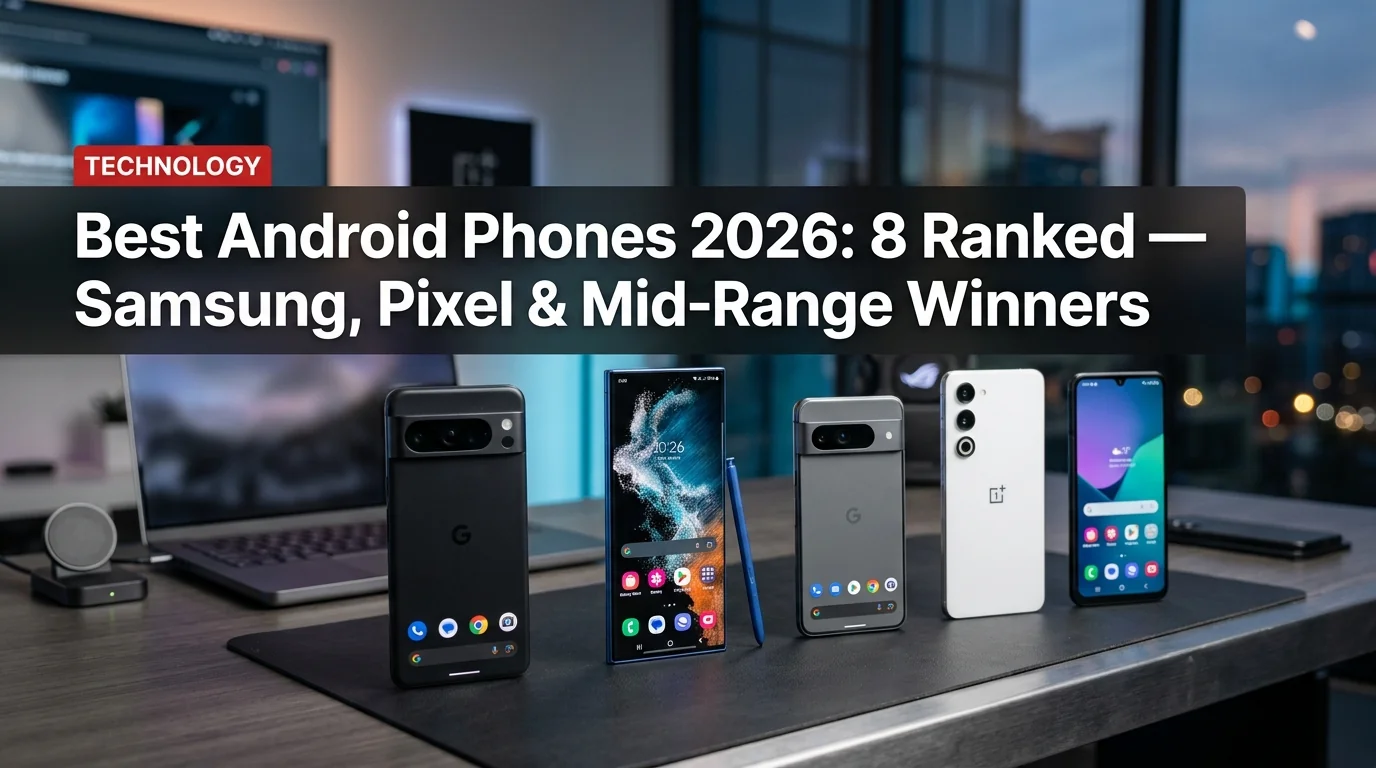
The Android market in 2026 is genuinely competitive for the first time in years. Samsung's Galaxy S26 Ultra delivers class-leading camera performance. Google's Pixel 10 Pro is the most coherent AI phone on the market. And mid-range options from Google and Samsung have gotten so good that spending $1,200 is harder to justify than ever. Here are the 8 best Android phones right now, ranked by use case.
The Rankings at a Glance
- Best overall: Samsung Galaxy S26 Ultra
- Best for AI: Google Pixel 10 Pro
- Best value flagship: Samsung Galaxy S26
- Best mid-range: Google Pixel 9a
- Best battery: OnePlus 15
- Best compact flagship: Samsung Galaxy S26
- Best budget: Samsung Galaxy A56
- Best for stock Android: Google Pixel 10
1. Samsung Galaxy S26 Ultra — Best Overall
Price: From $1,299 | Storage: 256GB–1TB
The Galaxy S26 Ultra is the most capable Android phone you can buy in 2026. The 200MP main camera produces stunning detail in daylight and has improved low-light processing over the S25 Ultra. The integrated S Pen remains unique in its class. And Samsung DeX on the S26 Ultra finally delivers a desktop experience that rivals a laptop for basic productivity tasks.
The Snapdragon 8 Elite Gen 2 processor is comfortably the fastest Android chip available, and the 5,000mAh battery gets through a full day with moderate use.
Who it's for: Power users who want the best camera, S Pen functionality, and don't mind the price tag.
Worth knowing: At 6.9 inches and 228g, it's not a small phone. The S26+ is the same specs in a more manageable 6.7-inch form factor.
2. Google Pixel 10 Pro — Best for AI
Price: From $999 | Storage: 128GB–512GB
The Pixel 10 Pro runs Tensor G5 — Google's most capable in-house chip — and it shows most in the AI features. Call Screen, Live Translate, and Magic Eraser have been on Pixels for years, but Android 17's Agentic AI integration is most polished here. Google controls both the hardware and the software, and the Pixel 10 Pro is the benchmark for what Android 17 AI features feel like when everything is tuned together.
The camera system is excellent — not quite at the S26 Ultra's level for telephoto, but the computational photography pipeline is arguably more consistent across lighting conditions. The 50MP main sensor with a 5x optical zoom is a workhorse.
Who it's for: Android users who prioritize AI features, clean software, and fast updates (7 years of OS and security updates guaranteed).
3. Samsung Galaxy S26 — Best Value Flagship
Price: From $799 | Storage: 128GB–256GB
The standard Galaxy S26 gives you 85% of the Ultra experience at 62% of the price. You lose the S Pen, the telephoto zoom steps down to 3x optical (from 5x+), and the display is 6.2 inches instead of 6.9 — but the primary camera and processor are identical to the Ultra.
For most people, the S26 is the smarter purchase. The ultra-wide is excellent, One UI 7 is the most polished Android skin available, and Samsung's five-year update promise (OS + security) provides solid longevity.
Who it's for: Flagship buyers who want Samsung's ecosystem and quality without paying Ultra pricing.
4. Google Pixel 9a — Best Mid-Range (Best Value)
Price: From $499 | Storage: 128GB–256GB
The Pixel 9a is the best value phone in the Android lineup, period. It runs the same Tensor G4 chip as last year's Pixel 9 Pro, carries the same camera sensors as the standard Pixel 9, gets seven years of software updates, and costs half the price of a flagship.
The 6.1-inch 120Hz OLED display is excellent for its price tier. The main camera consistently outperforms competitors at $500 thanks to Google's computational photography. There's no telephoto lens (a single rear camera setup), and wireless charging tops out at 18W — but for the price, these are acceptable trade-offs.
Who it's for: Budget-conscious buyers who want a long-lasting, well-supported phone with a great camera. The smart pick for most people.
5. OnePlus 15 — Best Battery Life
Price: From $849 | Storage: 256GB–512GB
The OnePlus 15 leads all Android flagships in charging speed and battery endurance in 2026. The 6,000mAh battery combined with Snapdragon 8 Elite means two full days of moderate use on a charge. When you do need to recharge, the 100W wired charging goes from 0 to 100% in under 25 minutes.
The Hasselblad-tuned camera system produces accurate, natural colors. OxygenOS 15 is lean and fast. Where OnePlus falls short is software longevity — four years of OS updates vs. Samsung and Google's five to seven.
Who it's for: Heavy users who need an all-day (and then some) battery and don't want to carry a charger everywhere.
6. Samsung Galaxy A56 — Best Mid-Range Samsung
Price: From $449 | Storage: 128GB–256GB
The Galaxy A56 is Samsung's best mid-range value proposition. A 6.7-inch 120Hz Super AMOLED display, 50MP main camera with optical image stabilization, 5,000mAh battery, and Samsung's four-year OS update promise in a sub-$450 package.
It uses Samsung's in-house Exynos 1580 chip — capable but a step below Snapdragon 8 Elite. You'll feel the difference in sustained gaming performance, but for everyday tasks, it's smooth and responsive.
Who it's for: Samsung loyalists who want the Galaxy aesthetic and ecosystem at a mid-range price.
7. Nothing Phone 3a — Best Design Under $500
Price: From $379 | Storage: 256GB
Nothing Phone 3a has the most distinctive design of any phone at this price — the signature Glyph Interface back, clean stock Android (close to it), and a build quality that feels premium for the cost. Snapdragon 7s Gen 3 handles daily tasks comfortably.
The camera system is competent but not class-leading. The main differentiator is style, software cleanliness, and a community of users who value design. Three years of OS updates is shorter than competitors.
Who it's for: Style-conscious buyers who want something different and don't mind slightly shorter software support.
8. Motorola Edge 60 Pro — Best Screen at Its Price
Price: From $649 | Storage: 256GB–512GB
Motorola's Edge 60 Pro packs a 6.7-inch 144Hz pOLED display with outstanding color accuracy — genuinely better than phones costing twice as much. The 50MP camera with optical zoom performs well in daylight. The 68W TurboPower charging is fast for its tier.
Motorola's software is close to stock Android, lightweight, and the "Ready For" desktop mode is genuinely useful when connected to a monitor. The three-year update window is the main drawback.
Who it's for: Display-first buyers who want an excellent screen experience without flagship pricing.
How to Choose the Right Android Phone
- Best cameras with multiple zoom levels
- Fastest processors for longevity
- More years of software updates
- Premium materials (titanium, ceramic glass)
- Better water resistance ratings
- Diminishing returns vs. mid-range
- Tariff-driven price increases in 2026
- Often too large for one-handed use
- Overkill for most everyday tasks
The Honest Answer: Who Should Buy What
Buy the Pixel 9a ($499) if you want a great phone that'll last 7 years and don't need to spend more. This is the right call for most people.
Buy the Galaxy S26 ($799) if you want Samsung's ecosystem, excellent cameras, and a premium feel without the Ultra's size and price premium.
Buy the Pixel 10 Pro ($999) if AI features, clean software, and Google's 7-year update commitment are your priorities.
Buy the Galaxy S26 Ultra ($1,299) if you need the best camera system available, use an S Pen, or simply want the top-of-the-market Android experience with no compromises.
Buy the OnePlus 15 ($849) if battery life is your single most important feature.
The mid-range market has matured so much in 2026 that the case for spending $1,000+ is more about specific features (S Pen, 10x zoom, maximum AI integration) than raw performance. The Pixel 9a delivers an experience that would have been flagship-tier just two years ago — for half the price.