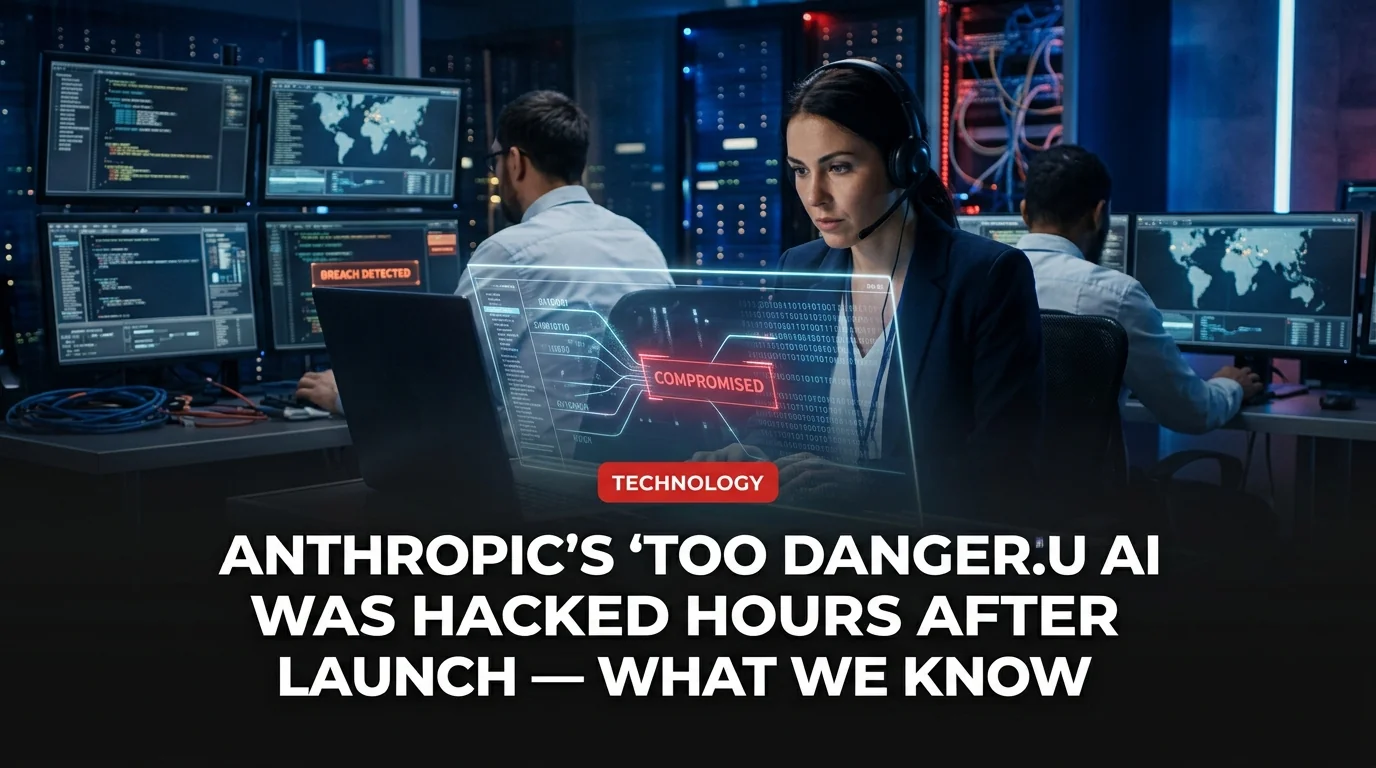
Anthropic built an AI model so capable of hacking that it refused to release it to the public. Then, within hours of its restricted announcement, an unauthorized group got in anyway.
The breach — reported by Bloomberg and confirmed by Anthropic on April 22 — involves Claude Mythos Preview, a cybersecurity AI that its own creator described as posing "unprecedented cybersecurity risks." The incident raises urgent questions about AI safety, third-party contractor security, and whether restricting dangerous AI is even enforceable.
What Is Claude Mythos?
Announced on April 7, 2026, Claude Mythos Preview is Anthropic's most powerful AI model — and the first one the company has publicly refused to release due to safety concerns. Unlike Claude's consumer-facing models, Mythos was designed specifically for offensive cybersecurity tasks.
According to Anthropic's own testing:
The model can identify zero-day vulnerabilities, chain multiple software bugs into multi-step exploits, and do it faster and more reliably than human security researchers. Anthropic shared limited access only with vetted enterprise clients — including Apple, Microsoft, and JPMorgan — under Project Glasswing, its AI-powered critical infrastructure defense initiative.
How the Breach Happened
The hack didn't involve sophisticated intrusion tools or state-sponsored cyberattackers. It was embarrassingly low-tech.
A private Discord group dedicated to tracking unreleased AI models made an educated guess about Mythos's API location — based on their familiarity with how Anthropic formats URLs for other models. They were right.
From there, the group exploited shared credentials: API keys and accounts belonging to authorized contractors who had legitimate access to Mythos. At least one person with inside access — reportedly a current employee at a third-party contractor working with Anthropic — facilitated access, according to sources cited by TechCrunch.
Anthropicconfirmed it is "investigating a report claiming unauthorised access to Claude Mythos Preview through one of our third-party vendor environments," adding there is "currently no evidence that Anthropic's systems are impacted."
That last part may be cold comfort. The breach didn't need to touch Anthropic's core systems — accessing the model itself through a vendor environment was enough.
Why This Matters
This isn't just an embarrassing security incident for one of the world's most valuable AI companies. It exposes a fundamental tension at the heart of responsible AI development.
Anthropicchose to build Mythos. It chose to deploy it, even in limited form. And despite calling it too dangerous for the public, it extended access to third-party contractors, enterprise clients, and research partners — creating exactly the attack surface that was exploited.
- Restricted release may have slowed wider misuse
- Anthropic detected and is investigating the breach
- No evidence core systems were compromised
- Breach happened within hours of announcement
- Third-party contractor security was clearly insufficient
- The model's capabilities are now in unknown hands
Security researchers have long warned that "safety by obscurity" — keeping dangerous AI restricted rather than addressing its underlying risks — is not a sustainable strategy. If a Discord group can find an AI model by guessing the URL format, the model's restricted status offers minimal real-world protection.
What Anthropic Is Doing About It
Beyond confirming the investigation, Anthropic hasn't disclosed what corrective measures it's taking. The company has not said whether the unauthorized users' access has been revoked, whether any exploits were generated using the model during the breach period, or whether affected contractors have had their credentials rotated.
Anthropichas previously emphasized Project Glasswing as a defensive initiative — using Mythos to help organizations find and patch vulnerabilities before attackers can exploit them. The breach undermines that framing considerably.
The Bigger Picture: AI Safety Theater?
Anthropichas staked its reputation on being the "safety-first" AI lab. Its Responsible Scaling Policy, Constitutional AI research, and willingness to withhold models from the market are cited as evidence of a principled approach to powerful AI development.
But the Mythos incident raises uncomfortable questions. If Anthropic can't keep its most dangerous model contained even within a narrow, vetted ecosystem, what does that say about the feasibility of controlling increasingly powerful AI systems at scale?
Competitors including OpenAI, Google DeepMind, and xAI are racing to build ever-more-capable models. As capabilities grow, the gap between "too dangerous" and "commercially deployed" may continue to narrow — regardless of which company draws the line.
For now, Anthropic says its investigation is ongoing. The company has not announced whether it will further restrict Mythos access, expand oversight of third-party vendors, or take any other concrete steps to prevent a repeat.
What is certain: the group that accessed Mythos knows exactly what it can do. And so, now, does everyone else.